What Is the Steps to Km Calculator?
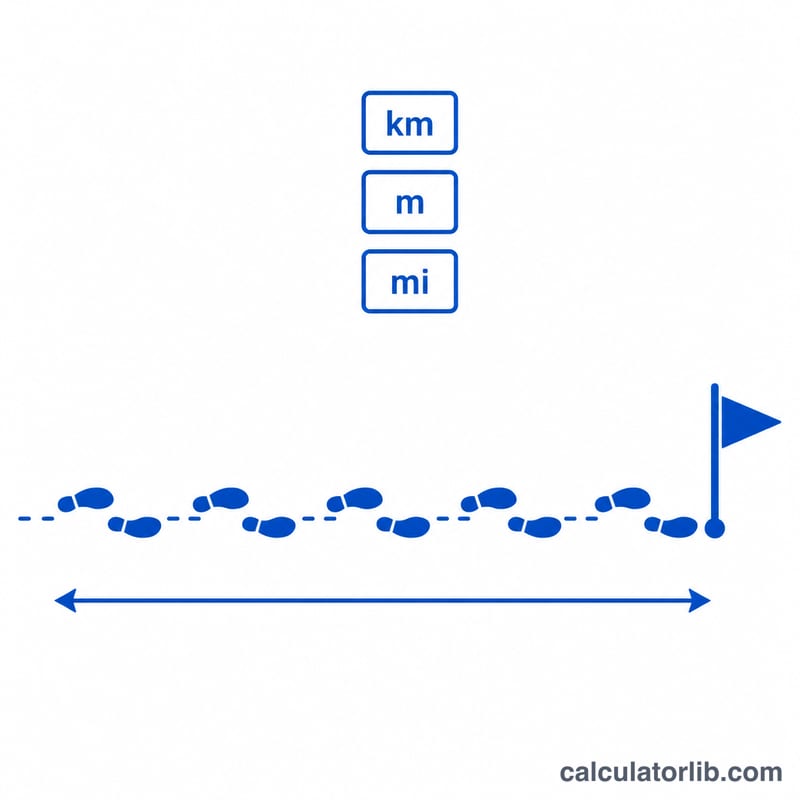
The Steps to Km Calculator converts a number of steps into the distance you have walked, expressed in kilometers, meters, and miles. Because every person's gait differs, the tool estimates your personal stride length from your height, giving a far more accurate result than a fixed average step.
How to Use It
Enter the number of steps you walked (for example, from a fitness tracker or pedometer) and your height in centimeters. The calculator estimates your stride length, multiplies it by your steps, and shows the total distance. You'll see the result in kilometers, with meters and miles for reference.
The Formula Explained
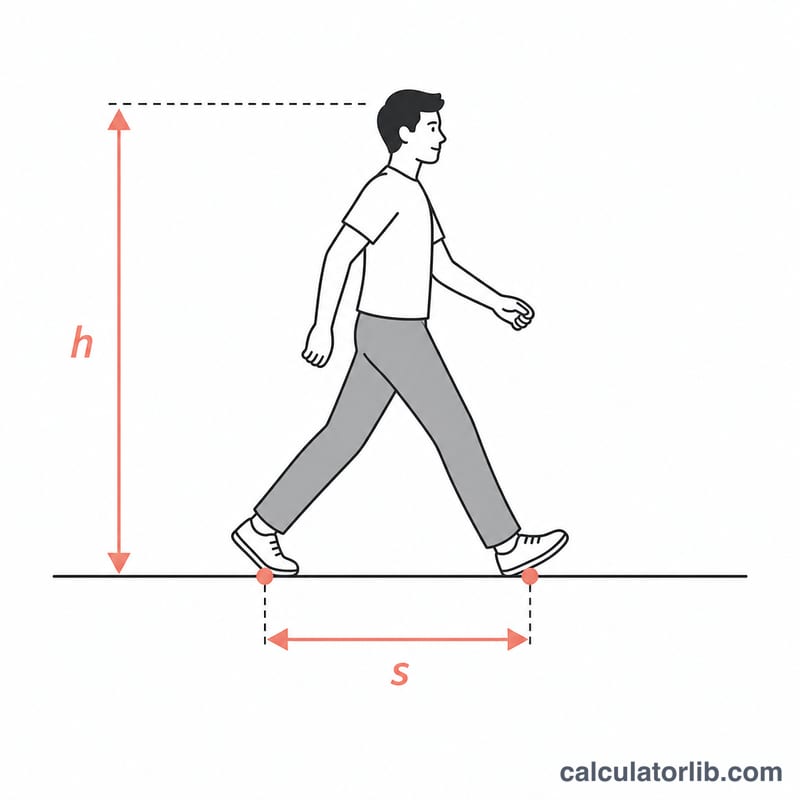
Walking stride length is commonly estimated as about 41.5% of a person's height. So a 170 cm tall person has a stride of roughly \(170 \times 0.415 / 100 = 0.7055\) meters. Total distance in meters equals steps × stride, and dividing by 1000 converts that to kilometers: $$\text{km} = \frac{\text{steps} \times \text{stride}_{\text{m}}}{1000}$$
Worked Example
Suppose you walked 10,000 steps and are 170 cm tall. Your stride length is 0.7055 m. Distance \(= 10{,}000 \times 0.7055 = 7{,}055\) meters \(= 7.055\) km, which is about 4.38 miles. A daily 10,000-step goal therefore covers roughly 7 km for an average-height adult.
Steps per Kilometer by Height
Because step length grows with leg length, a taller person covers a kilometre in fewer steps. The table below applies the walking factor used by this calculator, \(0.415\), so that step length in metres is \( \text{height (cm)} \times 0.415 / 100 \).
| Height (cm) | Step length (m) | Steps per 1 km | Steps per 1 mile | Distance from 10,000 steps (km) |
|---|---|---|---|---|
| 150 | 0.62 | 1,606 | 2,585 | 6.23 |
| 155 | 0.64 | 1,555 | 2,502 | 6.43 |
| 160 | 0.66 | 1,506 | 2,424 | 6.64 |
| 165 | 0.68 | 1,460 | 2,350 | 6.85 |
| 170 | 0.71 | 1,417 | 2,281 | 7.06 |
| 175 | 0.73 | 1,377 | 2,216 | 7.26 |
| 180 | 0.75 | 1,339 | 2,154 | 7.47 |
| 185 | 0.77 | 1,303 | 2,096 | 7.68 |
| 190 | 0.79 | 1,268 | 2,041 | 7.89 |
Notes on precision and method:
- All rows use the single walking factor 0.415. Step length is shown rounded to 2 decimals, but the steps-per-distance columns were computed from the unrounded value (for example 170 cm gives exactly 0.7055 m, not 0.71 m), so recomputing from the rounded column will differ slightly.
- Steps per mile use the international mile, 1 mile = 1.609344 km.
- "Step length" here is the distance from one footfall to the next footfall. Some sports-science texts use "stride length" for a full two-step cycle, which is roughly double these figures — this calculator, like most pedometers, works in step length.
- These are population-average estimates from a height-based rule of thumb, not a measurement of your own gait. Terrain, walking speed, footwear, age and leg-to-height proportion all shift the real value.
Stride Length Factors by Activity and Sex
Height-based factors are the usual shortcut when no measured step length is available. Each factor \(f\) is multiplied by your height in centimetres to give a step length in centimetres, which is then converted to metres. The general formula is:
$$ \text{km} = \frac{\text{steps} \times \text{height (cm)} \times f}{100 \times 1000} $$| Activity / group | Factor \(f\) (× height) | Step length at 170 cm | Comment |
|---|---|---|---|
| Walking, women | ≈ 0.413 | ≈ 0.70 m | Common textbook value; slightly shorter step for the same height |
| Walking, men | ≈ 0.415 | ≈ 0.71 m | The default used by this calculator |
| Brisk / purposeful walking | ≈ 0.42–0.45 | ≈ 0.71–0.77 m | Step lengthens as cadence and speed rise |
| Jogging | ≈ 0.60–0.65 | ≈ 1.02–1.11 m | Lower end of the running range, easy pace |
| Running | ≈ 0.65–0.75 | ≈ 1.11–1.28 m | Increases with pace; sprinting exceeds this range |
Some fitness trackers and pedometers skip height entirely and apply a single fixed average step length until you calibrate them — commonly around 0.70 m for women and 0.76 m for men. Those fixed values correspond to the height-based rule only for someone near the average height that the manufacturer assumed, which is why a very short or very tall user often sees distance drift on an uncalibrated device.
Substituting a factor. For 8,000 steps at a height of 172 cm using the walking factor 0.415:
$$ \text{km} = \frac{8000 \times 172 \times 0.415}{100 \times 1000} = \frac{8000 \times 0.7138}{1000} = \frac{5710.4}{1000} = 5.71\ \text{km} $$That is 5.71 km, or about 3.55 miles. Swapping in a jogging factor of 0.65 for the same inputs gives \( 8000 \times 1.118 / 1000 = 8.94 \) km — the same step count, a very different distance, which is why activity type matters more than any decimal place in the factor.
Every factor above is an average estimate drawn from general gait literature, not a measurement of an individual. For an accurate personal figure, walk a marked distance (for example a 100 m track straight or a 400 m lap) at your normal pace, count your steps, and divide: step length = distance ÷ steps. Repeat two or three times and average.
FAQ
Is the 0.415 factor accurate for everyone? It's a widely used average for walking. Running strides are longer, so the estimate may understate distance when running.
How many steps make a kilometer? For a 170 cm person with a 0.7 m stride, roughly 1,400 steps equal one kilometer.
Why does height matter? Taller people naturally take longer steps, so the same number of steps covers more ground.