12:00 UTC is 4:00 AM Pacific Standard Time (PST, UTC−8) from early November to mid-March and 5:00 AM Pacific Daylight Time (PDT, UTC−7) the rest of the year. So “8 UTC to PST” means midnight in winter and 1:00 AM in summer. Enter a date below and the converter uses the offset in force that day.
UTC to PST Time Converter
Use this converter to easily change time from UTC (Coordinated Universal Time) to PST (Pacific Standard Time). PST is used in the Pacific Time Zone of the United States and Canada, and it's commonly observed in places like Los Angeles and parts of Baja California in Mexico (also known as Zona Noroeste).
UTC to PST Time Conversion Table
| UTC Time | PST Time (Standard Time) |
PDT Time (Daylight Saving) |
Time Zone Offset | Applies To |
|---|---|---|---|---|
| 00:00 (Midnight) | 16:00 (Previous Day) | 17:00 (Previous Day) | UTC-8 / UTC-7 | United States, Canada, Baja California |
| 06:00 | 22:00 (Previous Day) | 23:00 (Previous Day) | UTC-8 / UTC-7 | North America |
| 12:00 (Noon) | 04:00 | 05:00 | UTC-8 / UTC-7 | Los Angeles, San Francisco |
| 18:00 | 10:00 | 11:00 | UTC-8 / UTC-7 | Pacific Time Zone |
| 23:59 | 15:59 | 16:59 | UTC-8 / UTC-7 | Pacific Standard Time / Pacific Daylight Time |
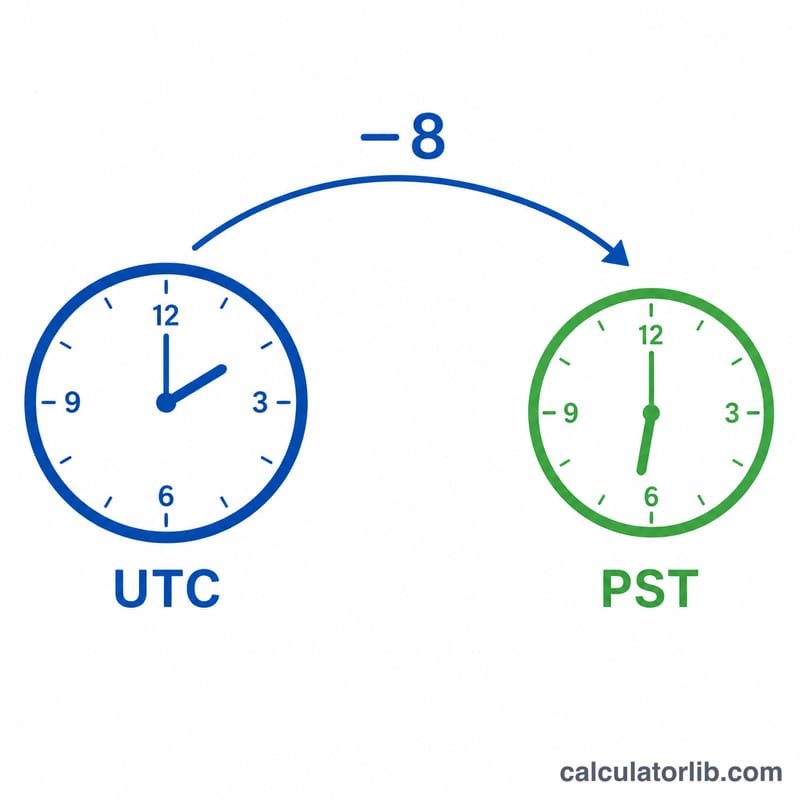
UTC is 8 hours ahead of Pacific Time when it's standard time. During Daylight Saving Time (DST), which is also called summer time, the Pacific region switches to PDT (Pacific Daylight Time), making UTC only 7 hours ahead.
This tool helps you convert date and time accurately between these zones, taking into account the time zone offset. Whether you're scheduling meetings or planning events across Mexico and the United States, this converter makes converting UTC simple.
The PST time zone is used in many parts of North America and includes several largest cities. It's also known by its offset: UTC-8 during standard time and UTC-7 during daylight time.
Worked Examples: UTC to PST
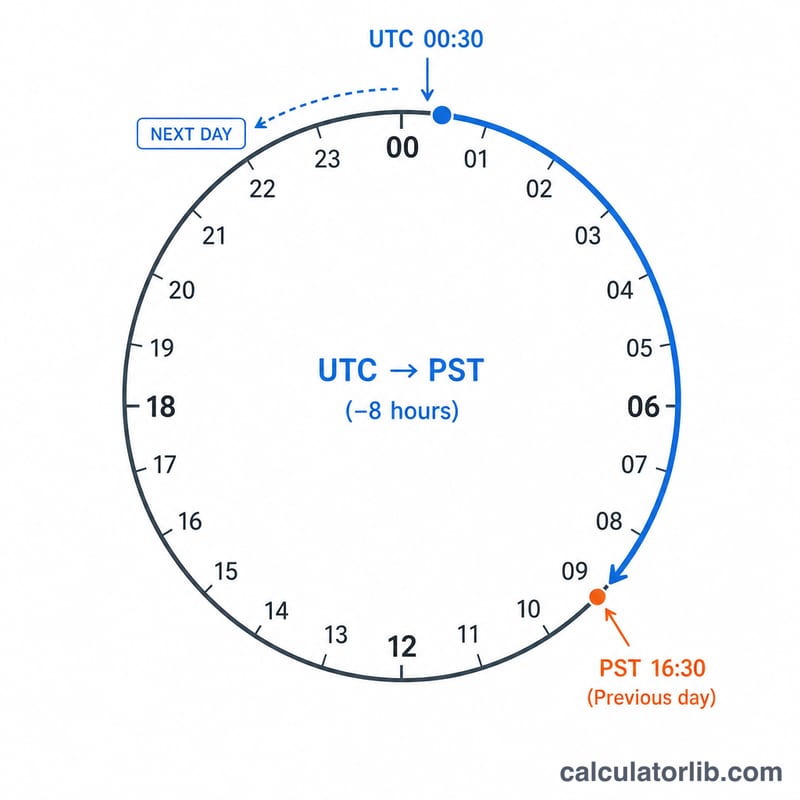
Pacific Standard Time (PST) is 8 hours behind Coordinated Universal Time (UTC), so the core operation is subtracting 8 from the UTC hour. The minutes never change. The general formula is:
$$\text{PST hour} = (\text{UTC hour} - 8 + 24) \bmod 24$$
The +24 and mod 24 keep the result in the valid 0–23 range and automatically tell us whether we rolled back to the previous day. These examples use the fixed PST offset, which is what the tool's standard-time row shows; for a date that falls in daylight saving time the main result uses PDT (UTC−7) and reads one hour later.
Example 1 — Same day
Convert 15:30 UTC to PST:
$$(15 - 8 + 24) \bmod 24 = 31 \bmod 24 = 7$$
Result: 07:30 PST, same day. Because the raw subtraction \(15 - 8 = 7\) was already 0 or greater, no day change occurs and the indicator reads same day.
Example 2 — Crossing midnight backward
Convert 03:00 UTC to PST:
$$(3 - 8 + 24) \bmod 24 = 19 \bmod 24 = 19$$
Result: 19:00 PST, previous day. Here the raw subtraction \(3 - 8 = -5\) was negative, so we added 24 to get 19 and the indicator reads previous day — 03:00 UTC is the evening before in California.
Example 3 — Midnight UTC
Convert 00:00 UTC to PST:
$$(0 - 8 + 24) \bmod 24 = 16 \bmod 24 = 16$$
Result: 16:00 PST (4:00 PM), previous day. Midnight UTC lands in the late afternoon of the prior calendar day in the Pacific zone.
Key Terms Explained
- UTC (Coordinated Universal Time)
- The global time standard from which all civil time zones are offset. UTC does not change with the seasons and has no daylight saving adjustment, making it the reliable reference point for conversions.
- PST (Pacific Standard Time)
- The standard time of the Pacific Time zone, fixed at UTC−8. PST is the offset used during the winter months. As a standard-time offset, PST itself is constant and does not observe daylight saving.
- PDT (Pacific Daylight Time)
- The daylight saving variant of Pacific Time, UTC−7, used roughly from mid-March to early November in regions that observe daylight saving. The calculator switches to PDT automatically for dates when it is in force, and its standard-time row still shows strict PST (UTC−8).
- GMT (Greenwich Mean Time)
- A time standard at the Prime Meridian. For everyday purposes GMT is effectively equal to UTC (the two differ by less than a second), so UTC−8 and GMT−8 describe the same Pacific Standard Time offset.
- Same-day / next-day indicator
- Subtracting 8 hours (PST) or 7 hours (PDT) can push the result back across midnight into the previous calendar day. The indicator flags this on both rows, alongside the local date: on the standard-time row it reads same day when the UTC hour is 8 or greater and previous day when it is 0–7; under PDT the cut-off is 7, so UTC hours 0–6 give the previous day.
How to Convert UTC to PST by Hand
- Write down the UTC time as hours (0–23) and minutes (0–59), for example 03:45.
- Keep the minutes unchanged. The PST offset is a whole number of hours, so the minute value is identical in both zones — 45 stays 45.
- Subtract 8 from the UTC hour. For 03:45 this gives \(3 - 8 = -5\).
- Borrow a day if the result is negative. If the hour is less than 0, add 24 and mark the date as the previous day: \(-5 + 24 = 19\). If the result was already 0 or more, keep it as is and mark same day.
- Format the result. Combine the adjusted hour with the unchanged minutes, padding with leading zeros where needed: 19:45 PST, previous day.
In compact form, this is the single expression \((\text{UTC hour} - 8 + 24) \bmod 24\), where the mod 24 performs the borrowing automatically and any UTC hour from 0 to 7 produces the previous-day flag.
Understanding Your UTC to PST Result
This converter takes a UTC date (today by default) and a UTC time and returns the clock time in the US and Canadian Pacific zone, using the official IANA time-zone rules for America/Los_Angeles. It picks the offset for that date automatically: Pacific Standard Time (PST, UTC\(-8\)) applies during the standard-time part of the year — roughly from the first Sunday in November to the second Sunday in March under current US and Canadian rules.
From the second Sunday in March to the first Sunday in November the region observes Pacific Daylight Time (PDT) at UTC\(-7\), and the main result switches to PDT, one hour later than the PST figure. So 16:00 UTC on 15 July 2026 gives 09:00 PDT — what a wall clock in Los Angeles shows — while 16:00 UTC on 15 January 2026 gives 08:00 PST. A line under the result states which one is in effect on that date. The switch happens at 2:00 AM local time (in 2026 on 8 March, when clocks jump to 3:00, and on 1 November, when they fall back to 1:00), and on those two days the tool adds a note. A second row still shows strict PST (UTC\(-8\)), fixed all year, for when you need the standard-time value itself.
The day indicator. Because subtracting 8 hours (7 under PDT) can push the clock back past midnight, the calculator reports on both rows whether the Pacific time lands on the same calendar date or the previous one, and it shows the local date. On the standard-time row any UTC time earlier than 08:00 falls on the previous Pacific date; under PDT the cut-off is 07:00. The arithmetic for the standard-time row is
$$\text{PST hour} = (\text{UTC hour} - 8 + 24) \bmod 24$$For 03:00 UTC that gives \((3 - 8 + 24) \bmod 24 = 19\), i.e. 19:00 PST on the previous day in the standard-time row; between March and November the main result reads 20:00 PDT, also on the previous day. From 08:00 UTC onward (07:00 under PDT) the result stays within the same date.
Minutes never change. The Pacific offset is a whole number of hours, so the minute value you enter is carried through unchanged — 14:37 UTC becomes 06:37 PST. (This is not true everywhere: India, Iran, Nepal, parts of Australia and Newfoundland all use offsets with a 30- or 45-minute component.)
The result follows the Los Angeles rules, not every place near UTC\(-8\). The tool applies the IANA rules for America/Los_Angeles, which match the US and Canadian Pacific zone; it does not look up other cities. Several places sit at UTC\(-8\) or nearby without following the US/Canadian pattern: most of Baja California Sur and Sonora in Mexico do not observe daylight saving time (Mexico ended nationwide DST in 2022, with a narrow exception for some northern border municipalities), and Arizona (except the Navajo Nation) stays on Mountain Standard Time year-round, which happens to coincide with PDT during the summer. For a place outside that pattern, confirm against the local rules in force on your date.