What is the Addition Calculator?
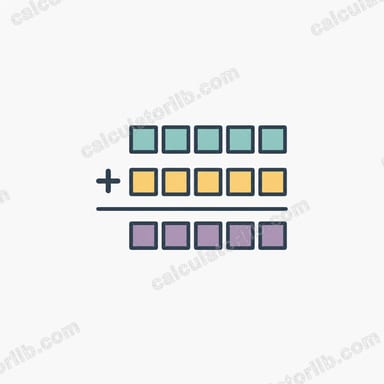
The Addition Calculator adds together any list of numbers you enter and instantly returns the total (sum). It also reports how many numbers you added and their average, making it handy for quick checks of receipts, scores, measurements, or any list of values. It works with whole numbers and decimals, and you can mix positive and negative numbers.
How to use it
Type your numbers into the input box, separating each one with a comma or a space — for example 12, 8, 5.5, 100. Press calculate and you'll see the running sum at the top, with the count and average shown below. There's no limit to how many values you can include.
The formula explained
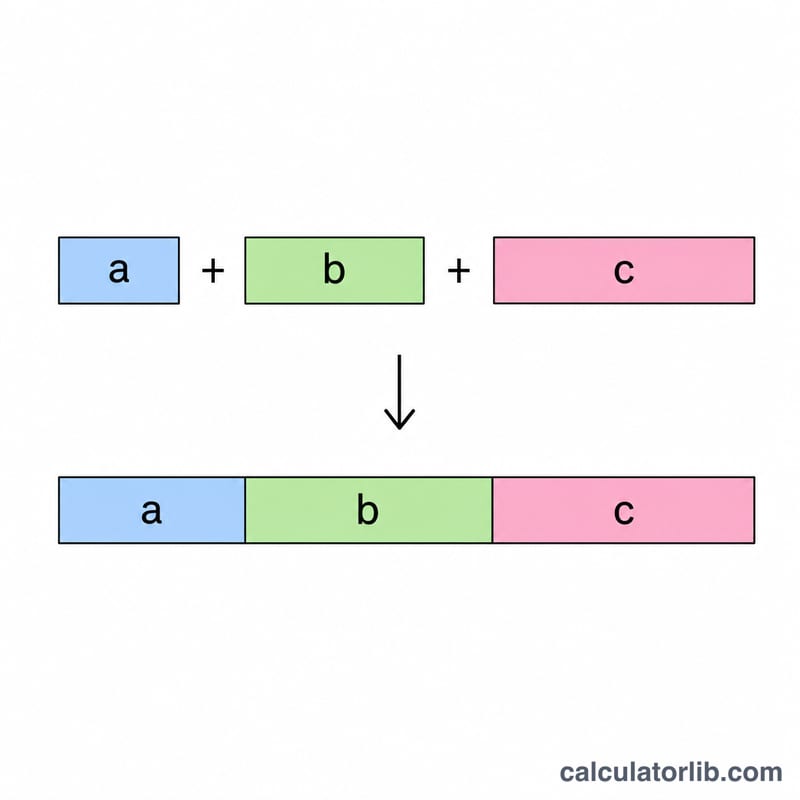
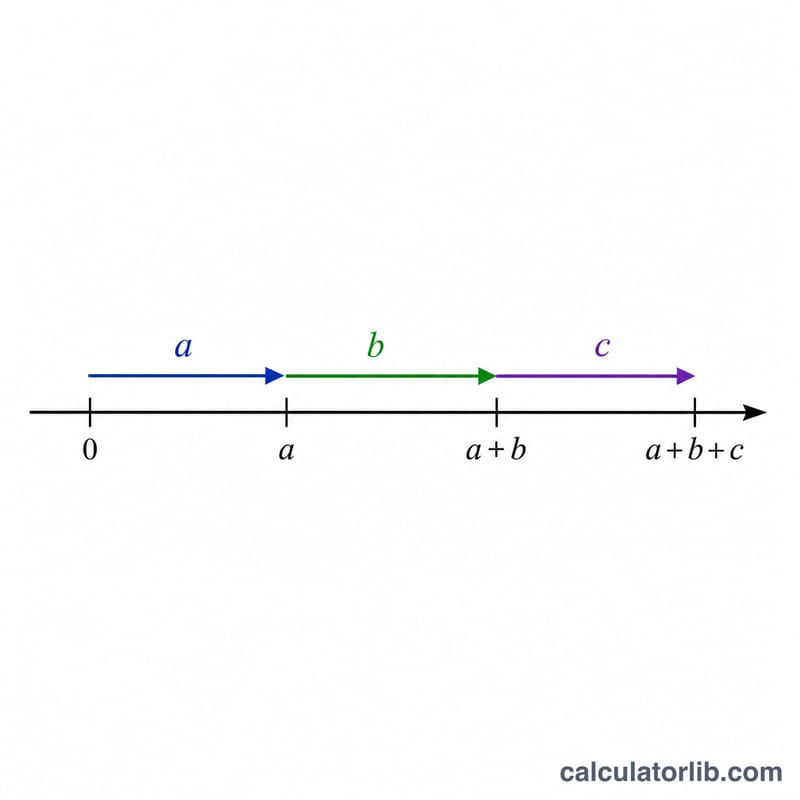
Addition is the most fundamental arithmetic operation. The sum is simply every value added together:
$$\text{sum} = a_1 + a_2 + \cdots + a_n$$
The average is the sum divided by the number of values (\(n\)). If you enter no numbers, the average defaults to zero to avoid dividing by zero.
Worked example
Suppose you enter 12, 8, 5.5, 100. Adding them gives $$12 + 8 + 5.5 + 100 = 125.5$$ There are 4 numbers, so the average is $$125.5 \div 4 = 31.375$$
More Worked Examples
Each example below shows the addition term by term, then the count \(n\), then the average written out as a division. The rules used are universal arithmetic — they do not depend on any country or standard.
Example 1 — Mixed positive and negative integers
Input list: -3, 10, -2, 7
Add the terms left to right:
$$-3 + 10 = 7 \qquad 7 + (-2) = 5 \qquad 5 + 7 = 12$$Or group by sign: the positives give \(10 + 7 = 17\), the negatives give \(-3 + (-2) = -5\), and \(17 - 5 = 12\). Both routes agree.
- Sum = 12
- Count \(n = 4\)
- Average \(= \dfrac{12}{4} = 3\)
Example 2 — Currency-style decimals from a receipt
Input list (space-separated): 4.99 12.50 0.75 3.20. These are money amounts in whatever currency the receipt uses — the arithmetic is the same for $, €, £ or ¥.
- Sum = 21.44
- Count \(n = 4\)
- Average \(= \dfrac{21.44}{4} = \) 5.36
So four items totalling 21.44 have a mean price of 5.36 per item — useful for splitting a bill evenly four ways.
Example 3 — A longer list of test scores
Input list: 88, 92, 75, 100, 67
- Sum = 422
- Count \(n = 5\)
- Average \(= \dfrac{422}{5} = 84.4\)
Written in summation notation:
$$\sum_{i=1}^{5} x_i = 422, \qquad \bar{x} = \frac{1}{5}\sum_{i=1}^{5} x_i = 84.4$$How to Add Numbers by Hand
The calculator does this instantly, but knowing the manual procedure lets you sanity-check any result.
- List and parse the values. Treat every comma, space, tab or line break as a separator, and everything between two separators as one term.
12, 8 5.5 100parses to four addends: 12, 8, 5.5 and 100. Watch out for thousands separators — a value typed as1,250may be read as two numbers, 1 and 250, so enter it as1250. - Align the decimal points and pad with zeros. Give every value the same number of decimal places so the columns line up: 12 → 12.0, 8 → 8.0, 5.5 stays 5.5, 100 → 100.0. Padding with trailing zeros never changes a value.
- Add column by column from the rightmost digit, carrying tens into the next column to the left. For \(12 + 8 + 5.5 + 100\):
Tenths column: \(0+0+5+0 = 5\). Units column: \(2+8+5+0 = 15\) — write 5, carry 1. Tens column: \(1 + 1 + 0 + 0 + 0 = 2\). Hundreds column: 1. Result: \(125.5\).
- Handle negative values. Adding a negative number is the same as subtracting its absolute value: \(a + (-b) = a - b\). For a mixed list it is usually faster to total the positives and the negatives separately, then combine the two subtotals — as in Example 1 above, where \(17 + (-5) = 12\).
- Count the terms, \(n\). Count the parsed addends, not the digits. An empty entry between two commas is not a term.
- Divide the sum by \(n\) for the average: $$\bar{x} = \frac{\text{Sum}}{n}$$ For the column example, \(n = 4\) and \(\bar{x} = 125.5 \div 4 = 31.375\).
- Check with a rounded estimate. Round each addend to an easy number and add mentally: \(12 + 8 + 6 + 100 \approx 126\), which is close to 125.5 — so no digit was dropped or misplaced. A quick estimate catches the two most common hand-addition errors: a missing carry and a misaligned decimal point.
Key Terms Explained
| Term | Notation | Meaning |
|---|---|---|
| Addend | \(a_1, a_2, \dots, a_n\) | Each individual value being added. In -3, 10, -2, 7 the addends are \(a_1 = -3\), \(a_2 = 10\), \(a_3 = -2\), \(a_4 = 7\). |
| Sum (total) | \(S\) | The result of the addition: \(S = a_1 + a_2 + \cdots + a_n\). |
| Operand | — | Any value an operator acts on. For addition, the operands are exactly the addends. |
| Count | \(n\) | How many addends were entered. Needed for the average. |
| Mean (arithmetic average) | \(\bar{x}\) | \(\bar{x} = S \div n\) — the sum divided by the count. \(422 \div 5 = 84.4\). |
| Summation notation | \(\sum\) | The Greek capital sigma, a shorthand for "add all of these": \(\sum_{i=1}^{n} x_i = x_1 + x_2 + \cdots + x_n\). The \(i=1\) below and \(n\) above give the first and last index. |
| Integer | \(\mathbb{Z}\) | A whole number with no fractional part: \(\dots, -2, -1, 0, 1, 2, \dots\) |
| Decimal | — | A number written with a fractional part after the decimal point, e.g. 5.5 or 4.99. Decimals and integers can be mixed freely in one list. |
| Negative number | \(-a\) | A value less than zero, written with a leading minus sign. Adding it decreases the sum: \(a + (-b) = a - b\). |
| Commutative property | \(a + b = b + a\) | Order does not change the sum, so re-ordering the input list gives the same total. |
| Associative property | \((a+b)+c = a+(b+c)\) | Grouping does not change the sum, so you may add in any convenient chunks — e.g. all positives first, then all negatives. |
| Additive identity | \(a + 0 = a\) | Zero is the value that leaves any number unchanged when added. Note that entering a 0 still increases \(n\) by one, so it lowers the average. |
| Separator (delimiter) | , space | The character this tool uses to decide where one number ends and the next begins. Commas, spaces, tabs and new lines all work, and consecutive separators are ignored. |
One caution on notation that varies by country: in some regions a comma is the decimal mark (for example "3,5" meaning three and a half). This calculator treats the comma as a separator and the period as the decimal mark, so write three and a half as 3.5.
FAQ
Can I add decimals? Yes — values like 5.5 or 0.25 are fully supported.
Can I add negative numbers? Yes. Enter them with a minus sign, e.g. -3, 10, -2 sums to 5.
What separator should I use? Commas or spaces both work, and you can even mix them.