

What is the Salary to Hourly Calculator?
The Salary to Hourly Calculator converts a fixed annual salary into an equivalent hourly wage. It is useful when comparing a salaried job offer to an hourly position, estimating freelance rates, or simply understanding what your yearly pay works out to per hour. The tool also breaks your income down into daily, weekly and monthly figures.
How to use it
Enter your gross annual salary, the number of hours you typically work each week, and the number of weeks you work per year. A standard full-time schedule is 40 hours per week for 52 weeks. If you take unpaid time off, lower the weeks-per-year value to reflect the time you are actually paid for. Click calculate to see your hourly wage along with daily, weekly and monthly equivalents.
The formula explained
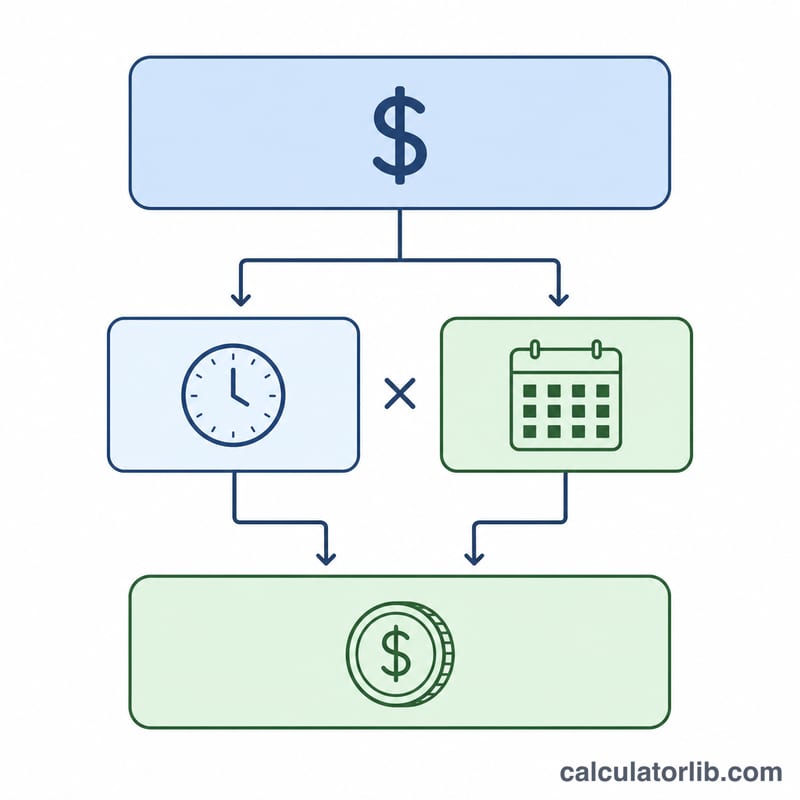
The calculation is straightforward: divide your annual salary by the total number of hours you work in a year. Total annual hours equal hours per week multiplied by weeks per year.
$$\text{Hourly} = \dfrac{\text{Annual}}{\text{Hours/Week} \times \text{Weeks/Year}}$$
For example, with 40 hours a week over 52 weeks you work 2,080 hours per year, the common assumption for full-time U.S. employment.
Worked example
Suppose you earn $52,000 per year and work 40 hours per week for 52 weeks. Total hours = $$40 \times 52 = 2{,}080.$$ Hourly wage = $$52{,}000 \div 2{,}080 = \$25.00 \text{ per hour}.$$ Weekly pay = $$52{,}000 \div 52 = \$1{,}000,$$ and monthly pay = $$52{,}000 \div 12 \approx \$4{,}333.33.$$
Common Salary to Hourly Conversions
The table below converts common annual salaries to hourly, weekly and monthly pay using the standard full-time assumption of 40 hours per week for 52 weeks, which equals 2,080 working hours per year. The hourly rate is found by dividing the annual salary by 2,080:
$$\text{Hourly} = \frac{\text{Annual Salary}}{40 \times 52} = \frac{\text{Annual Salary}}{2{,}080}$$Weekly pay is the annual salary divided by 52, and monthly pay is the annual salary divided by 12.
| Annual Salary | Hourly (2,080 hrs) | Weekly | Monthly |
|---|---|---|---|
| $30,000 | $14.42 | $576.92 | $2,500.00 |
| $40,000 | $19.23 | $769.23 | $3,333.33 |
| $50,000 | $24.04 | $961.54 | $4,166.67 |
| $60,000 | $28.85 | $1,153.85 | $5,000.00 |
| $75,000 | $36.06 | $1,442.31 | $6,250.00 |
| $100,000 | $48.08 | $1,923.08 | $8,333.33 |
These figures represent gross (pre-tax) pay. Your take-home amount will be lower after taxes, benefits and other deductions.
How Hours and Weeks Change Your Hourly Rate
Two people earning the same annual salary can have very different hourly wages depending on how many hours they work each week and how many weeks they work each year. The implied hourly rate is the salary divided by total hours worked:
$$\text{Hourly} = \frac{\text{Annual Salary}}{\text{Hours per Week} \times \text{Weeks per Year}}$$The table below applies this to a $52,000 salary across four schedules. Fewer total hours raise the effective hourly rate, while longer weeks or more weeks worked lower it.
| Schedule | Total Hours/Year | Hourly Wage |
|---|---|---|
| 40 hrs/wk × 52 wks | 2,080 | $25.00 |
| 35 hrs/wk × 52 wks | 1,820 | $28.57 |
| 40 hrs/wk × 48 wks | 1,920 | $27.08 |
| 45 hrs/wk × 50 wks | 2,250 | $23.11 |
For example, working 35 hours a week instead of 40 raises the effective rate from $25.00 to $28.57 — a difference of $3.57 per hour for the same paycheck. When comparing job offers, always factor in expected hours and unpaid time off, not just the headline salary.
FAQ
Does this account for taxes? No. The result is based on your gross (pre-tax) salary. Your take-home hourly rate will be lower after taxes and deductions.
What if I work overtime? The figure assumes consistent weekly hours. If you regularly work more than entered, your effective hourly rate is lower; reduce or increase the hours-per-week field to model different scenarios.
How many hours is full-time? Most full-time roles are 40 hours per week, which over 52 weeks is 2,080 hours per year. Adjust the weeks to subtract unpaid vacation if needed.