
What is the Triangle Area (Coordinates) Calculator?
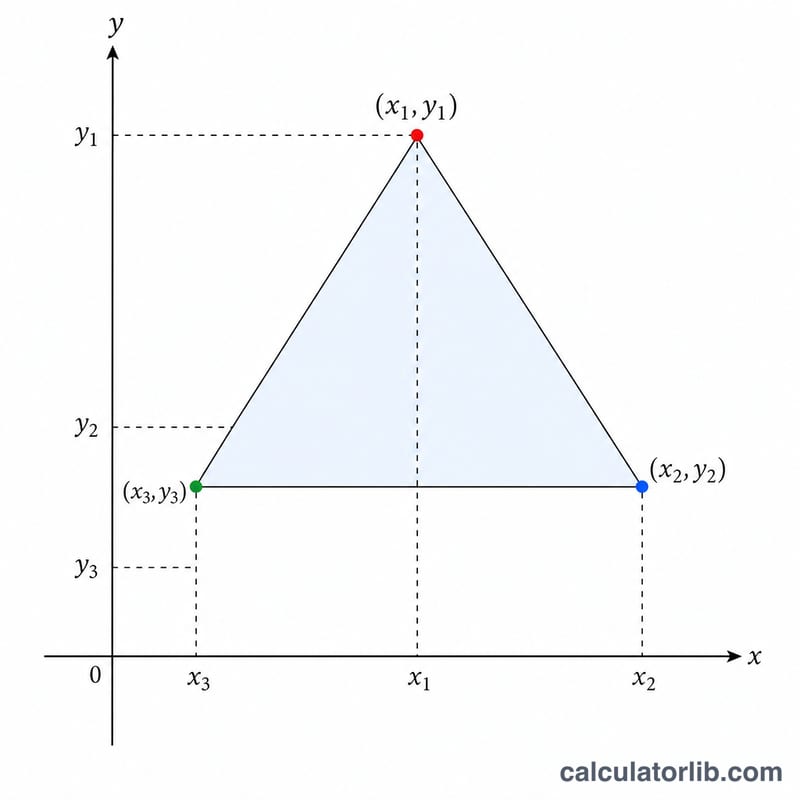
This calculator finds the area of any triangle when you know the coordinates of its three vertices. It uses the shoelace formula (also called the Gauss area formula), which works for triangles placed anywhere on the coordinate plane — no need to know side lengths, heights, or angles.
How to use it
Enter the (x, y) coordinates for each of the three vertices: point 1, point 2, and point 3. The calculator returns the area in square units. It also shows the signed area, which is positive when the vertices are listed counter-clockwise and negative when they are listed clockwise.
The formula explained
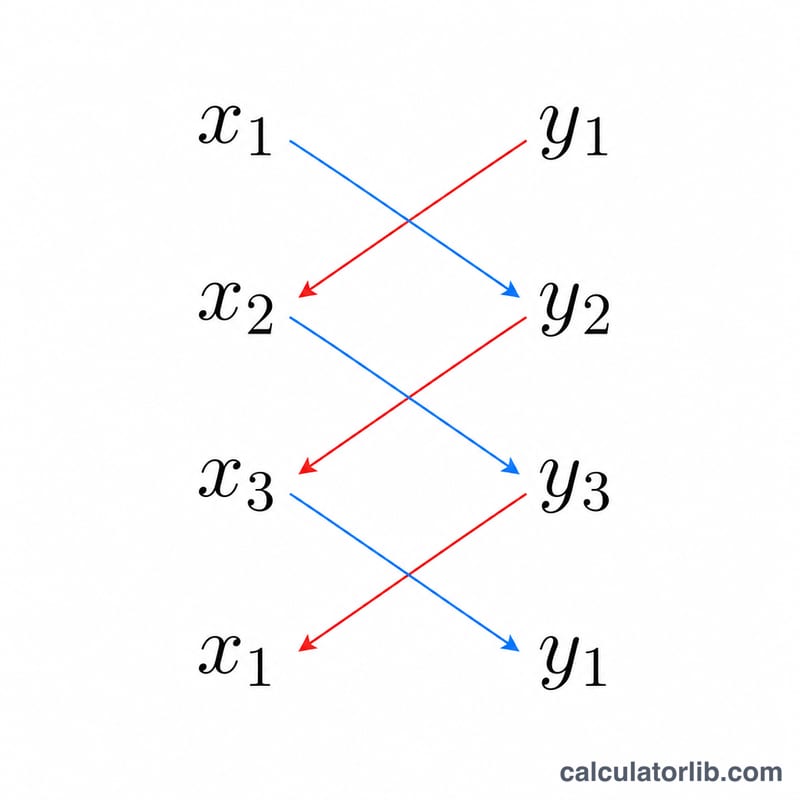
The shoelace formula for three points is:
$$A = \tfrac{1}{2}\left| x_1(y_2-y_3) + x_2(y_3-y_1) + x_3(y_1-y_2) \right|$$Each term cross-multiplies a coordinate of one vertex with the difference of the other two y-values. The sum equals twice the signed area; taking the absolute value and halving gives the true area regardless of orientation.
Worked example
Take vertices (1,1), (5,2), and (3,8):
$$\begin{aligned} &= \tfrac{1}{2} \left| 1\cdot(2-8) + 5\cdot(8-1) + 3\cdot(1-2) \right| \\ &= \tfrac{1}{2} \left| 1\cdot(-6) + 5\cdot(7) + 3\cdot(-1) \right| \\ &= \tfrac{1}{2} \left| -6 + 35 - 3 \right| \\ &= \tfrac{1}{2} \left| 26 \right| = 13 \text{ square units.} \end{aligned}$$More Worked Examples
Each example substitutes the three vertices into the shoelace formula. The signed area is computed first (without the absolute value), and the true area is its magnitude.
Example 1 — Triangle with negative coordinates
Vertices: \(A(-3, -2)\), \(B(4, -1)\), \(C(1, 5)\). Substituting \(x_1=-3,\ y_1=-2,\ x_2=4,\ y_2=-1,\ x_3=1,\ y_3=5\):
$$\text{Signed} = \tfrac{1}{2}\big[\,-3(-1-5) + 4(5-(-2)) + 1(-2-(-1))\,\big]$$$$= \tfrac{1}{2}\big[\,-3(-6) + 4(7) + 1(-1)\,\big] = \tfrac{1}{2}\big[18 + 28 - 1\big] = \tfrac{45}{2} = 22.5$$The signed area is positive, so the vertices are listed counter-clockwise. The area is 22.5 square units.
Example 2 — Clockwise order gives a negative signed area
Take the same triangle but list the vertices clockwise: \(A(-3, -2)\), \(C(1, 5)\), \(B(4, -1)\). Now \(x_1=-3,\ y_1=-2,\ x_2=1,\ y_2=5,\ x_3=4,\ y_3=-1\):
$$\text{Signed} = \tfrac{1}{2}\big[\,-3(5-(-1)) + 1((-1)-(-2)) + 4((-2)-5)\,\big]$$$$= \tfrac{1}{2}\big[\,-3(6) + 1(1) + 4(-7)\,\big] = \tfrac{1}{2}\big[-18 + 1 - 28\big] = \tfrac{-45}{2} = -22.5$$The signed area is \(-22.5\): the negative sign tells us the points are ordered clockwise. The actual area is the absolute value, \(|-22.5| = 22.5\) square units — identical to Example 1, because order does not change the size of the triangle.
Example 3 — Collinear points give area 0
Vertices: \(P(0, 0)\), \(Q(2, 4)\), \(R(5, 10)\). Note that all three lie on the line \(y = 2x\). Substituting \(x_1=0,\ y_1=0,\ x_2=2,\ y_2=4,\ x_3=5,\ y_3=10\):
$$\text{Area} = \tfrac{1}{2}\big|\,0(4-10) + 2(10-0) + 5(0-4)\,\big|$$$$= \tfrac{1}{2}\big|\,0 + 20 - 20\,\big| = \tfrac{1}{2}\,|0| = 0$$The area is 0 square units, confirming the three points are collinear and form no enclosed triangle.
Key Terms & Variables
- Vertex \((x, y)\)
- A corner point of the triangle, given by its horizontal coordinate \(x\) and vertical coordinate \(y\). The three vertices are labeled \((x_1, y_1)\), \((x_2, y_2)\), and \((x_3, y_3)\) and are the only inputs the shoelace formula needs.
- Signed area
- The result of the shoelace expression before taking the absolute value. Its magnitude equals the triangle's area, while its sign encodes the order in which the vertices were listed: positive for counter-clockwise, negative for clockwise.
- Counter-clockwise (CCW) orientation
- Vertices listed so that tracing \((x_1,y_1)\to(x_2,y_2)\to(x_3,y_3)\) turns to the left. This produces a positive signed area in a standard \(xy\)-plane.
- Clockwise (CW) orientation
- Vertices listed so the same trace turns to the right. This produces a negative signed area. The final area (absolute value) is unchanged, so vertex order never affects the size of the answer.
- Collinear points
- Three points that all lie on a single straight line. They enclose no region, so the shoelace formula returns a signed area and an area of exactly \(0\). This is a quick test for collinearity.
- Square units
- The units of area. If coordinates are measured in meters, the area is in square meters (m²); in pixels, square pixels, and so on. Area always carries the squared version of the coordinate's length unit.
FAQ
Does the order of points matter? Not for the area — the absolute value removes orientation. The order only changes the sign of the signed area.
What if the area comes out as 0? A zero area means the three points are collinear (they lie on a single straight line) and do not form a real triangle.
Can I use negative coordinates? Yes. The formula works for any real coordinates, positive or negative.