
What is the BMR & Daily Calorie Calculator?
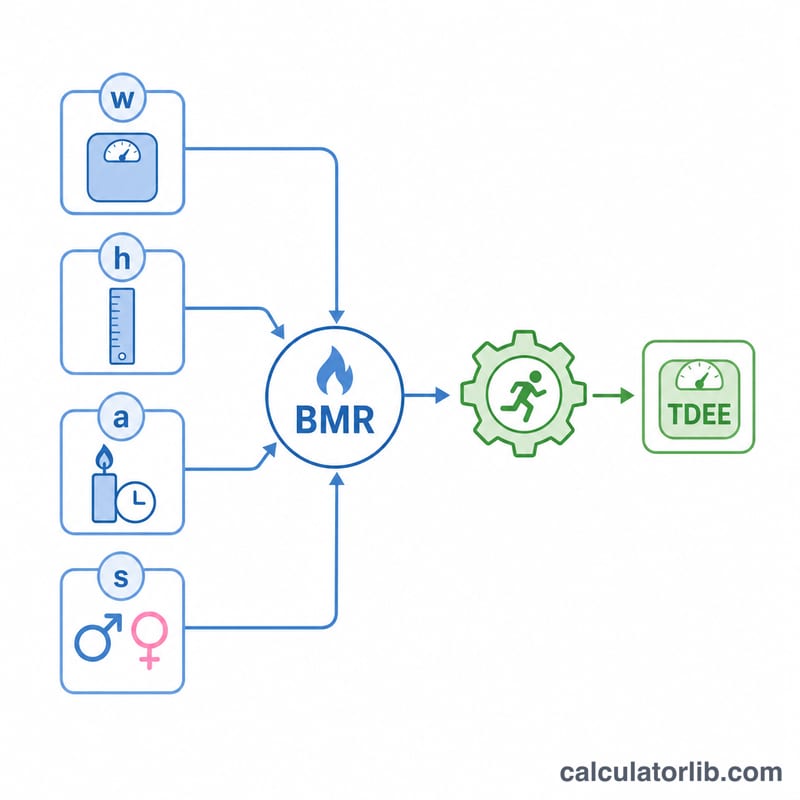
Your Basal Metabolic Rate (BMR) is the number of calories your body burns at complete rest just to keep vital functions running — breathing, circulation, and cell repair. This calculator uses the Mifflin-St Jeor equation, widely regarded as one of the most accurate BMR formulas for the general population. It then scales your BMR by an activity factor to estimate your Total Daily Energy Expenditure (TDEE), the calories you actually burn each day including movement and exercise.
How to use it
Select your gender, then enter your weight in kilograms, height in centimetres, and age in years. Choose the activity level that best matches your typical week. The calculator returns your BMR, your maintenance calories (TDEE), plus suggested daily targets to lose or gain weight at a moderate pace of roughly 0.5 kg per week (a 500-calorie daily adjustment).
The formula explained
The Mifflin-St Jeor equations are:
Men: $$\text{BMR} = 10 \times \text{weight(kg)} + 6.25 \times \text{height(cm)} - 5 \times \text{age} + 5$$Women: $$\text{BMR} = 10 \times \text{weight(kg)} + 6.25 \times \text{height(cm)} - 5 \times \text{age} - 161$$
$$\text{TDEE} = \text{BMR} \times \text{activity factor}$$ where the factor ranges from \(1.2\) (sedentary) to \(1.9\) (extra active).
Worked example
A 30-year-old man weighing 70 kg and 175 cm tall: $$\text{BMR} = 10 \times 70 + 6.25 \times 175 - 5 \times 30 + 5 = 700 + 1093.75 - 150 + 5 = \mathbf{1648.75 \text{ cal/day}}$$ If he is lightly active (factor \(1.375\)), $$\text{TDEE} = 1648.75 \times 1.375 \approx \mathbf{2267 \text{ cal/day}}$$ to maintain his weight.
Understanding Your BMR and TDEE Results
BMR (Basal Metabolic Rate) is the number of calories your body needs to keep basic functions running while completely at rest — breathing, circulation, cell production and maintaining body temperature. It represents the largest share of most people's daily energy use.
TDEE (Total Daily Energy Expenditure) is your BMR scaled up by your activity multiplier. It estimates the total calories you burn in a typical day, including movement, exercise and digestion. Eating at your TDEE keeps your weight roughly stable (maintenance).
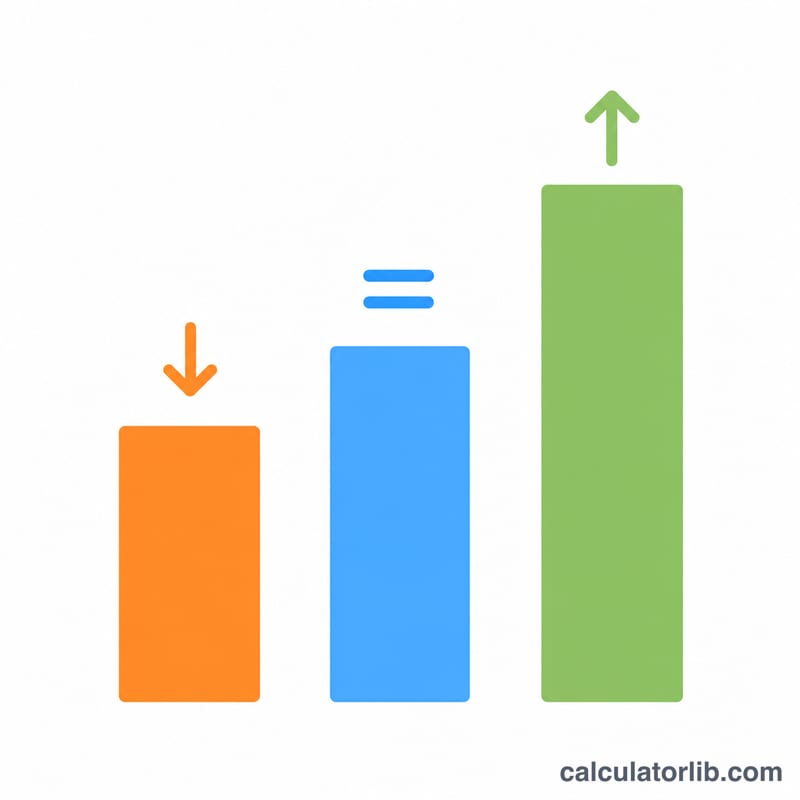
To change weight, you adjust intake relative to TDEE. Because roughly 7,700 kcal is stored in about 1 kg of body fat, a sustained deficit of about 500 kcal/day corresponds to roughly 0.5 kg of fat loss per week, and a similar daily surplus corresponds to roughly the same weekly gain. Larger surpluses or deficits scale these figures proportionally.
These numbers are estimates. Real energy needs vary between individuals because of differences in muscle mass, genetics, hormones, NEAT (non-exercise movement) and measurement accuracy, so two people with identical inputs may differ by a few hundred calories. Use the result as a starting point, then adjust based on how your weight actually responds over 2–4 weeks.
As general guidance, very low intakes are widely discouraged: commonly cited minimums are around 1,200 kcal/day for women and 1,500 kcal/day for men. Dropping below these can make it hard to meet nutrient needs. This is general educational information, not personal medical advice — consult a qualified professional before making significant changes to your diet.
FAQ
Is Mifflin-St Jeor more accurate than Harris-Benedict? For most modern populations, yes — research generally finds it predicts resting energy expenditure with smaller error.
Why does the calculator use metric units? The Mifflin-St Jeor equation is defined in kilograms and centimetres. Convert pounds to kg (÷2.205) and inches to cm (×2.54) if needed.
Are these calorie targets exact? No — they are evidence-based estimates. Individual metabolism varies, so adjust based on real-world weight trends over several weeks.