
What Is a Bike Gear Ratio Calculator?
A bike gear ratio calculator works out how your drivetrain translates pedalling effort into distance travelled. It takes three simple inputs — the number of teeth on your chainring (the front gear), the number of teeth on your rear cog (or sprocket), and your wheel diameter — and returns two key numbers: the gear ratio and gear inches. These figures let you compare different gearing setups objectively, whether you ride a road bike, mountain bike, single-speed, or fixed-gear. The method is universal and works for bikes anywhere in the world.
How to Use It
Enter the following details and the calculator does the rest:
- Chainring teeth – count the teeth on the front gear you want to test (e.g. 50).
- Cog teeth – count the teeth on the rear sprocket (e.g. 14).
- Wheel diameter – the diameter of your wheel including the tyre, in inches (700c road wheels are roughly 27 inches; 26-inch and 29-inch MTB wheels match their names).
Repeat with different gear combinations to see which setup gives you the spin or punch you want.
The Formula Explained
Two calculations are involved:
- Gear ratio \(= \text{chainring teeth} \div \text{cog teeth}\)
- Gear inches \(= (\text{chainring teeth} \div \text{cog teeth}) \times \text{wheel diameter}\)
The gear ratio tells you how many times the wheel turns for one full pedal revolution. Gear inches is a classic measure — it represents the diameter of the wheel a penny-farthing would need to travel the same distance per pedal stroke. Higher gear inches means a harder, faster gear; lower means an easier gear for climbing.
$$\text{Gear Inches} = \frac{\text{Chainring}}{\text{Cog}} \times \text{Wheel Diameter (in)}$$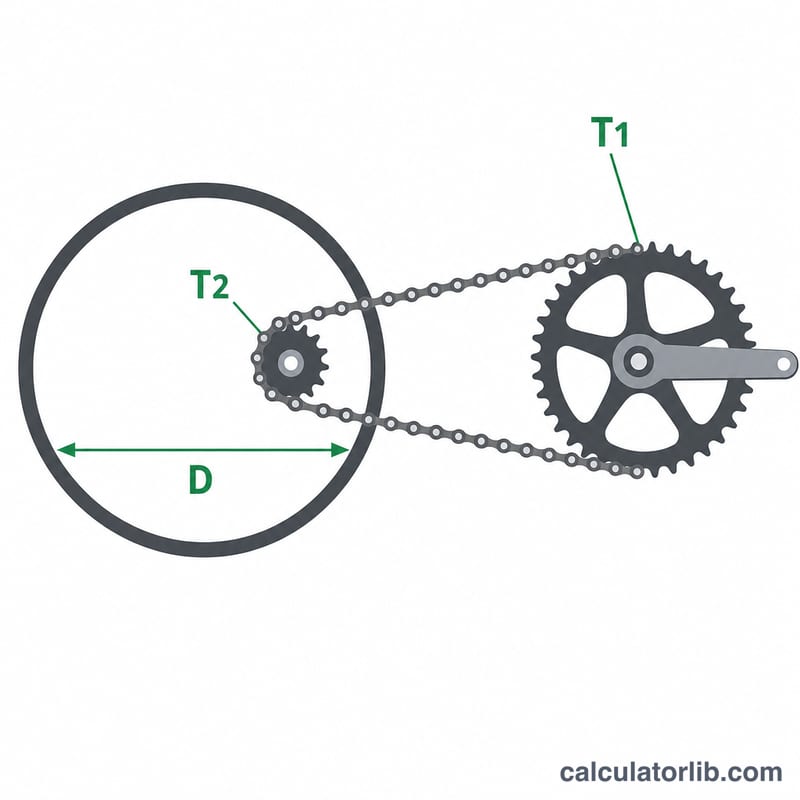
Worked Example
Suppose you ride a 50-tooth chainring with a 14-tooth cog on a 700c wheel (≈27 inches):
- Gear ratio $$= 50 \div 14 = \mathbf{3.57}$$
- Gear inches $$= 3.57 \times 27 = \mathbf{96.4 \text{ inches}}$$
That is a fast, high gear suited to flat roads or descents. Drop to a 34-tooth chainring and the gear inches fall to about 65.6 — far better for steep climbs.
Gear Inches Across Common Setups
Gear inches express how far a bike travels per pedal revolution, normalized to wheel size, making setups directly comparable. The formula is:
$$\text{Gear Inches} = \frac{\text{Chainring}}{\text{Cog}} \times \text{Wheel Diameter (in)}$$The table below spans low (climbing) gears through high (flat and descent) gears using realistic chainring/cog combinations and typical wheel diameters (700c \(\approx 26.4\) in, 26" MTB \(\approx 26.2\) in).
| Setup (Chainring/Cog) | Wheel | Wheel Diameter (in) | Gear Ratio | Gear Inches | Typical Use |
|---|---|---|---|---|---|
| 34 / 28 | 700c road | 26.4 | 1.21 | 32.1 | Steep climbing |
| 36 / 22 | 26" MTB | 26.2 | 1.64 | 42.9 | Off-road climbing / rolling |
| 32 / 16 | 700c single-speed | 26.4 | 2.00 | 52.8 | Flat cruising (single-speed) |
| 50 / 19 | 700c road | 26.4 | 2.63 | 69.5 | Rolling / steady flat |
| 50 / 14 | 700c road | 26.4 | 3.57 | 94.3 | Fast flat / descent |
| 53 / 11 | 700c road | 26.4 | 4.82 | 127.2 | High-speed descent / sprint |
For a worked example, a 50/14 setup on a 700c wheel gives \(\frac{50}{14} \times 26.4 = 3.571 \times 26.4 = 94.3\) gear inches. Once you know the gear ratio, pair it with a target cadence to estimate road speed using a cadence and speed tool.
Gear Inches Ranges and What They Mean
Gear inches give a quick sense of how hard or easy a gear feels independent of bike type. Lower numbers spin easily and suit climbing; higher numbers cover more ground per revolution and suit speed. The bands below are typical guidelines for road and mountain biking — actual feel depends on rider strength, terrain and cadence.
| Gear Inches | Feel | Typical Use | Example Setup |
|---|---|---|---|
| Under 30 | Very easy, low torque | Steep / loose climbing, loaded touring | 34/30 700c, 32/34 MTB |
| 30 – 50 | Easy | Climbing and rolling hills | 34/28 700c, 36/24 26" |
| 50 – 70 | Moderate | Flat cruising, steady tempo | 32/16 single-speed, 50/19 700c |
| 70 – 90 | Firm | Brisk flat riding, mild descents | 50/17 700c, 50/15 700c |
| 90 and above | Hard, high speed | Fast flats, descents, sprinting | 50/14 700c, 53/11 700c |
As a rough rule, a typical recreational road cruising gear sits around 65–75 gear inches, while dedicated climbing gears often drop below 35. Riders frequently aim for a low gear that lets them maintain roughly 70–90 pedal RPM on their steepest regular climb.
Wheel Diameter Reference for Common Sizes
Gear inches require the outside wheel diameter including the inflated tyre, not just the rim size. The values below are approximate full diameters for common wheel/tyre combinations; exact figures vary with tyre width and casing, so measure your own wheel for precision (roll-out divided by \(\pi\) gives the effective diameter).
| Wheel / Tyre Size | Rim (ISO) | Approx. Diameter incl. Tyre (in) | Notes |
|---|---|---|---|
| 700c × 23–25 (road) | 622 mm | 26.3 – 26.5 | Standard road racing |
| 700c × 28–32 | 622 mm | 26.6 – 27.0 | Endurance / gravel |
| 650b / 27.5" | 584 mm | 26.5 – 27.7 | Wider tyres raise diameter |
| 26" MTB | 559 mm | 26.0 – 26.5 | Classic mountain bike |
| 27.5" MTB | 584 mm | 27.3 – 27.8 | Same rim as 650b, wide tyre |
| 29er (700c MTB) | 622 mm | 28.5 – 29.2 | 622 rim with wide knobby tyre |
| 27" (vintage road) | 630 mm | 27.0 – 27.3 | Older road bikes |
To estimate the true diameter of a given tyre from its printed size (e.g. 700×28 or 50-622), use a tire diameter from size calculator. Because measured diameter is the foundation of the gear-inch result, even a 0.5 in difference in tyre size shifts gear inches by roughly 2%.
Frequently Asked Questions
What are good gear inches for climbing? Many cyclists aim for 30–40 gear inches for steep hills, allowing a comfortable cadence without straining.
How do I measure wheel diameter? Measure from the ground to the top of the tyre, then double it, or use a known size: 700c ≈ 27", 26" MTB = 26", 29er = 29".
Does this work for single-speed bikes? Yes — just use your single chainring and single cog tooth counts.