What Is Anchor Rode Scope?
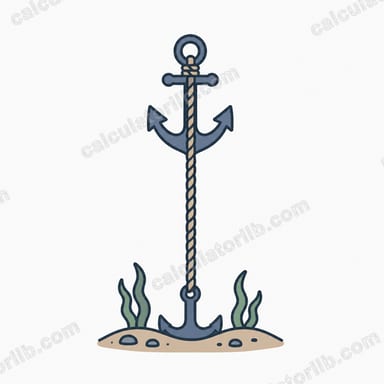
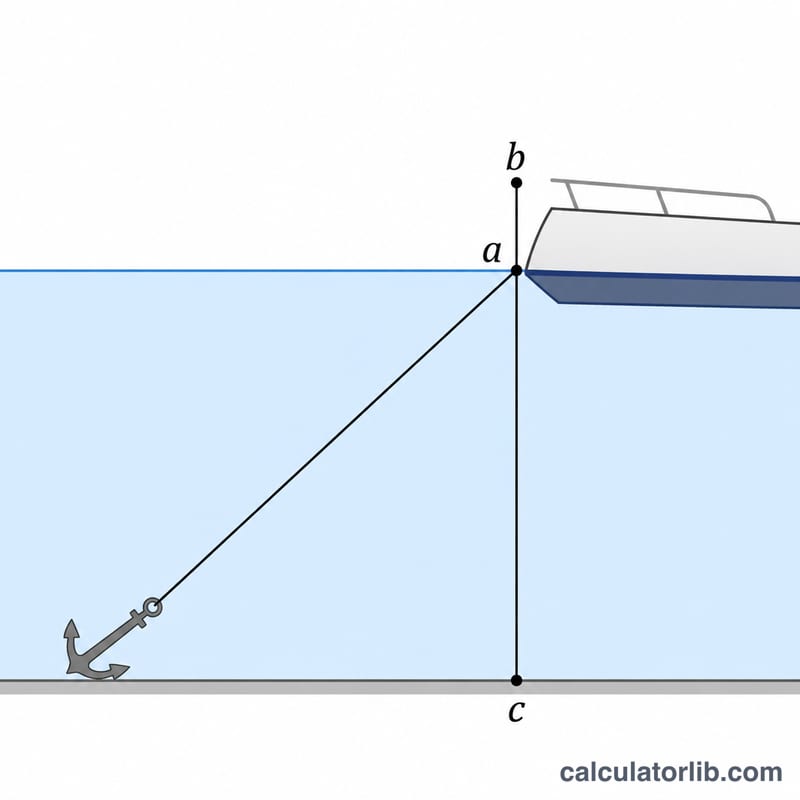
Anchor rode is the line, chain, or combination that connects your boat to its anchor. The key to holding power is not just how much rode you have, but the scope ratio — the ratio of deployed rode length to the vertical distance from the bow roller to the seabed. A low scope pulls upward on the anchor and drags it; a proper scope pulls more horizontally so the flukes dig in and hold.
The Formula
The rode length to deploy is:
$$R = S \times (D + H)$$where \(R\) = rode to let out (ft), \(S\) = desired scope ratio (e.g. 7 for 7:1), \(D\) = water depth at the anchor (ft), and \(H\) = height of the bow roller above the waterline (ft). Adding \(H\) matters because scope is measured from the bow, not the water surface. In tidal waters, use the maximum expected depth at high tide for \(D\).
How to Use It
Enter the charted or sounded water depth, your bow height above the water, and the scope ratio you want. A common all-purpose value is 7:1 for overnight anchoring; 5:1 may suffice in calm, protected water with all-chain rode, while 10:1 is prudent in storms.
Worked Example
Suppose the water depth is \(20\) ft, your bow sits \(4\) ft above the water, and you want a 7:1 scope. The total vertical distance is \(20 + 4 = 24\) ft, so:
$$R = 7 \times (20 + 4) = 7 \times 24 = 168\,\text{ft}$$You would let out 168 feet of rode to achieve a true 7:1 scope.
Rode Length Across Common Scenarios
Anchor rode is the line and/or chain that connects your boat to the anchor. The amount to let out is driven by scope — the ratio of deployed rode to the vertical distance from the seabed to your bow roller. That vertical distance is the water depth plus your bow height above the water, so the working formula is:
$$\text{Rode} = \text{Scope} \times (\text{Depth} + \text{Bow Height})$$
The table below uses a fixed bow height of 4 ft and computes each cell as \(R = S \times (D + H)\). Find your water depth on the left, then read across to the scope ratio you plan to use. All values are in feet.
| Water depth (ft) | Depth + bow height (ft) | Rode at 5:1 | Rode at 7:1 | Rode at 10:1 |
|---|---|---|---|---|
| 10 | 14 | 70 | 98 | 140 |
| 15 | 19 | 95 | 133 | 190 |
| 20 | 24 | 120 | 168 | 240 |
| 30 | 34 | 170 | 238 | 340 |
Worked example — 20 ft of water, 4 ft bow height, 7:1 scope:
$$R = 7 \times (20 + 4) = 7 \times 24 = 168 \text{ ft}$$
Always measure depth at (or correct for) high tide so you don't come up short when the water rises, and make sure you actually carry enough rode aboard for the deepest anchorage and highest scope you expect to use.
Recommended Scope Ratios by Condition
Scope is the single biggest factor in holding power: a lower angle of pull on the anchor lets it dig in and stay set. As a rule of thumb, more wind, more sea state, and less-elastic rode all call for more scope. The ranges below reflect widely published U.S. recreational-boating and U.S. Coast Guard Auxiliary anchoring guidance; treat them as general starting points, not fixed rules.
| Condition | Suggested scope | Notes |
|---|---|---|
| Lunch / day stop, calm, boat attended | 3:1 | Short-term only, someone aboard and watching. Not for leaving the boat or overnight. |
| Calm, well-protected anchorage | 4:1 – 5:1 | Reasonable when using all-chain rode in settled conditions. |
| Standard overnight anchoring | 7:1 | The commonly cited default for a secure, unattended set in normal conditions. |
| Heavy weather / storm | 10:1 or more | Maximize scope, and let out all available rode if conditions deteriorate. |
Rode type shifts where you land within these ranges:
- All-chain rode can use the lower end of a range. Chain adds weight that keeps the pull more horizontal (the catenary curve) and resists chafe on the bottom, so a 5:1 all-chain set can behave like a longer nylon set.
- Rope or rope-and-chain (combination) rode should use the higher end. Line is lighter and pulls at a steeper angle, so extra length is needed to keep the load on the anchor low; the length of chain in a combination rode also improves the angle and protects against abrasion.
Other practical points: allow enough swing room for the full arc your boat will trace around the anchor as wind and current shift, back down on the anchor under power to confirm it is set before relying on it, and re-check scope when the tide or conditions change. These figures are general information for planning, not a substitute for local knowledge, official charts, or professional/marine-safety advice; always adjust for your specific boat, anchor, and anchorage.
FAQ
Does chain change the scope needed? Yes. All-chain rode adds weight that lowers the pull angle, so you can often use a slightly shorter scope than with nylon rope.
Should I include the tide? Always plan for the highest expected water depth during your stay, or the boat could swing into a low-scope situation at high tide.
What if I lack swing room? Reducing scope reduces holding power, so consider a different anchorage, a second anchor, or an anchor with better holding characteristics rather than shortening rode below a safe scope.