
What Is Bond Current Yield?
The current yield of a bond measures the annual income (coupon interest) it provides relative to its current market price. Unlike the coupon rate—which is fixed against the bond's face value—the current yield reflects what an investor actually earns if they buy the bond today at its prevailing price. It is one of the simplest and most widely used metrics for comparing income-producing bonds.
How to Use This Calculator
Enter three values: the bond's face (par) value, its annual coupon rate as a percentage, and the current market price you would pay for the bond. The calculator first computes the annual coupon payment (face value × coupon rate), then divides that payment by the current price and multiplies by 100 to express the result as a percentage.
The Formula Explained
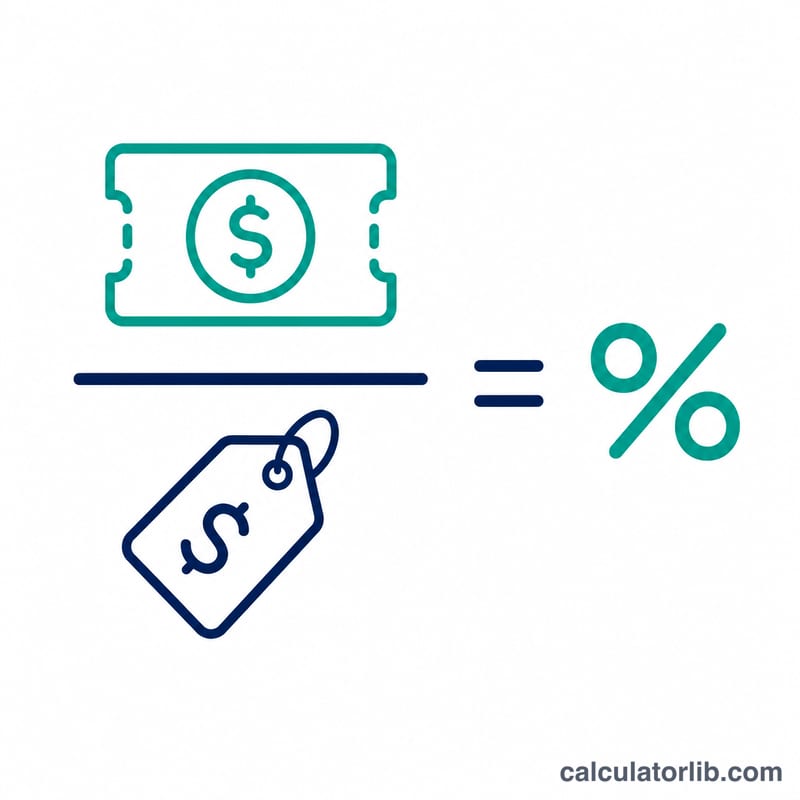
$$\text{Current Yield} = \frac{\text{Annual Coupon Payment}}{\text{Current Bond Price}} \times 100$$ When a bond trades below par (at a discount), its current yield is higher than its coupon rate. When it trades above par (at a premium), the current yield is lower. This inverse relationship between price and yield is fundamental to fixed-income investing.
Worked Example
Suppose a bond has a $1,000 face value, a 5% annual coupon rate, and is currently priced at $950. The annual coupon payment is \(\$1{,}000 \times 5\% = \$50\). The current yield is $$\$50 \div \$950 \times 100 = 5.26\%$$ Because the bond is trading at a discount, its current yield (5.26%) exceeds its stated coupon rate (5%).
Interpreting Your Current Yield
Current yield measures the annual income a bond pays relative to its current market price. It is calculated as the annual coupon payment divided by the price you pay, expressed as a percentage:
$$\text{Current Yield} = \frac{\text{Face Value} \times \frac{\text{Coupon Rate}}{100}}{\text{Current Price}} \times 100$$
The relationship between current yield and the bond's stated coupon rate tells you whether the bond trades at a discount, at par, or at a premium:
- Current yield > coupon rate (discount): The bond's price is below face value. For example, a $1,000 bond with a 5% coupon trading at $900 has a current yield of 5.56%, higher than the 5% coupon. You collect the same coupon dollars but paid less than par, so the income return is higher.
- Current yield = coupon rate (par): The bond's price equals its face value. A $1,000 bond with a 5% coupon trading at exactly $1,000 has a current yield of 5%, identical to the coupon rate.
- Current yield < coupon rate (premium): The bond's price is above face value. A $1,000 bond with a 5% coupon trading at $1,100 has a current yield of about 4.55%, lower than the 5% coupon, because you paid more than par for the same coupon stream.
Limitation — an income-only snapshot: Current yield reflects only the coupon income relative to today's price. It is a single-point-in-time measure and does not account for how long you hold the bond or what happens at maturity.
It ignores capital gains and losses: A bond bought at a discount will return additional gain as its price pulls toward face value at maturity, while a bond bought at a premium will incur a capital loss as its price falls toward face value. Current yield captures none of this principal movement.
It ignores reinvestment: Current yield says nothing about the rate at which coupon payments can be reinvested over the life of the bond.
How it differs from yield to maturity (YTM): YTM is the total annualized return earned if the bond is held to maturity, incorporating coupon income, the gain or loss between purchase price and face value, and the timing of all cash flows. For a discount bond, YTM is higher than current yield; for a premium bond, YTM is lower than current yield; for a bond at par, current yield, coupon rate, and YTM are all equal. Current yield is simpler and useful for comparing income, but YTM is the more complete measure of total return.
This is general educational information about how the metric is calculated and interpreted, not personal investment advice.
Key Terms Defined
- Face value (par value)
- The principal amount printed on the bond that the issuer repays at maturity, commonly $1,000 for corporate bonds. Coupon payments are calculated as a percentage of this amount.
- Annual coupon payment
- The total interest paid by the bond each year, equal to face value multiplied by the coupon rate. For a $1,000 bond with a 5% coupon, the annual coupon payment is $50 (often paid as two semiannual installments of $25).
- Coupon rate
- The fixed annual interest rate stated on the bond, expressed as a percentage of face value. It determines the dollar amount of each coupon and does not change over the bond's life.
- Current market price
- The price at which the bond currently trades, which fluctuates with interest rates, credit quality, and time to maturity. It may be above, below, or equal to face value.
- Current yield
- The annual coupon payment divided by the current market price, expressed as a percentage. It measures the income return based on what you pay today.
- Discount
- A bond trading below its face value (price < par). Discount bonds have a current yield above their coupon rate.
- Premium
- A bond trading above its face value (price > par). Premium bonds have a current yield below their coupon rate.
- Yield to maturity (YTM)
- The total annualized return an investor earns if the bond is held until maturity, accounting for all coupon payments plus the gain or loss between the purchase price and face value. It is a more comprehensive measure than current yield.
FAQ
Is current yield the same as yield to maturity? No. Current yield only considers annual coupon income versus price. Yield to maturity also factors in capital gains or losses and the timing of all cash flows until the bond matures.
Why does price affect yield? Coupon payments are fixed in dollar terms, so paying less for a bond raises the percentage return, while paying more lowers it.
Does this account for taxes or fees? No. The result is a gross yield before any taxes, transaction costs, or accrued interest adjustments.