What Is the Carbon Offset Trees Calculator?
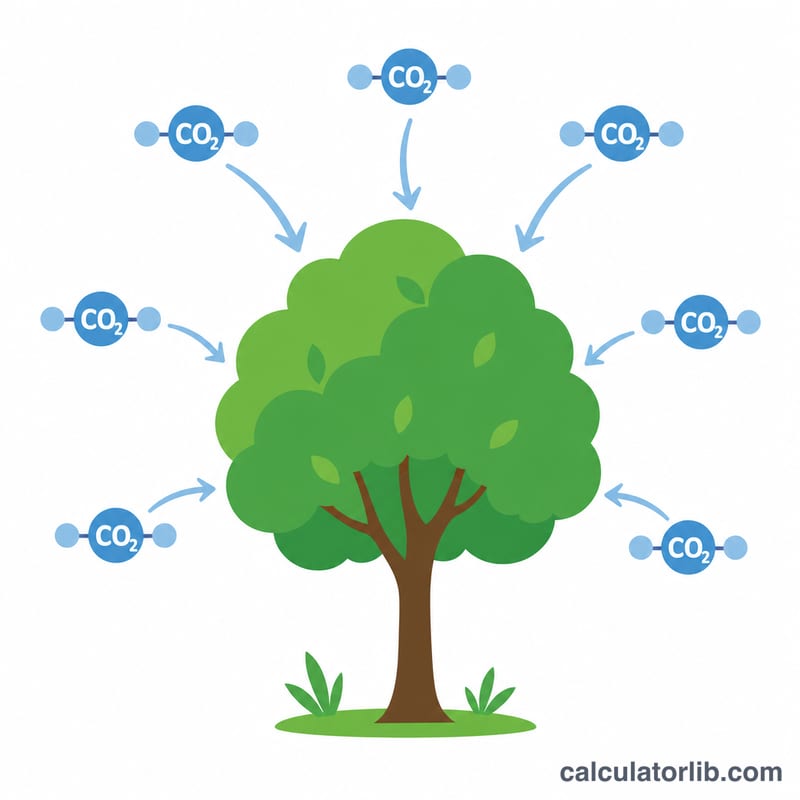
This calculator estimates how many trees you would need to plant to absorb a given amount of carbon dioxide (CO₂) each year. Trees pull CO₂ out of the atmosphere through photosynthesis, locking carbon into their wood, roots and soil. A commonly cited average is that a mature tree absorbs roughly 21 kilograms of CO₂ per year, though this varies widely by species, climate, age and growing conditions.
How to Use It
Enter your total annual CO₂ emissions in kilograms (a typical person's footprint ranges from about 4,000 to 16,000 kg per year depending on country and lifestyle). Adjust the "CO₂ absorbed per tree" value if you have a more specific figure for your region or species. The calculator then divides your emissions by the per-tree absorption rate and rounds up, since you can't plant a fraction of a tree.
The Formula Explained
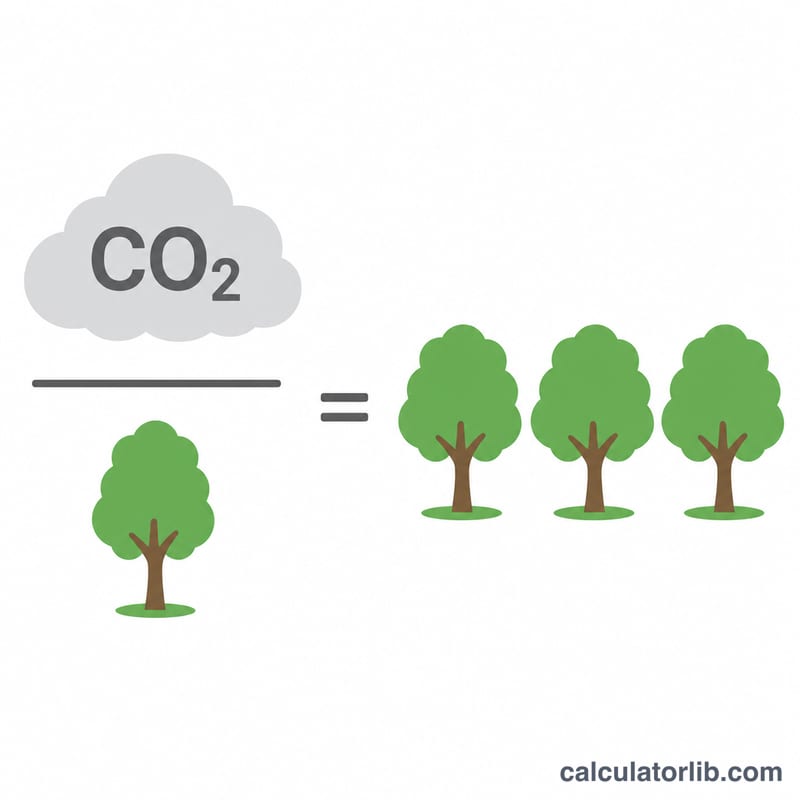
The core equation is simply:
$$\text{Trees} = \left\lceil \frac{\text{CO}_2\text{ (kg/yr)}}{\text{Absorbed per Tree (kg/yr)}} \right\rceil$$
For example, if you emit 4,200 kg of CO₂ per year and each tree absorbs 21 kg, you would need \(4{,}200 \div 21 = 200\) trees grown for one year to offset those emissions. Note this assumes each tree is mature and absorbing at its annual rate — newly planted saplings absorb far less in their early years.
Worked Example
Suppose your annual emissions are 5,000 kg and you use the default 21 kg/tree rate. \(\text{Trees} = 5{,}000 \div 21 \approx 238.1\), which rounds up to 239 trees. Those 239 trees would offset about 5,019 kg of CO₂ per year.
Typical Annual CO₂ Emissions by Country (per person)
The table shows approximate per-capita fossil CO₂ emissions (fuel burning and industry) for a few widely cited countries and regions. They are rounded values of the kind published by the Global Carbon Project and Our World in Data, based on data from around 2022. Exact figures vary by dataset, year, and whether emissions are counted by production (territorial) or consumption. Treat them as orders of magnitude, not precise values.
| Country / region | Approx. CO₂ per person (kg/yr) | Approx. tonnes/yr | Trees at 21 kg/tree/yr |
|---|---|---|---|
| World average | 4,700 | 4.7 | 224 |
| United States | 14,000 | 14 | 667 |
| China | 8,000 | 8 | 381 |
| European Union | 6,000 | 6 | 286 |
| India | 2,000 | 2 | 96 |
Tree counts are rounded up: trees = ⌈emissions ÷ 21⌉. They assume mature trees each absorbing about 21 kg of CO₂ per year, which is an average, not a fixed constant.
Trees Needed Across Different Scenarios
The table gives the number of trees needed, ⌈emissions ÷ absorption per tree⌉, for several annual emission levels and three per-tree absorption rates.
| Emissions (kg CO₂/yr) | 10 kg/tree/yr | 21 kg/tree/yr | 40 kg/tree/yr |
|---|---|---|---|
| 2,000 | 200 | 96 | 50 |
| 4,700 | 470 | 224 | 118 |
| 8,000 | 800 | 381 | 200 |
| 14,000 | 1,400 | 667 | 350 |
Example: for 4,700 kg/yr at 21 kg per tree, \(4700 \div 21 \approx 223.8\), which rounds up to 224 trees.
The wide spread between 10 and 40 kg per tree reflects real variability. Absorption depends on species, climate, soil, growth stage, and tree health. Fast-growing trees in good conditions absorb more, while slow-growing or stressed trees absorb less.
Interpreting Your Result
- Mature trees, not saplings. The result is the number of mature, actively growing trees absorbing CO₂ at the assumed rate for one full year. A newly planted sapling sequesters very little at first.
- Time to reach the rate. Trees typically take years to decades to reach average absorption rates, so the offset is realised gradually, not in the year of planting. Some trees also die or are removed, which reduces the total.
- A recurring annual need. The figure covers one year of emissions. If emissions continue at the same level, the same number of mature trees must keep absorbing every year, and newly planted trees add to the total over time.
- Land area is implied. Plantation spacing of about 3 m × 3 m gives roughly 1,100 trees per hectare, and about 5 m × 5 m gives roughly 400 per hectare. For example, 224 trees would need about 0.2 to 0.56 hectares at those densities. Natural forests, species mix, and local conditions change this.
- An estimate only. The default of about 21 kg CO₂ per tree per year is a commonly quoted average. Actual values vary widely, so treat the output as a rough guide.
FAQ
How much CO₂ does one tree absorb? Estimates commonly range from 10 to 40 kg per year for an established tree; 21 kg is a widely used average. A tree's lifetime sequestration can total around 1 tonne (1,000 kg).
Does a newly planted tree offset my emissions immediately? No. Young trees absorb very little at first and reach their full absorption rate only after years of growth, so real-world offsetting takes time.
Is planting trees enough to be carbon neutral? Trees are a helpful natural offset, but reducing emissions at the source is far more effective and permanent than relying on tree planting alone.