What Is the Cents to Dollars Calculator?
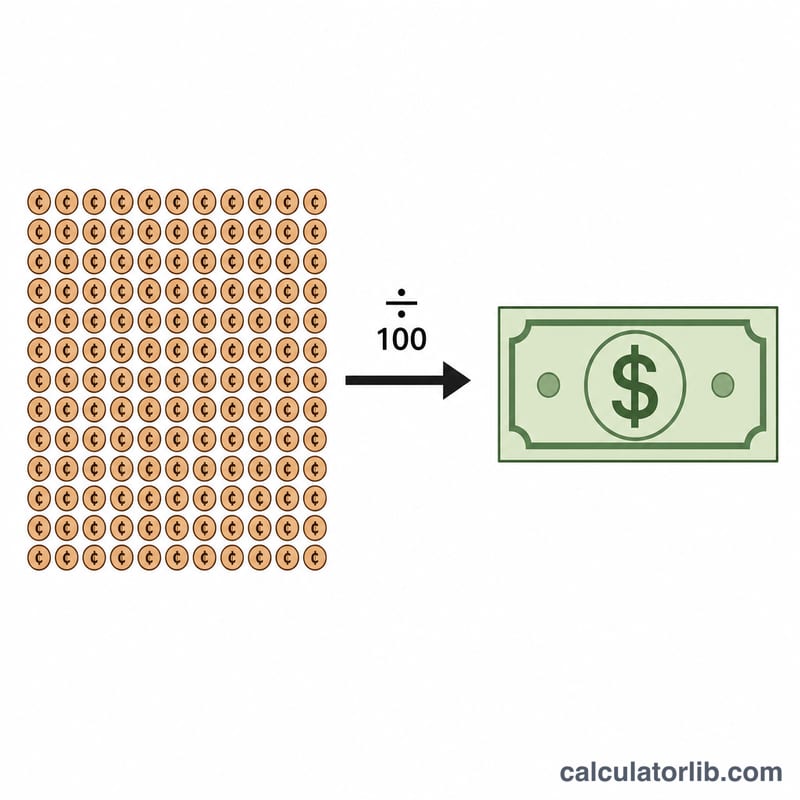
The Cents to Dollars Calculator is a simple tool that converts any amount expressed in cents (¢) into its equivalent value in dollars ($). Because the US dollar — and most decimal currencies — is divided into 100 cents, the conversion is a straightforward division by 100. This tool is handy for counting coins, tallying register totals, reading price tags listed in cents, or working through math homework.
How to Use It
Type the amount of cents into the input field and the calculator instantly returns the value in dollars. For example, enter 250 and you will see $2.50. You can enter whole numbers or decimals (such as fractional cents in accounting), and the result is displayed with standard dollar formatting.
The Formula Explained
The conversion uses one equation:
$$\text{dollars} = \frac{\text{cents}}{100}$$Since 100 cents make up exactly 1 dollar, dividing the cent amount by 100 shifts the decimal point two places to the left. This same rule applies to any currency built on a 100-subunit system, such as euros and pence-free decimal pounds.
Worked Example
Suppose you have collected 1,575 cents in loose change. Apply the formula: $$1{,}575 \div 100 = 15.75$$ So 1,575 cents equals $15.75. Likewise, 99 cents becomes $0.99 and 10,000 cents becomes $100.00.
US Coin and Bill Values in Cents
Because one dollar equals exactly 100 cents, every United States denomination has a clean whole-number value in cents. The table below lists the circulating US coins and the most common Federal Reserve notes. (These denominations are specific to the US dollar; other currencies that use a 1/100 subunit — euro cents, British pence, etc. — divide by 100 the same way but have different coin sets.)
| Denomination | Value in cents | Value in dollars |
|---|---|---|
| Penny (1¢ coin) | 1¢ | $0.01 |
| Nickel | 5¢ | $0.05 |
| Dime | 10¢ | $0.10 |
| Quarter | 25¢ | $0.25 |
| Half dollar | 50¢ | $0.50 |
| Dollar coin | 100¢ | $1.00 |
| $1 bill | 100¢ | $1.00 |
| $5 bill | 500¢ | $5.00 |
| $10 bill | 1,000¢ | $10.00 |
| $20 bill | 2,000¢ | $20.00 |
Worked line: totaling a mixed handful
Count each coin type, multiply by its value in cents, add the results, then divide the total by 100. For 3 quarters, 2 dimes and 4 pennies:
$$3 \times 25 + 2 \times 10 + 4 \times 1 = 75 + 20 + 4 = 99\ \text{cents}$$
$$\text{Dollars} = \frac{99}{100} = \$0.99$$
So the handful is worth $0.99. Adding one more penny would make it 100¢, or exactly $1.00.
The same method scales to a full coin jar: a standard bank roll of 40 quarters is \(40 \times 25 = 1{,}000\) cents, or $10.00.
How to Convert Cents to Dollars by Hand
The conversion is a single division by 100, which in decimal notation is just a shift of the decimal point. Follow these five steps; the examples carry 7¢, 1,575¢ and 50.5¢ through each one.
- Write the cent amount as a plain number. Strip the ¢ symbol and any thousands separators so you are working with digits only: 7¢ → 7, 1,575¢ → 1575, 50.5¢ → 50.5. If no decimal point is written, it sits implicitly at the right-hand end (7 = 7.0).
- Move the decimal point two places to the left — equivalently, divide by 100: $$\text{Dollars} = \frac{\text{Cents}}{100}$$ For the examples: \(7 \div 100 = 0.07\), \(1575 \div 100 = 15.75\), and \(50.5 \div 100 = 0.505\).
- Pad with leading zeros when the amount is under 100¢. Shifting the point past the front of the number leaves empty places that must be filled with zeros: 7 becomes 0.07 (not 0.7 or .7), and 50.5 becomes 0.505. Amounts of 100¢ or more need no padding — 1575 becomes 15.75 directly.
- Add the dollar sign and format to two decimal places with thousands separators. 7¢ → $0.07; 1,575¢ → $15.75; a larger figure such as 123,456¢ → $1,234.56. Keeping exactly two decimals is what makes the amount look like a normal price rather than a bare decimal.
- Decide what to do with fractional cents. A value like 50.5¢ converts exactly to $0.505. Fractional cents are legitimate and are routinely carried in unit pricing, fuel prices, interest accrual and per-unit manufacturing costs, so keep the extra digits through intermediate calculations. For an actual payment or invoice line, round to two decimals at the end: half-up rounding gives $0.51, while banker's rounding (round-half-to-even) gives $0.50 because the digit before the half is even. Pick one rule, apply it consistently, and round only once — rounding at every intermediate step introduces drift.
Full substitution for each example
$$\frac{7}{100} = 0.07 \quad\Rightarrow\quad \$0.07$$
$$\frac{1575}{100} = 15.75 \quad\Rightarrow\quad \$15.75$$
$$\frac{50.5}{100} = 0.505 \quad\Rightarrow\quad \$0.505 \approx \$0.51 \text{ (half-up)}$$
Entering 1575 in the calculator returns $15.75. To go the other way, multiply by 100: \(15.75 \times 100 = 1{,}575\) cents.
FAQ
How many cents are in a dollar? There are exactly 100 cents in one US dollar.
Can I convert fractional cents? Yes. Enter a decimal like 50.5 cents and the calculator returns $0.505, which is useful in accounting and unit pricing.
Does this work for other currencies? Any currency divided into 100 subunits (like the euro and its cents) follows the same divide-by-100 rule.