
What Is the Skip the Coffee Savings Calculator?
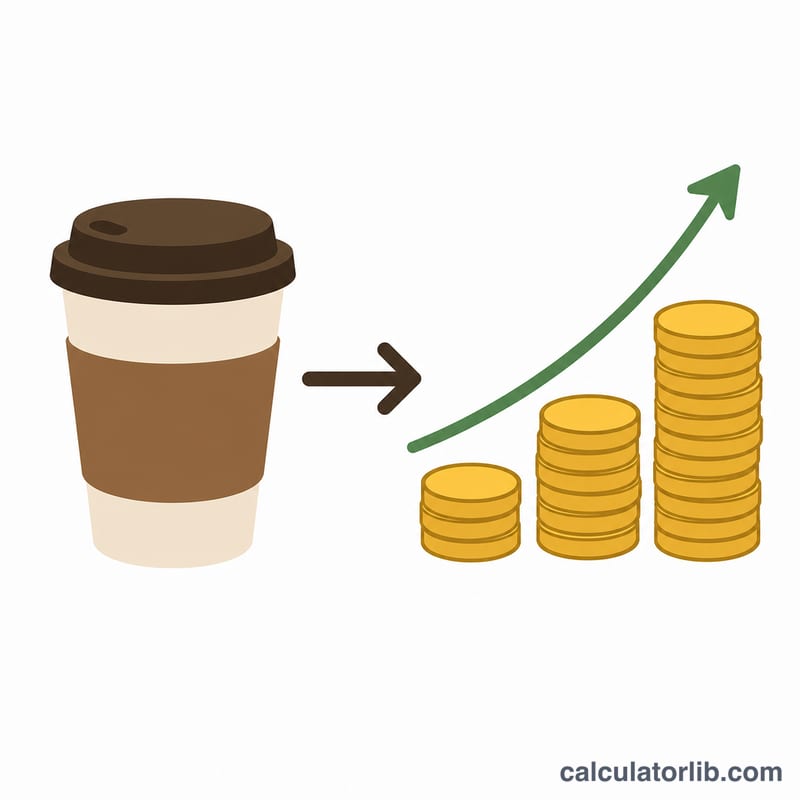
This calculator shows the long-term financial impact of a small daily habit. Instead of buying a coffee every day, what if you invested that money? By converting your daily coffee cost into an annual contribution and growing it at an investment return rate, this tool reveals how a few dollars a day can compound into thousands over the years — a classic illustration of the "latte factor."
How to Use It
Enter three values: the cost of your daily coffee (for example $5), the number of years you plan to save (for example 30), and an expected annual investment return (a long-run stock market average is often estimated around 7%). The calculator multiplies your daily cost by 365 to get the yearly amount, then compounds each year's deposit for the remaining years.
The Formula Explained
The annual contribution is your daily cost times 365. Each annual deposit is assumed to be made at the end of the year and then grows at the return rate \(r\) for the remaining years. The future value is the sum of all these compounded deposits:
$$FV = \sum_{y=1}^{n} (C \times 365)(1 + r)^{\,n - y}$$
The interest earned is simply the future value minus everything you actually contributed:
$$I = FV - (C \times 365 \times n)$$
Worked Example
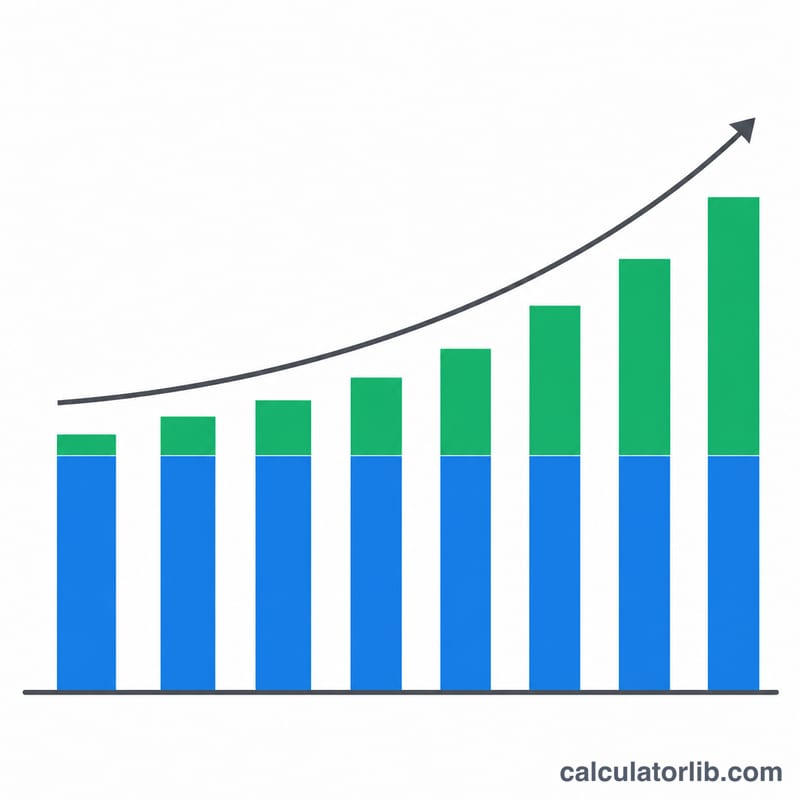
Suppose you spend $5 a day, save for 2 years, and earn 10% annually. Your annual contribution is \(5 \times 365 = 1{,}825\). The first deposit grows for one year: \(1{,}825 \times 1.10 = 2{,}007.50\). The second deposit, made at the end of year two, does not grow: \(1{,}825\). Total future value $$FV = 2{,}007.50 + 1{,}825 = 3{,}832.50$$ of which $3,650 was contributed and $182.50 is interest.
FAQ
Why multiply by 365? It assumes you buy a coffee every single day of the year. If you only buy on weekdays, use about 260 days by adjusting your daily cost.
What return rate should I use? A common assumption for long-term diversified stock investments is 7% after inflation, though actual returns vary and are not guaranteed.
Does this account for inflation or taxes? No. It is a simplified illustration. Real returns may be reduced by taxes, fees, and inflation.