
What Is the DART Rate?
The DART rate (Days Away, Restricted, or Transferred) is an OSHA safety metric used in the United States to measure the number of workplace injuries and illnesses that result in days away from work, restricted duty, or job transfer. It is one of the most closely watched indicators of a company's safety performance, often compared against industry averages published by the U.S. Bureau of Labor Statistics. This calculator follows the standard OSHA recordkeeping convention.

How to Use This Calculator
Enter the number of DART-qualifying incidents recorded during the period and the total number of hours all employees worked over the same period. Click calculate to see your DART rate expressed per 100 full-time workers. Use figures from your OSHA 300 Log for the incident count and your payroll records for total hours worked.
The Formula Explained
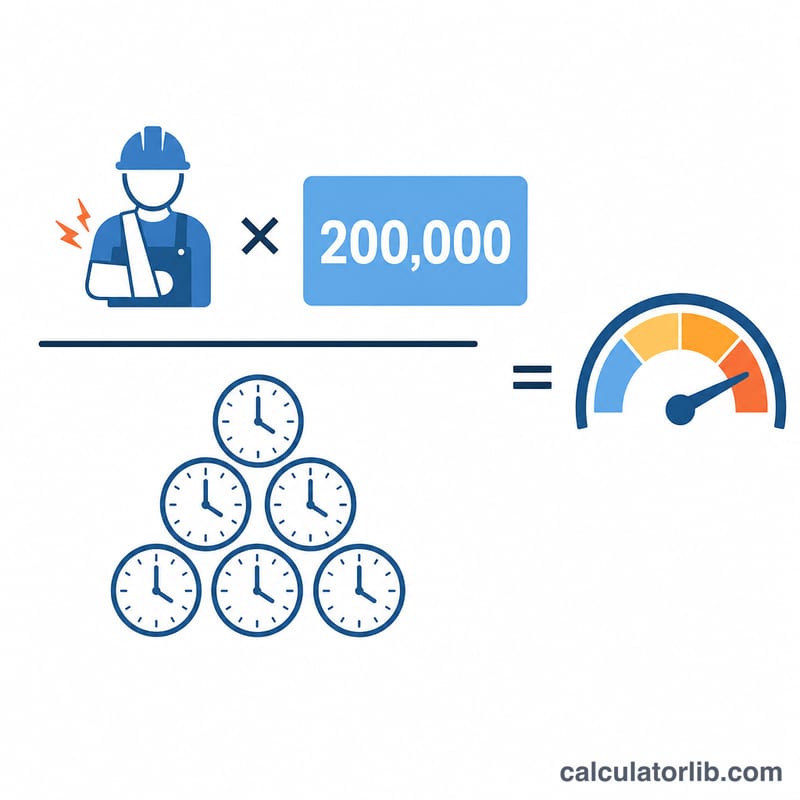
The DART rate is calculated as (Number of DART incidents × 200,000) ÷ Total hours worked.
$$\text{DART Rate} = \frac{\text{DART Incidents} \times 200{,}000}{\text{Total Hours Worked}}$$The constant 200,000 represents the number of hours 100 employees would work in a year (100 workers × 40 hours/week × 50 weeks). Multiplying by this base normalizes the rate so companies of different sizes can be compared on an equal footing.
Worked Example
Suppose a facility recorded 3 DART incidents and its employees worked a combined 200,000 hours during the year. The DART rate is
$$\frac{3 \times 200{,}000}{200{,}000} = 3.0$$This means roughly 3 DART cases occurred per 100 full-time employees.
FAQ
How is DART different from TRIR? TRIR (Total Recordable Incident Rate) counts all recordable cases, while DART only counts cases involving days away, restricted duty, or transfer — a subset of recordables.
What is a good DART rate? Lower is better. Compare your result to the BLS published average for your industry (NAICS code); a rate below your industry average is generally considered good.
What period should I use? Typically a calendar year, but any consistent period works as long as incidents and hours cover the same timeframe.