What is the ECG Boxes to Seconds Calculator?
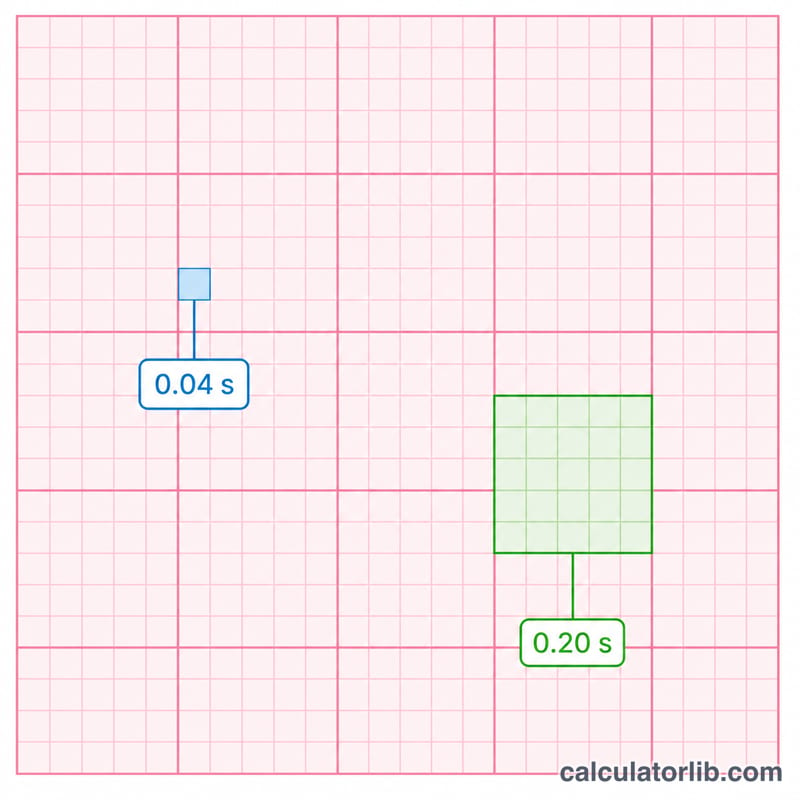
On standard ECG (electrocardiogram) paper running at 25 mm/s, each small box (1 mm) represents 0.04 seconds and each large box (5 mm) represents 0.20 seconds. This calculator converts a measured number of small or large boxes into a precise time duration in seconds and milliseconds, and gives the equivalent heart rate when the interval represents one R-R cycle.
How to use it
Count the boxes spanning the interval you want to measure (for example a QRS complex, QT interval, or one R-R interval). Enter the number of small boxes or the number of large boxes — if you only know large boxes, leave small boxes blank. Choose the paper speed (25 mm/s is standard worldwide; 50 mm/s doubles the resolution). The tool returns the duration and the corresponding rate.
The formula
$$\text{Time (s)} = \text{small\_boxes} \times \left( \frac{1}{\text{paper\_speed}} \right)$$ Since one large box equals five small boxes, large_boxes are first converted: \(\text{small\_total} = \text{large\_boxes} \times 5\). At 25 mm/s this gives 0.04 s per small box and 0.20 s per large box. $$\text{Heart rate (bpm)} = \frac{60}{\text{time in seconds}}$$
Worked example
Suppose an R-R interval spans 4 large boxes at 25 mm/s. Convert: \(4 \times 5 = 20\) small boxes. Duration $$= 20 \times 0.04 = 0.80 \text{ s} \ (800 \text{ ms})$$ Heart rate $$= \frac{60}{0.80} = 75 \text{ bpm}$$ — a normal resting rate.
Normal ECG Interval Durations in Boxes and Seconds
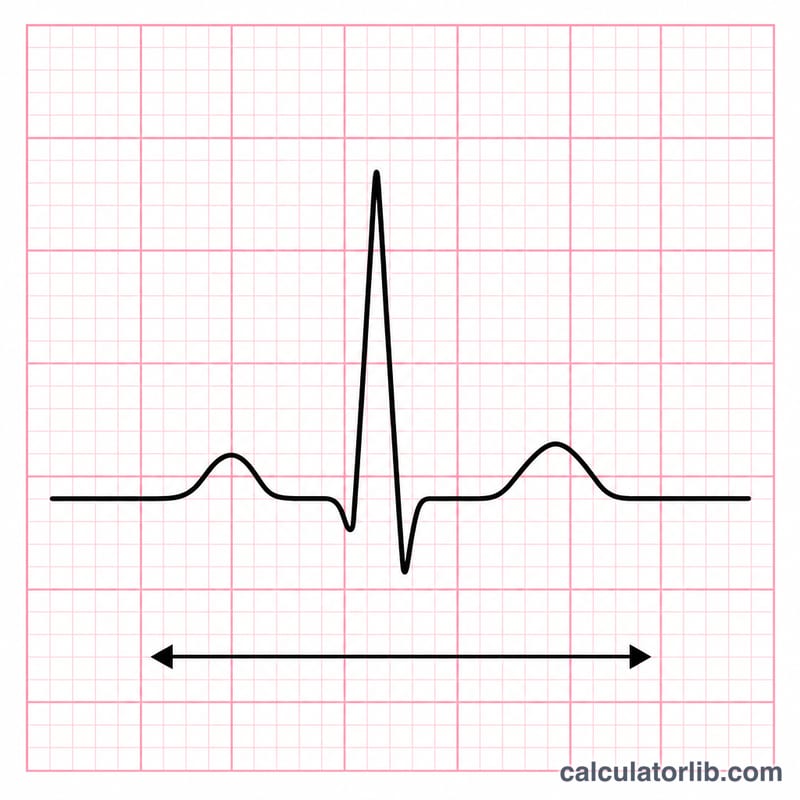
On standard ECG paper run at 25 mm/s, one small box (1 mm) is 0.04 s (40 ms) and one large box (5 mm) is 0.20 s (200 ms). The table converts commonly cited adult reference ranges into boxes. Ranges follow standard ECG textbooks and AHA/ACC/HRS recommendations. They vary by age, sex and source, and children usually have shorter intervals and faster rates.
| Interval | Typical normal duration (25 mm/s) | Small boxes | Large boxes |
|---|---|---|---|
| P wave | <0.12 s (<120 ms) | under 3 | under 0.6 |
| PR interval | 0.12–0.20 s (120–200 ms) | 3–5 | 0.6–1 |
| QRS duration | <0.12 s (<120 ms) | under 3 | under 0.6 |
| QT interval | roughly 0.36–0.44 s (360–440 ms) | about 9–11 | about 1.8–2.2 |
| R-R interval at 60–100 bpm | 0.60–1.00 s (600–1000 ms) | 15–25 | 3–5 |
The QT interval changes with heart rate, so clinicians usually use a rate-corrected value (QTc). Cutoffs for a prolonged QTc differ between sources, and many use about 450 ms for men and 460 ms for women. Treat the figures above as general reference values, not diagnostic thresholds.
Boxes to Time Conversion Table (25 and 50 mm/s)
Each small box is 1 mm, so time in seconds = millimetres ÷ paper speed. At 25 mm/s: \(1 \div 25 = 0.04\) s per small box and \(5 \div 25 = 0.20\) s per large box. At 50 mm/s: \(1 \div 50 = 0.02\) s and \(5 \div 50 = 0.10\) s. For example, 5 small boxes at 25 mm/s: \(5 \times 0.04 = \) 0.20 s.
The heart rate columns assume the distance is one R-R interval in a regular rhythm: \(\text{bpm} = 60 \div \text{R-R (s)}\). Rates from very short intervals (a few small boxes) are shown only to illustrate the arithmetic.
| Boxes | 25 mm/s: seconds | 25 mm/s: ms | 25 mm/s: rate if R-R (bpm) | 50 mm/s: seconds | 50 mm/s: ms | 50 mm/s: rate if R-R (bpm) |
|---|---|---|---|---|---|---|
| 1 small | 0.04 | 40 | 1500 | 0.02 | 20 | 3000 |
| 2 small | 0.08 | 80 | 750 | 0.04 | 40 | 1500 |
| 3 small | 0.12 | 120 | 500 | 0.06 | 60 | 1000 |
| 4 small | 0.16 | 160 | 375 | 0.08 | 80 | 750 |
| 5 small | 0.20 | 200 | 300 | 0.10 | 100 | 600 |
| 10 small | 0.40 | 400 | 150 | 0.20 | 200 | 300 |
| 1 large | 0.20 | 200 | 300 | 0.10 | 100 | 600 |
| 2 large | 0.40 | 400 | 150 | 0.20 | 200 | 300 |
| 3 large | 0.60 | 600 | 100 | 0.30 | 300 | 200 |
| 4 large | 0.80 | 800 | 75 | 0.40 | 400 | 150 |
| 5 large | 1.00 | 1000 | 60 | 0.50 | 500 | 120 |
| 6 large | 1.20 | 1200 | 50 | 0.60 | 600 | 100 |
Interpreting the Measured Duration
- Compare with reference ranges. Interval durations (PR, QRS, QT and so on) are compared with standard reference ranges such as those in the table above. Normal limits depend on age, sex, heart rate and the source used.
- Rate classification. By conventional definitions, a rate under 60 bpm is in the bradycardia range and a rate over 100 bpm is in the tachycardia range. At 25 mm/s this corresponds to an R-R interval longer than 5 large boxes (1.00 s) or shorter than 3 large boxes (0.60 s). Whether a rate matters clinically depends on the person and the context.
- Regular rhythms only. The formulas \(300 \div \text{large boxes}\) and \(1500 \div \text{small boxes}\) (at 25 mm/s) assume every R-R interval is about the same. For an irregular rhythm, use the 6-second strip method. At 25 mm/s, 30 large boxes span 6 seconds, so count the QRS complexes in that span and multiply by 10.
- Verify paper speed. The standard is 25 mm/s, but some tracings are recorded at 50 mm/s. If you enter the wrong speed, every time and rate will be off by a factor of two. Check the speed printed on the tracing.
- Measure carefully. Measure from the start to the end of the interval, and count boxes on a clear, well-calibrated tracing.
This tool is for education and is not a diagnosis. ECGs should be interpreted by a qualified clinician who considers the whole clinical picture.
FAQ
How many seconds is one small box? 0.04 s at 25 mm/s, or 0.02 s at 50 mm/s.
How many seconds is one large box? 0.20 s at 25 mm/s, or 0.10 s at 50 mm/s.
Why does paper speed matter? Faster paper spreads the same event over more boxes, so each box represents less time. At 50 mm/s every duration per box is halved.