
What is the Photoelectric Effect Calculator?
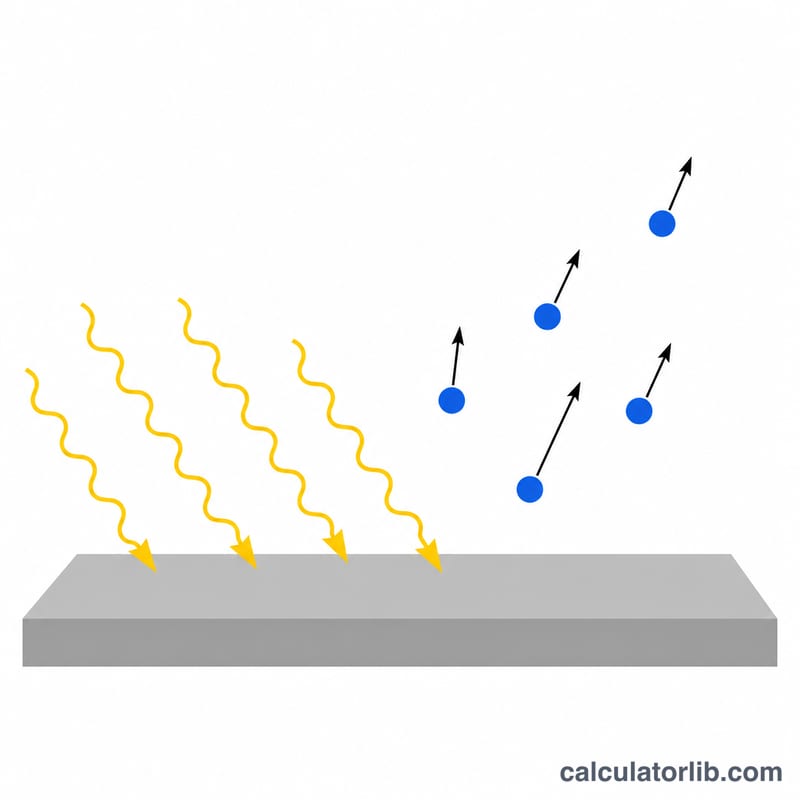
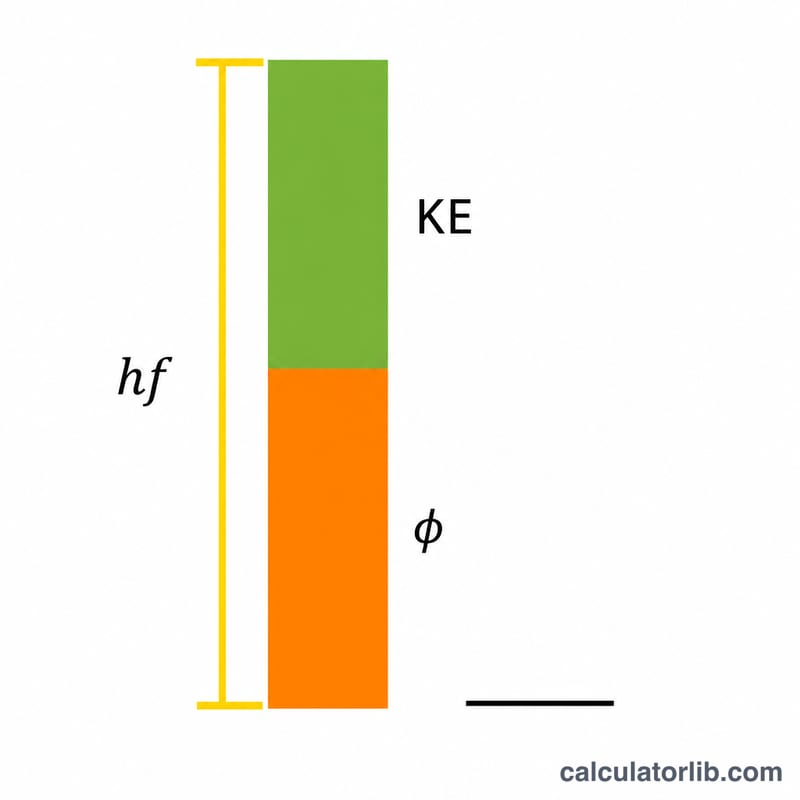
This calculator applies Einstein's photoelectric equation to determine the maximum kinetic energy of electrons ejected from a metal surface when light of a given frequency strikes it. When a photon of energy \(hf\) hits a metal, part of that energy (the work function \(\varphi\)) is used to free the electron, and the remainder becomes the electron's kinetic energy.
How to use it
Enter the frequency of the incident light in hertz (scientific notation such as 1.0e15 is accepted) and the work function of the metal in electron-volts (eV). The tool returns the maximum kinetic energy in both eV and joules, the photon energy, and the threshold frequency below which no electrons are emitted.
The formula explained
The governing equation is $$KE_{max} = hf - \varphi$$ where \(h = 6.62607015\times10^{-34}\ \text{J}\cdot\text{s}\) is Planck's constant, \(f\) is the light frequency, and \(\varphi\) is the work function. To work in eV, photon energy in joules is divided by the elementary charge \(1.602176634\times10^{-19}\ \text{J/eV}\). The threshold frequency is \(f_0 = \varphi/h\), found by setting \(KE_{max}\) to zero.
Worked example
For light at \(f = 1.0\times10^{15}\ \text{Hz}\) on a metal with \(\varphi = 2.3\ \text{eV}\): photon energy $$= hf = 6.62607015\times10^{-19}\ \text{J} \approx 4.136\ \text{eV}.$$ Then $$KE_{max} = 4.136 - 2.3 \approx 1.836\ \text{eV}.$$ The threshold frequency is $$f_0 = \frac{2.3 \times 1.602176634\times10^{-19}}{6.62607015\times10^{-34}} \approx 5.56\times10^{14}\ \text{Hz}.$$
FAQ
What if \(KE_{max}\) is negative? A negative value means the photon energy is below the work function, so no electrons are emitted.
Does intensity matter? Not for the kinetic energy — only frequency does. Higher intensity ejects more electrons but does not increase their energy.
What is the threshold frequency? It is the lowest frequency that can eject an electron; light below it produces no photoelectrons regardless of intensity.