
What this calculator does
This tool tells you how likely a team or player is to win a best-of-N series (best-of-3, best-of-5, best-of-7, and so on) when you know the probability of winning a single game. It is widely used for sports playoff predictions, esports brackets, and any head-to-head contest where the first side to reach a majority of wins takes the series.
How to use it
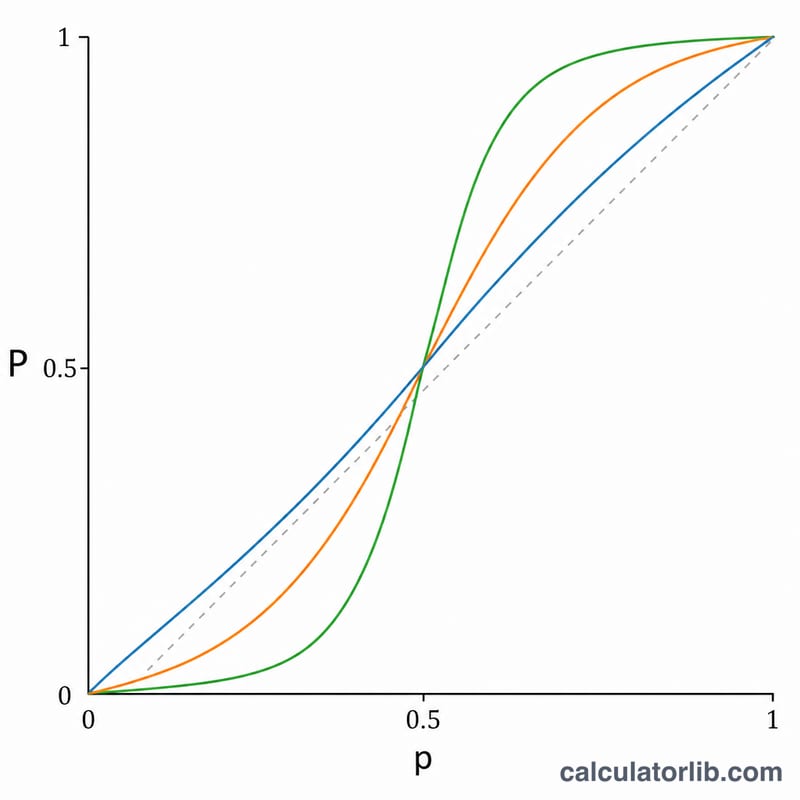
Enter the probability that your side wins one individual game as a decimal between 0 and 1 (for example, 0.6 means a 60% per-game edge). Then enter the series length \(N\), which should be an odd number such as 3, 5, or 7. The calculator returns your overall chance of winning the series, the number of game wins needed to clinch it, and your opponent's probability.
The formula explained
To win a best-of-N series you must reach \(w = \left\lfloor N/2 \right\rfloor + 1\) wins. Treating each game as an independent Bernoulli trial with success probability \(p\), the chance of winning the series is the sum of binomial probabilities of winning \(k\) games for every \(k\) from \(w\) up to \(N\). An equivalent and computationally clean version uses the negative binomial: the deciding \(w\)-th win lands on game \(g\) with probability \(\binom{g-1}{w-1}\, p^{w}\,(1-p)^{g-w}\), summed over \(g\) from \(w\) to \(N\). Both expressions give the same answer; this calculator evaluates the clinch form:
$$P_{\text{win}} = \sum_{g=w}^{N} \binom{g-1}{\,w-1\,}\, p^{\,w}\,(1-p)^{\,g-w}$$ $$\text{where}\quad \left\{ \begin{aligned} p &= \text{Win Prob. per Game} \\ N &= \text{Series Length} \\ w &= \left\lfloor \tfrac{N}{2} \right\rfloor + 1 \end{aligned} \right.$$
Worked example
Suppose \(p = 0.5\) in a best-of-3 series, so \(w = 2\). The series is won with 2 wins out of at most 3 games. $$P = \binom{1}{1}(0.5)^2 + \binom{2}{1}(0.5)^2(0.5)^1 = 0.25 + 2 \times 0.125 = 0.5.$$ With an even matchup the series probability is also 50%, as expected.
FAQ
Why must N be odd? A best-of-N series with an odd \(N\) cannot end in a tie, so exactly one side reaches the majority. Even values can leave a draw, which this model does not handle.
Does it assume each game is independent? Yes. It assumes a constant per-game win probability with no home-field, fatigue, or momentum effects.
Can I use it for a single game? Yes. Set \(N = 1\) and the series probability simply equals your per-game probability \(p\).