What is the Kg to Lbs Calculator?
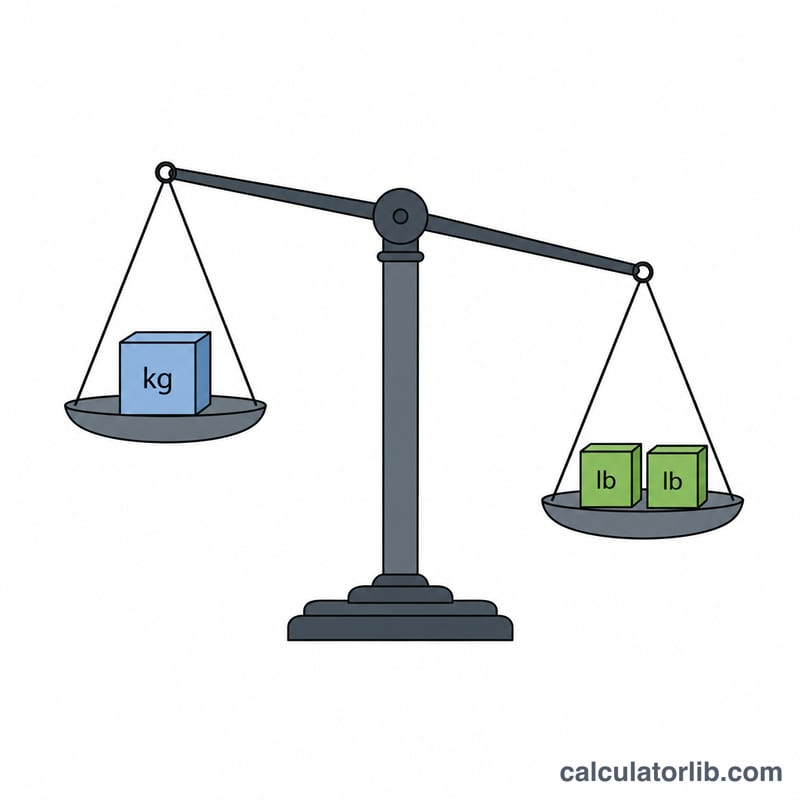
This tool converts a weight expressed in kilograms (kg) into pounds (lbs), the unit commonly used in the United States and United Kingdom. The conversion is universal and exact — it relies only on the internationally defined relationship between the kilogram and the avoirdupois pound, so it applies anywhere in the world.
How to use it
Type the weight in kilograms into the input box and the calculator instantly returns the equivalent in pounds, along with the value in ounces for finer detail. You can enter whole numbers or decimals, such as 68.5 kg.
The formula explained
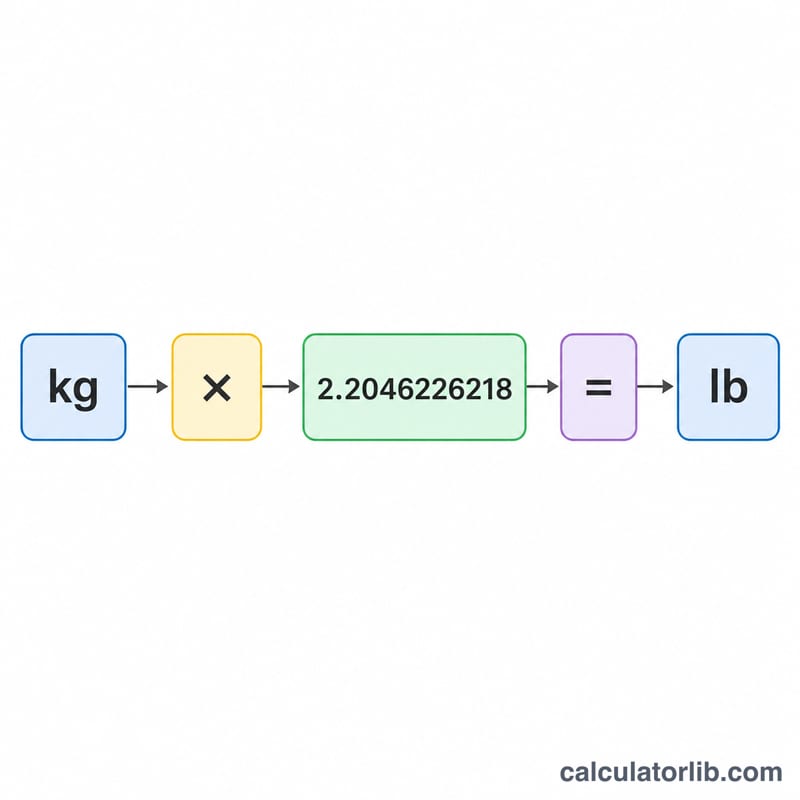
One kilogram equals exactly 2.2046226218 pounds. To convert, simply multiply the kilogram value by this factor:
$$\text{lbs} = \text{kg} \times 2.2046226218$$
To go the other direction, divide pounds by the same factor: \(\text{kg} = \text{lbs} \div 2.2046226218\). Since 1 pound contains 16 ounces, the calculator also reports ounces as \(\text{oz} = \text{lbs} \times 16\).
Worked example
Suppose you weigh 70 kg. Multiply: $$70 \times 2.2046226218 = 154.32 \text{ lbs}.$$ In ounces that is \(154.32 \times 16 \approx 2{,}469.2\) oz. So 70 kilograms is about 154.32 pounds.
Kg to Lbs Conversion Chart
This chart lists common kilogram weights and what they equal in pounds. Each value uses \(\text{lbs} = \text{kg} \times 2.2046226218\) and is rounded to 2 decimals. The last column splits the result into whole pounds plus ounces, where the ounces are the leftover fraction of a pound × 16.
| Kilograms (kg) | Pounds (lbs) | Pounds + ounces |
|---|---|---|
| 0.5 kg | 1.10 lbs | 1 lb 1.64 oz |
| 1 kg | 2.20 lbs | 2 lb 3.27 oz |
| 2 kg | 4.41 lbs | 4 lb 6.55 oz |
| 5 kg | 11.02 lbs | 11 lb 0.37 oz |
| 10 kg | 22.05 lbs | 22 lb 0.74 oz |
| 20 kg | 44.09 lbs | 44 lb 1.48 oz |
| 25 kg | 55.12 lbs | 55 lb 1.85 oz |
| 30 kg | 66.14 lbs | 66 lb 2.22 oz |
| 40 kg | 88.18 lbs | 88 lb 2.96 oz |
| 50 kg | 110.23 lbs | 110 lb 3.70 oz |
| 60 kg | 132.28 lbs | 132 lb 4.44 oz |
| 70 kg | 154.32 lbs | 154 lb 5.18 oz |
| 75 kg | 165.35 lbs | 165 lb 5.55 oz |
| 80 kg | 176.37 lbs | 176 lb 5.92 oz |
| 90 kg | 198.42 lbs | 198 lb 6.66 oz |
| 100 kg | 220.46 lbs | 220 lb 7.40 oz |
| 150 kg | 330.69 lbs | 330 lb 11.09 oz |
| 200 kg | 440.92 lbs | 440 lb 14.79 oz |
Example for 1 kg: $$1 \times 2.2046226218 = 2.2046226218 \text{ lbs}$$ That gives 2 whole pounds. The remaining 0.2046226218 lb × 16 = 3.27 oz, so 1 kg = 2 lb 3.27 oz.
Quick mental estimate: multiply the kilograms by 2.2. For example, 70 kg × 2.2 = 154 lbs, which is very close to the exact 154.32 lbs.
Exact Definition of the Pound
The pound used in everyday life, also called the international avoirdupois pound, is defined in terms of the kilogram. Since the International Yard and Pound Agreement of 1959, it has been exactly 0.45359237 kg. So the kg-to-lbs factor is simply the reciprocal of that number:
$$1 \text{ kg} = \frac{1}{0.45359237} \text{ lb} \approx 2.2046226218 \text{ lb}$$The pound divides into ounces exactly:
- 1 lb = 16 oz (exact)
- 1 oz = 453.59237 g ÷ 16 = 28.349523125 g (exact)
- 1 kg ≈ 35.27 oz
| Unit | Exact value in metric |
|---|---|
| 1 avoirdupois pound (lb) | 0.45359237 kg = 453.59237 g |
| 1 avoirdupois ounce (oz) | 28.349523125 g |
| 1 troy pound (lb t) | 0.3732417216 kg = 373.2417216 g |
| 1 kilogram (kg) | ≈ 2.2046226218 lb |
Avoirdupois vs. troy pound: This calculator uses the avoirdupois pound. The troy pound (0.3732417216 kg, or 12 troy ounces) is a separate unit used for precious metals such as gold and silver. It is about 18% lighter than the avoirdupois pound, so don't mix the two up when converting bullion weights.
The pound is used for everyday weights mainly in the United States. It is also used informally in the United Kingdom, often alongside stones. Most other countries use kilograms.
FAQ
Is 1 kg exactly 2.2 lbs? No — 2.2 is a rough approximation. The precise factor is 2.2046226218 lbs per kilogram.
How do I convert back from pounds to kilograms? Divide the pound value by 2.2046226218. For example, \(100 \div 2.2046226218 \approx 45.36\) kg.
Does this work for body weight and shipping weight alike? Yes. Mass conversion is identical regardless of what is being weighed.