What the Land Area Calculator Does
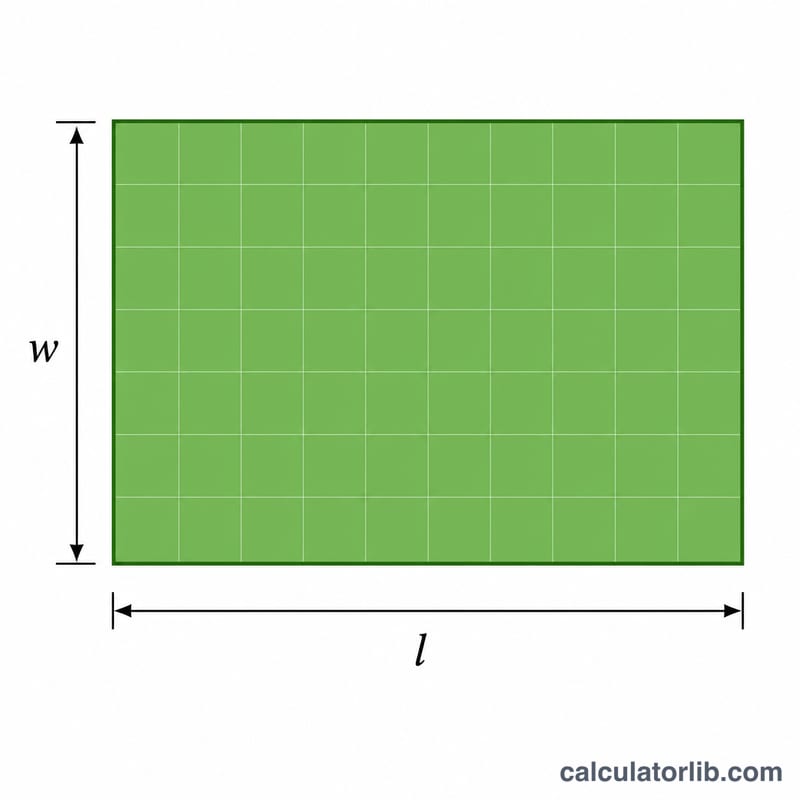
The Land Area Calculator works out the size of a rectangular plot of land from just two measurements: its length and its width, both in metres. It returns the total area in square metres, and also converts that figure into other common land units so you can interpret it whichever way suits your project. It's a quick, no-sign-up tool for property buyers, farmers, builders, surveyors and anyone planning fencing, paving or landscaping on a rectangular or square plot.
The Inputs You Provide
- Length (metres): the longer side of your plot.
- Width (metres): the shorter side, measured at a right angle to the length.
Both values should be in metres. If your measurements are in feet or yards, convert them first (1 foot \(\approx 0.3048\) m, 1 yard \(\approx 0.9144\) m).
The Formula and What Gets Calculated
The core formula is simply:
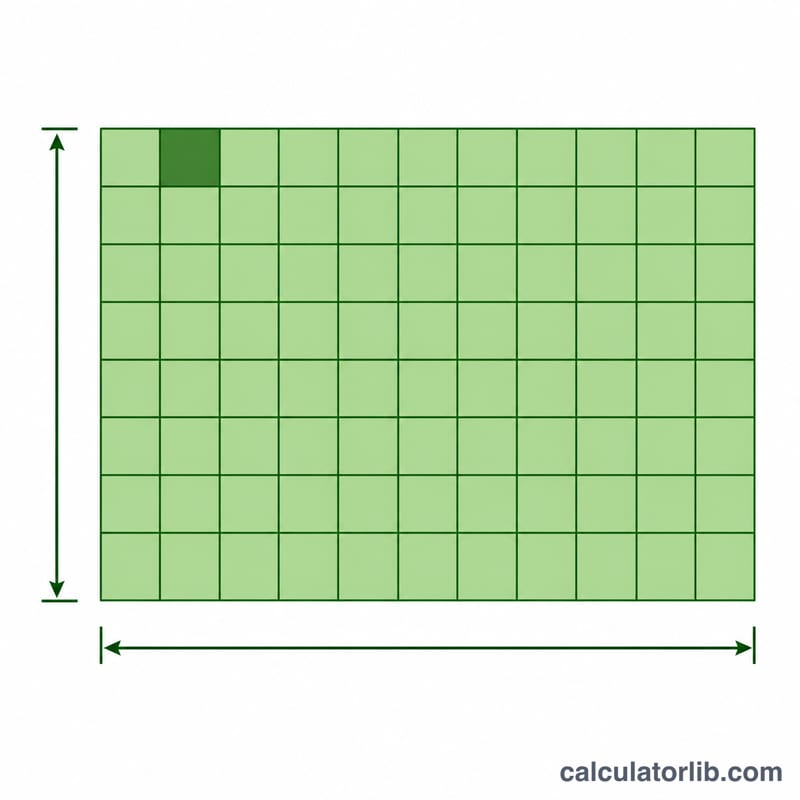
$$\text{Area} = \text{Length} \times \text{Width}$$
From that single multiplication, the calculator derives several useful results:
- Area in square metres \(= \text{Length} \times \text{Width}\)
- Perimeter \(= 2 \times (\text{Length} + \text{Width})\)
- Acres \(= \text{Area} \div 4046.86\)
- Hectares \(= \text{Area} \div 10{,}000\)
So one set of measurements instantly gives you area, the distance around the plot (handy for fencing), and the area expressed in acres and hectares.
Worked Example
Suppose your plot is 50 metres long and 30 metres wide:
- Area \(= 50 \times 30 =\) 1,500 m²
- Perimeter \(= 2 \times (50 + 30) =\) 160 m
- Acres \(= 1{,}500 \div 4046.86 \approx\) 0.371 acres
- Hectares \(= 1{,}500 \div 10{,}000 =\) 0.15 hectares
So you'd need 160 metres of fencing to enclose roughly a third of an acre.
Land Area Unit Conversion Table
The calculator returns area in square metres from \(\text{Area} = \text{Length} \times \text{Width}\). The tables below convert that result into the other units commonly used in property listings and building work. Note that unit preference is regional: square metres and hectares are standard in most of the world and in all metric/SI-based systems, while acres and square feet are usual in the United States and still widely quoted in the UK, India and parts of the Caribbean.
From metric units to other units
| Unit | = m² | = km² | = ares (a) | = ft² | = yd² | = acres |
|---|---|---|---|---|---|---|
| 1 square metre (m²) | 1 | 0.000001 | 0.01 | 10.7639 | 1.19599 | 0.000247105 |
| 1 hectare (ha) | 10,000 | 0.01 | 100 | 107,639.1 | 11,959.9 | 2.47105 |
From other units back to metric
| Unit | = m² | = hectares | Notes |
|---|---|---|---|
| 1 square foot (ft²) | 0.09290304 (exact) | 0.000009290304 | International foot |
| 1 square yard (yd²) | 0.83612736 (exact) | 0.000083612736 | = 9 ft² |
| 1 are (a) | 100 | 0.01 | A 10 m × 10 m square |
| 1 acre | 4046.8564224 (exact) | 0.40468564224 | = 43,560 ft² = 4840 yd² |
| 1 hectare (ha) | 10,000 | 1 | = 2.47105 acres; a 100 m × 100 m square |
| 1 square kilometre (km²) | 1,000,000 | 100 | = 100 ha ≈ 247.105 acres |
Linear input conversions
If your tape measure reads in feet or yards, convert each side to metres before entering it:
- 1 foot = 0.3048 m (exact)
- 1 yard = 0.9144 m (exact)
- 1 inch = 0.0254 m (exact)
Linear factors are squared when converting area. Because a foot is 0.3048 m, a square foot is \(0.3048^2 = 0.09290304\) m² — not 0.3048 m². Likewise, converting metres to feet uses 3.28084, but square metres to square feet uses \(3.28084^2 = 10.7639\). Applying the linear factor to an area is one of the most common measurement errors.
Worked check: a plot measured as 40 ft × 60 ft is \(40 \times 0.3048 = 12.192\) m by \(60 \times 0.3048 = 18.288\) m, giving \(12.192 \times 18.288 = 222.97\) m². Cross-checking, \(2400 \text{ ft}^2 \times 0.09290304 = 222.97\) m² — the two routes agree.
Plot Size Scenarios Compared
Six typical rectangular plots, from a small building lot to a small farm field. Area is \(L \times W\); perimeter is \(2(L + W)\), which is the figure you need for fencing, hedging or boundary walls. Conversions use 10.7639 ft² per m² and 0.000247105 acres per m².
| Dimensions (m) | Area (m²) | Area (ft²) | Acres | Hectares | Perimeter (m) | Typical use |
|---|---|---|---|---|---|---|
| 10 × 20 | 200 | 2,153 | 0.049 | 0.02 | 60 | Small urban house lot |
| 20 × 30 | 600 | 6,458 | 0.148 | 0.06 | 100 | Suburban house and garden |
| 30 × 40 | 1,200 | 12,917 | 0.297 | 0.12 | 140 | Large residential plot |
| 50 × 30 | 1,500 | 16,146 | 0.371 | 0.15 | 160 | Small commercial yard |
| 100 × 100 | 10,000 | 107,639 | 2.471 | 1.00 | 400 | Exactly one hectare |
| 200 × 500 | 100,000 | 1,076,391 | 24.711 | 10.00 | 1,400 | Farm field / development site |
Equal area, very different perimeter
Area alone does not tell you how much fencing a plot needs. All three shapes below enclose 10,000 m² (1 hectare), yet the fencing bill differs by more than double:
| Dimensions (m) | Area (m²) | Perimeter (m) | Extra fence vs. square |
|---|---|---|---|
| 100 × 100 (square) | 10,000 | 400 | — |
| 50 × 200 | 10,000 | 500 | +100 m (+25%) |
| 25 × 400 | 10,000 | 850 | +450 m (+113%) |
| 10 × 1,000 | 10,000 | 2,020 | +1,620 m (+405%) |
For a fixed area, the square is the rectangle with the smallest possible perimeter — the more elongated the plot, the more boundary you pay for. That matters for fencing, drainage runs and edging costs, while paving, turf and topsoil quantities depend only on the area.
Practical Tips for Using Your Area Result
- Measure each side twice and average. Run the tape along the same line twice and take the mean of the two readings. If they differ by more than about 1%, re-measure — on a 30 m side, a 0.3 m error already shifts a 1,200 m² result by roughly 12 m².
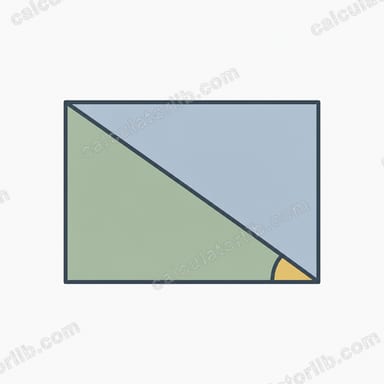
- Keep the corners square. The formula \(\text{Area} = L \times W\) is only exact for a true rectangle. Check with the 3-4-5 method: mark 3 m along one side and 4 m along the other; if the corner is a right angle, the diagonal between the marks measures exactly 5 m. Alternatively, measure both diagonals of the plot — in a rectangle they are equal.
- Use the perimeter, not the area, for fencing. Perimeter is \(P = 2(L + W)\). For a 30 m × 40 m plot, \(P = 2(30 + 40) = 140\) m. Then add roughly 5–10% for gates, corner and straining posts, offcuts and uneven ground — here about 147–154 m of material.
- Add a waste allowance for surface materials. For paving, turf, gravel or topsoil, order about 5–10% more than the calculated area (10% or more where lots of cutting around curves and obstacles is needed), then round up to whole packs, rolls or pallets. Turf rolls, for example, are typically sold by the roll, not by the exact square metre.
- Depth matters for loose materials. Convert area to volume before ordering: \(\text{Volume (m}^3) = \text{Area (m}^2) \times \text{Depth (m)}\). A 200 m² lawn at 50 mm of topsoil needs \(200 \times 0.05 = 10\) m³.
- Check what the quoted dimensions actually mean. Listed plot sizes may be measured to the centre of a boundary wall, to the outer face, or to the legal boundary line — and a stated "built area" may be internal floor area rather than land area. Confirm the basis before you commit to an order or an offer.
- Split irregular plots into rectangles. Divide an L-shaped or stepped plot into rectangles, calculate each with the tool, and add the results. A plot made of a 12 m × 8 m block plus a 5 m × 4 m block is 96 m² + 20 m² = 116 m². For a triangular corner, use \(\tfrac{1}{2} \times \text{base} \times \text{height}\); for a strongly irregular boundary, a surveyor's coordinate method will be more accurate than any hand division.
- Work in one unit throughout. Convert feet or yards to metres before entering values (1 ft = 0.3048 m), rather than mixing units and converting the area afterwards.
- Do not use a calculator estimate for legal purposes. For sales contracts, land registration, boundary disputes, planning applications or tax assessments, rely on the measurements in the title deed or plan produced by a licensed surveyor. Registration rules, minimum plot sizes and even the definition of local land units vary by country and jurisdiction; this tool gives a planning estimate, not a legally recognised measurement.
This section is general practical guidance only and is not professional surveying, legal or financial advice. For decisions with legal or financial consequences, consult a qualified local surveyor or professional adviser.
Frequently Asked Questions
Does this work for non-rectangular plots? No. The formula assumes a rectangle (or square). For irregular shapes, split the land into rectangles, calculate each area, and add them together.
How do I convert square metres to square feet? Multiply by 10.764. For example, 1,500 m² \(\approx\) 16,146 ft².
Why show acres and hectares? Land is often traded and registered in these units. Hectares (10,000 m²) are standard across most of the world, while acres (about 4,047 m²) are common in the US and UK for larger plots.