What the LCD Calculator Does
The LCD Calculator finds the least common denominator for a set of fractions — the smallest number that every denominator divides into evenly. This is the value you need to add, subtract, or compare fractions, since all of them must share the same denominator before the operation makes sense. You can enter ordinary fractions like 1/4, whole numbers like 5, or several values at once.
How to Use It
Type your fractions into the input box, separated by commas, for example: 1/4, 3/8, 5/6. The calculator scans the text, splits it on commas, trims spaces, and keeps only entries that match the pattern a/b (a fraction) or c (a whole number). Anything that doesn't fit that pattern is ignored, so stray text won't break the result.
- Fractions: entered as
numerator/denominator— only the denominator is used. - Whole numbers: treated as having a denominator of 1.
- Separator: always a comma between values.
The Formula Explained
The LCD is simply the least common multiple (LCM) of all the denominators. The calculator extracts the denominator from each entry (using 1 for plain integers), then combines them pairwise: \(\operatorname{lcm}(a, b, c) = \operatorname{lcm}(\operatorname{lcm}(a, b), c)\). The LCM of two numbers is found from their greatest common divisor:
$$\operatorname{lcm}(a, b) = \frac{a \times b}{\gcd(a, b)}$$The general formula for the least common denominator is:
$$\text{LCD} = \operatorname{lcm}\left(d_1, d_2, \dots, d_n\right)$$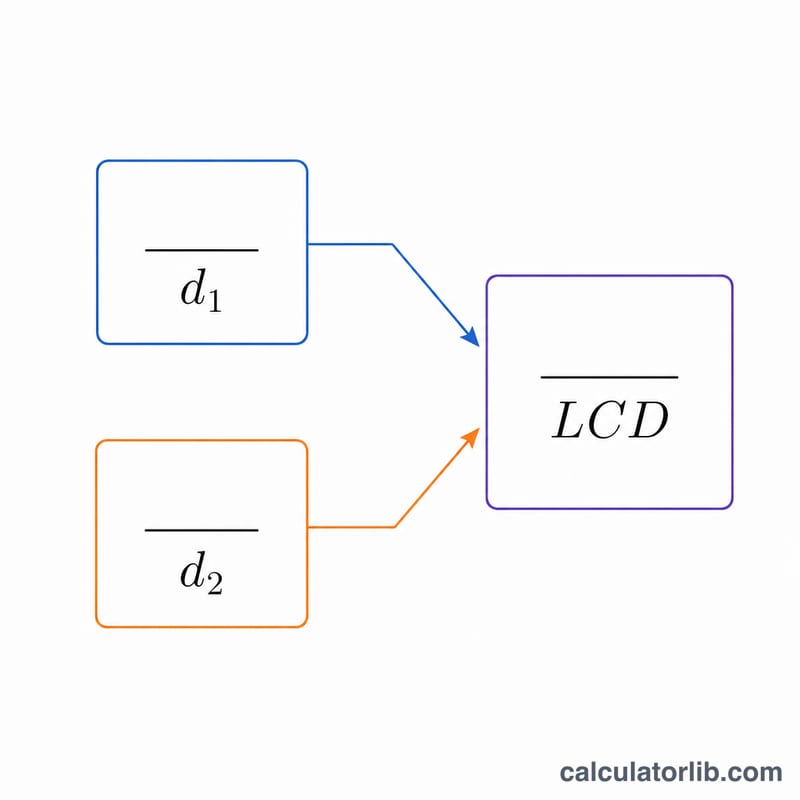
Worked Example
Suppose you enter 1/4, 3/8, 5/6. The denominators are 4, 8 and 6.
- \(\operatorname{lcm}(4, 8) = 8\)
- \(\operatorname{lcm}(8, 6) = \dfrac{8 \times 6}{\gcd(8, 6)} = \dfrac{48}{2} = 24\)
So the least common denominator is 24. You could then rewrite the fractions as 6/24, 9/24 and 20/24 to add or compare them.
More Worked Examples
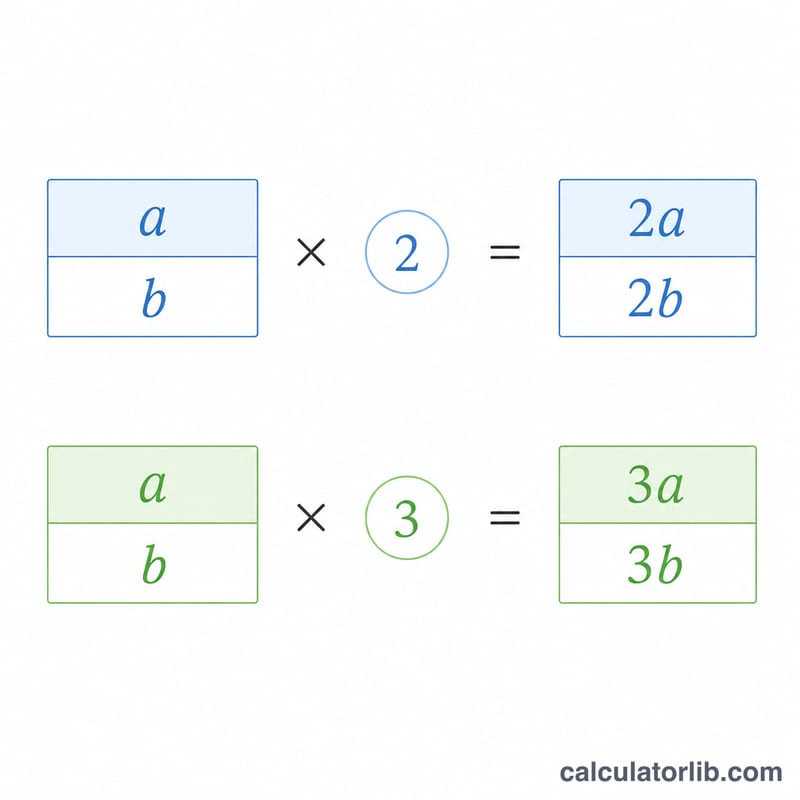
Each example below finds the LCD as the least common multiple of the denominators. It then rewrites every fraction over that LCD by multiplying the numerator and denominator by the same factor, \(\text{LCD} \div d\).
Example 1: Co-prime denominators (2/3 and 4/5)
- The denominators are 3 and 5.
- 3 and 5 have no common factor other than 1, so \(\gcd(3, 5) = 1\).
- When the gcd is 1, the lcm is just the product: $$\operatorname{lcm}(3, 5) = \frac{3 \times 5}{\gcd(3,5)} = \frac{15}{1} = 15$$
- LCD = 15
- Rewrite each fraction: $$\frac{2}{3} = \frac{2 \times 5}{3 \times 5} = \frac{10}{15}, \qquad \frac{4}{5} = \frac{4 \times 3}{5 \times 3} = \frac{12}{15}$$
Example 2: A whole number mixed with fractions (3, 2/9 and 5/12)
- Write the whole number as a fraction over 1: \(3 = \frac{3}{1}\). The denominators are 1, 9 and 12.
- A denominator of 1 never changes the lcm, because \(\operatorname{lcm}(1, n) = n\).
- Find \(\operatorname{lcm}(9, 12)\). Since \(\gcd(9, 12) = 3\): $$\operatorname{lcm}(9, 12) = \frac{9 \times 12}{3} = \frac{108}{3} = 36$$
- LCD = 36
- Rewrite each term: $$\frac{3}{1} = \frac{3 \times 36}{1 \times 36} = \frac{108}{36}, \qquad \frac{2}{9} = \frac{2 \times 4}{9 \times 4} = \frac{8}{36}, \qquad \frac{5}{12} = \frac{5 \times 3}{12 \times 3} = \frac{15}{36}$$
Example 3: Four fractions (1/6, 3/10, 7/15 and 1/4)
For more than two denominators, apply the lcm two numbers at a time, carrying the running result forward.
- The denominators are 6, 10, 15 and 4.
- \(\gcd(6, 10) = 2\), so \(\operatorname{lcm}(6, 10) = \frac{6 \times 10}{2} = \frac{60}{2} = 30\).
- \(\gcd(30, 15) = 15\), so \(\operatorname{lcm}(30, 15) = \frac{30 \times 15}{15} = \frac{450}{15} = 30\). Since 15 already divides 30, the result stays the same.
- \(\gcd(30, 4) = 2\), so \(\operatorname{lcm}(30, 4) = \frac{30 \times 4}{2} = \frac{120}{2} = 60\).
- LCD = 60
- Rewrite each fraction: $$\frac{1}{6} = \frac{1 \times 10}{6 \times 10} = \frac{10}{60}, \quad \frac{3}{10} = \frac{3 \times 6}{10 \times 6} = \frac{18}{60}, \quad \frac{7}{15} = \frac{7 \times 4}{15 \times 4} = \frac{28}{60}, \quad \frac{1}{4} = \frac{1 \times 15}{4 \times 15} = \frac{15}{60}$$
| Fractions | Denominators | LCD | Rewritten over the LCD |
|---|---|---|---|
| 2/3, 4/5 | 3, 5 | 15 | 10/15, 12/15 |
| 3, 2/9, 5/12 | 1, 9, 12 | 36 | 108/36, 8/36, 15/36 |
| 1/6, 3/10, 7/15, 1/4 | 6, 10, 15, 4 | 60 | 10/60, 18/60, 28/60, 15/60 |
How to Find the LCD by Hand (Prime Factorization Method)
The LCD is the smallest number that every denominator divides into evenly. Prime factorization finds it directly. The example below uses the denominators 4, 8 and 6.
- List the denominators. Write a whole number as a fraction over 1. For a mixed number, convert it to an improper fraction first; the denominator stays the same. Here the denominators are 4, 8 and 6.
- Break each denominator into prime factors. $$4 = 2^2, \qquad 8 = 2^3, \qquad 6 = 2 \times 3$$
- For each prime, take the highest power that appears. The prime 2 appears as \(2^2\), \(2^3\) and \(2^1\), so the highest power is \(2^3\). The prime 3 appears only as \(3^1\).
- Multiply those highest powers together. $$\text{LCD} = 2^3 \times 3 = 8 \times 3 = 24$$ This gives 24, the same answer as the earlier example.
- Rescale each numerator. Multiply each numerator by \(\text{LCD} \div \text{denominator}\). For example, with 1/4, 3/8 and 5/6: $$\frac{1}{4} = \frac{1 \times 6}{24} = \frac{6}{24}, \qquad \frac{3}{8} = \frac{3 \times 3}{24} = \frac{9}{24}, \qquad \frac{5}{6} = \frac{5 \times 4}{24} = \frac{20}{24}$$
Alternative: the a × b / gcd method with the Euclidean algorithm
For two denominators, \(\operatorname{lcm}(a, b) = \frac{a \times b}{\gcd(a, b)}\). The Euclidean algorithm finds the gcd quickly. Divide the larger number by the smaller one, replace the pair with the smaller number and the remainder, and repeat until the remainder is 0. The last non-zero remainder is the gcd. For 8 and 6:
$$8 = 1 \times 6 + 2, \qquad 6 = 3 \times 2 + 0 \;\Rightarrow\; \gcd(8, 6) = 2$$$$\operatorname{lcm}(8, 6) = \frac{8 \times 6}{2} = \frac{48}{2} = 24$$Then combine with the remaining denominator 4. Since \(\gcd(24, 4) = 4\), \(\operatorname{lcm}(24, 4) = \frac{24 \times 4}{4} = 24\), so the LCD is still 24. With three or more denominators, keep applying the formula pairwise to the running result.
Frequently Asked Questions
Does the numerator affect the LCD? No. The LCD depends only on the denominators, so the calculator uses just the part after each slash.
What if I enter a whole number like 5? A whole number is treated as 5/1, giving it a denominator of 1, which never changes the LCM.
Is the LCD the same as the LCM? Yes — the least common denominator of a set of fractions is exactly the least common multiple of their denominators.