
What Is the Man-Hours Calculator?
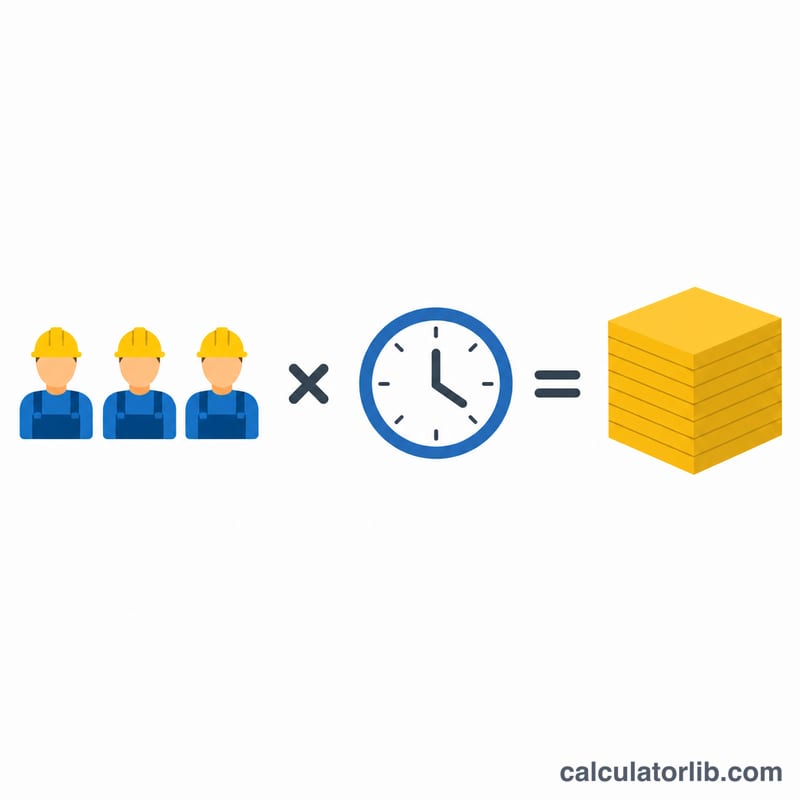
A man-hour (also called a person-hour) is the amount of work performed by one worker in one hour. This calculator gives you the total man-hours required for a task or project by combining the number of workers with the hours each worker puts in. It is a universal measure used in project management, construction, manufacturing, and labor cost estimation.
How to Use It
Enter the number of workers assigned to the job and the number of hours each worker works. Click calculate and the tool returns the total man-hours. This figure is useful for scheduling, comparing crew sizes, estimating wages, and tracking productivity.
The Formula Explained
The calculation is straightforward multiplication:
$$\text{Man-Hours} = \text{Number of Workers} \times \text{Hours Worked per Worker}$$
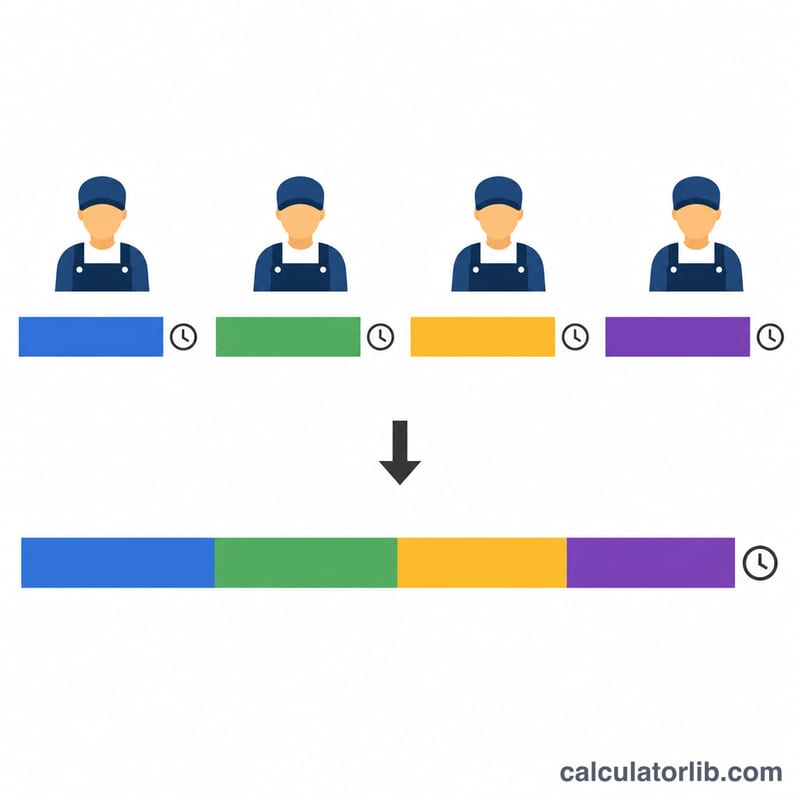
If different workers log different hours, sum each worker's hours individually, or use the average hours per worker for an estimate.
Worked Example
Suppose a crew of 12 workers each works an 8-hour shift. The total man-hours equal \(12 \times 8 = 96\) man-hours. If you knew the project required 480 man-hours total, you could then estimate it would take \(480 \div 96 = 5\) such days to complete.
Man-Hours Across Common Crew and Shift Scenarios
Man-hours are simply the product of crew size and hours worked per person: \( \text{Man-Hours} = \text{Workers} \times \text{Hours per Worker} \). The table below applies that product to a fixed workload of 480 man-hours — a figure chosen only as a round example — and shows how the same total labor input can be delivered by very different crews over very different calendar spans.
| Workers | Hours per Worker per Day | Total Man-Hours per Day | Days to Complete a 480 Man-Hour Job | Elapsed Calendar Days |
|---|---|---|---|---|
| 2 | 8 | 16 | 30 | 30 working days (about 6 five-day weeks) |
| 4 | 8 | 32 | 15 | 15 working days (about 3 weeks) |
| 6 | 10 | 60 | 8 | 8 working days (about 1.5 weeks) |
| 12 | 8 | 96 | 5 | 5 working days (1 week) |
| 20 | 12 | 240 | 2 | 2 days |
Two points are worth reading directly off the table. First, the total man-hours required for a fixed workload do not change: every row still consumes 480 man-hours in total (16 × 30, 32 × 15, 60 × 8, 96 × 5, 240 × 2). Only the elapsed time shrinks as you add workers or lengthen shifts. Man-hours measure labor input; calendar days measure schedule.
Second, real output rarely scales linearly. Doubling the crew seldom halves the duration in practice, because of crowding and trade stacking in a limited work area, extra supervision and coordination overhead, tasks that cannot be split or that must wait on a predecessor, equipment or access bottlenecks, and fatigue on extended shifts. Long 10- and 12-hour days in particular tend to deliver fewer productive hours per paid hour than an 8-hour day. Treat the "days to complete" column as an arithmetic baseline to be adjusted with judgement or a productivity factor, not as a schedule promise.
Interpreting Your Man-Hours Result
The number this calculator returns is a quantity of labor input, expressed in man-hours (person-hours). On its own it is neutral — it becomes useful when read in one of three standard ways.
1. As a cost
Multiply man-hours by an average loaded (fully burdened) hourly rate — wages plus payroll taxes, insurance, benefits and any agreed overhead or markup:
$$\text{Labor Cost} = \text{Man-Hours} \times \text{Loaded Rate per Hour}$$
For example, 480 man-hours at a loaded rate of 45 per hour gives 480 × 45 = 21,600 in labor cost. Rates vary enormously by country, trade, union agreement and year, so use your own local figures; a bare wage rate will understate true cost, often substantially.
2. As a duration
Divide the man-hours the job requires by the man-hours your crew can supply per day:
$$\text{Days} = \frac{ {\text{Required Man-Hours}}}{\text{Man-Hours Available per Day}}$$
With a 6-person crew on 10-hour shifts, availability is 60 man-hours per day, so a 480 man-hour job needs 480 ÷ 60 = 8 working days. Working days then have to be mapped onto the calendar, allowing for weekends, holidays, weather and shift patterns.
3. As a productivity or unit rate
Divide output by labor input to get productivity, or invert it to get a unit rate:
$$\text{Productivity} = \frac{ {\text{Output Quantity}}}{\text{Man-Hours}} \qquad \text{Unit Rate} = \frac{ {\text{Man-Hours}}}{\text{Output Quantity}}$$
If a crew lays 640 m² of blockwork in 480 man-hours, productivity is 640 ÷ 480 ≈ 1.33 m² per man-hour, and the unit rate is 480 ÷ 640 = 0.75 man-hours per m². Unit rates (man-hours per m², per linear metre, per tonne of steel erected, per weld, per unit assembled) are the normal currency of construction and industrial estimating, because they let you scale a historical crew performance onto a new quantity take-off.
What man-hours do not tell you
- They are not schedule time. 240 man-hours can be one person for six weeks or twenty people for a day and a half. Never quote man-hours to a client as a completion date.
- They assume linear scaling. The multiplication ignores diminishing returns from crowding a work face, the learning curve on early repetitions of an unfamiliar task, fatigue and error rates during sustained overtime, and the coordination load that grows with crew size.
- They hide non-productive time unless you account for it: travel between work areas, tool and material fetching, rework, waiting on permits, inspections, equipment or other trades.
For that reason most estimating and cost-control practices distinguish direct productive man-hours (hands actually on the task) from paid hours (everything on the timesheet, including paid breaks, toolbox talks, standby and idle time). The ratio between them — sometimes expressed as a utilization rate or wrapped into a productivity factor — is what separates a raw multiplication from a credible estimate. Decide which of the two your input hours represent before you use the result, and be consistent: cost estimates generally need paid hours, while productivity benchmarks need productive hours.
Key Terms and Definitions
Terminology in labor estimating varies between industries and countries; the definitions below reflect common usage rather than any single legal standard.
| Term | Definition and units |
|---|---|
| Man-hour / person-hour | One person working for one hour. The base unit of labor input. Man-hour and person-hour are interchangeable and numerically identical; person-hour (or labour hour) is the preferred gender-neutral term and is what most modern standards and style guides use. This page keeps "man-hour" only because it remains the most common search term. |
| Man-day (person-day) | Man-hours divided by a standard workday: \( \text{Man-Days} = \text{Man-Hours} \div \text{Hours per Workday} \). A workday of 8 h is the most common convention, so 96 man-hours = 12 man-days — but always state the assumed day length, since 7.5 h and 10 h conventions are also used. |
| Man-month (person-month) | One person's output for one nominal month. There is no universal figure; it is typically defined as a stated number of working days (often about 20–22) times the standard workday, so roughly 160–176 h in an 8-hour-day convention. Because the convention varies by organisation, a man-month figure should never be compared across sources without checking its definition. |
| Crew-hour | One complete crew working for one hour. Converting to labor input: 1 crew-hour = crew size in man-hours. A 5-person crew for 6 hours = 6 crew-hours = 30 man-hours. |
| FTE (full-time equivalent) | A headcount-equivalent unit: total hours divided by the hours one full-time employee works in the period. In the United States the annual convention is commonly 2,080 paid hours (40 h/week × 52 weeks) before deducting leave; many other countries use a lower figure reflecting shorter statutory weeks or more mandated leave, so state your basis. 1,040 hours of work in a US-convention year = 0.5 FTE. |
| Direct labor hours | Hours spent working on the deliverable itself — installing, fabricating, assembling. Normally charged to a specific cost code or work package. |
| Indirect labor hours | Hours that support the work without directly producing it: supervision, planning, quality control, safety, scaffolding and temporary works, site cleanup, material handling. Usually carried as overhead or as separate indirect accounts. |
| Productive hours vs paid hours | Productive hours are hours of actual task output; paid hours are all hours on the timesheet, including paid breaks, briefings, travel allowances, standby and idle time. Paid hours are always ≥ productive hours. Mixing the two is the most frequent source of error in labor estimates. |
| Unit rate | Man-hours per unit of output — man-hours per m² of plaster, per linear metre of pipe, per tonne of steel, per assembled unit. It is the reciprocal of productivity and the standard building block of detailed estimates: \( \text{Man-Hours} = \text{Quantity} \times \text{Unit Rate} \). |
| Productivity factor (PF) | A dimensionless multiplier comparing actual to budgeted/baseline performance, or adjusting a benchmark rate for local conditions (weather, congestion, overtime, skill level, remoteness). Defined as actual man-hours ÷ earned or baseline man-hours, a PF above 1.0 means the work is taking more hours than planned; some organisations define it the other way round, so check the sign convention. |
| Elapsed hours (clock hours) | Hours of wall-clock time from start to finish, regardless of how many people are working. Elapsed hours = man-hours only when exactly one person works. Schedules are built in elapsed time; budgets in man-hours. |
| Utilization rate | The share of available or paid hours that is actually productive (or, in services, billable): \( \text{Utilization} = \text{Productive Hours} \div \text{Available Hours} \times 100\% \). Used to convert nominal crew availability into realistic capacity. |
FAQ
What is the difference between man-hours and hours? One hour of elapsed time can represent many man-hours if multiple people work simultaneously. Five workers for one hour equals five man-hours but only one clock-hour.
How do I convert man-hours to man-days? Divide total man-hours by the length of a standard workday (often 8 hours). \(96 \div 8 = 12\) man-days.
Can I use fractional hours? Yes. Enter decimal values such as 7.5 hours to reflect partial shifts or break time.