What is the mL to Grams Calculator?
Milliliters (mL) measure volume while grams (g) measure mass, so you can't convert between them without knowing the substance's density. This calculator multiplies the volume you enter by the density (in grams per milliliter) to give the weight in grams. It's perfect for cooking, baking, chemistry homework and lab work where a recipe or method lists volume but your scale reads in grams.
How to use it
Enter the volume in milliliters, then type the density of your substance in g/mL or pick one from the preset list (water, milk, oil, honey, ethanol, flour, sugar). The result instantly shows the equivalent weight in grams, kilograms and ounces.
The formula explained
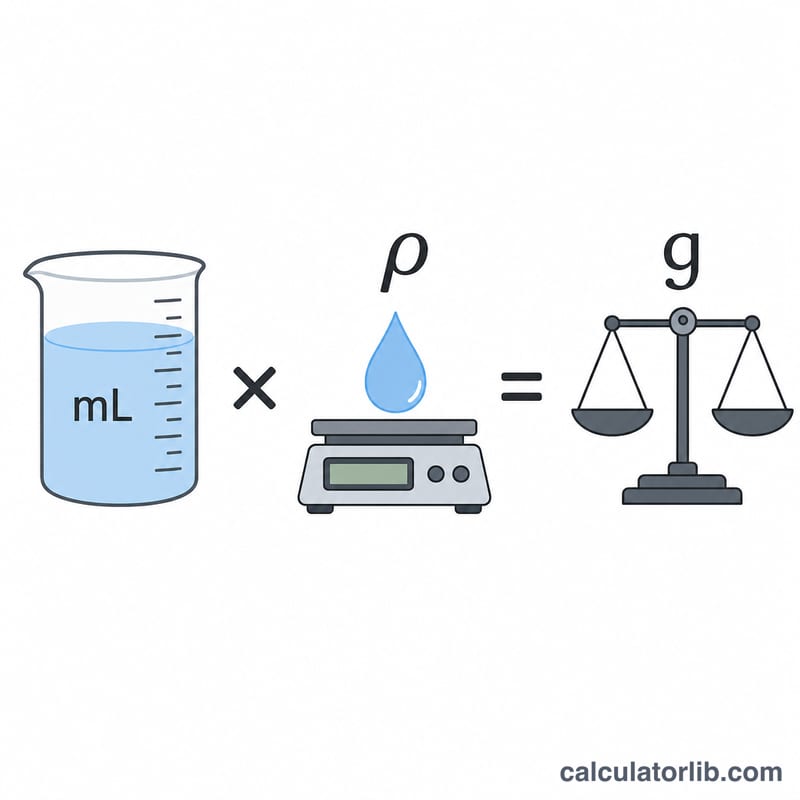
The conversion is simply:
$$\text{grams} = \text{mL} \times \text{density (g/mL)}$$
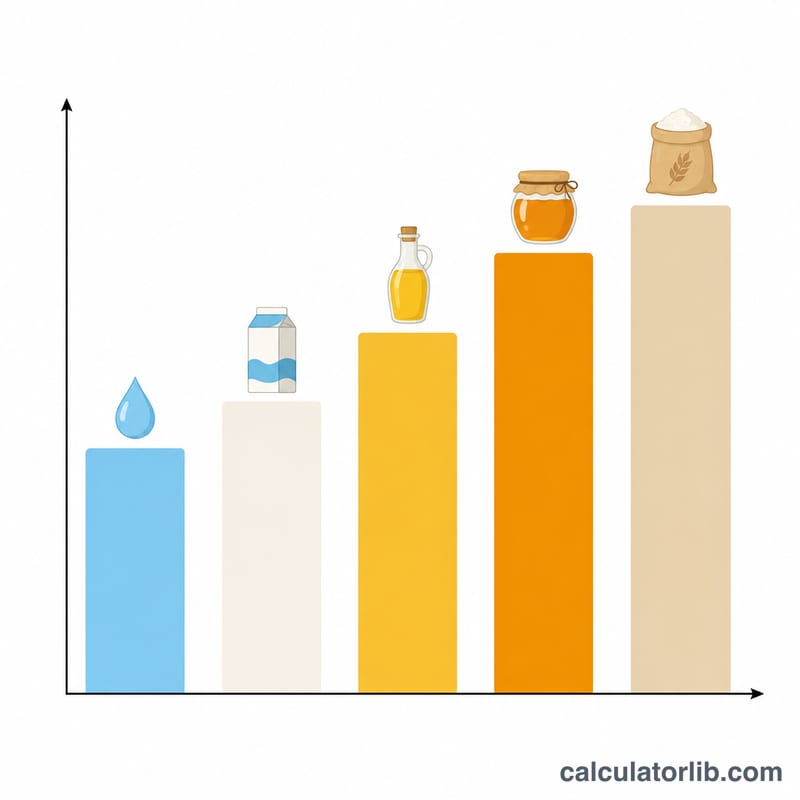
Pure water has a density of about \(1.00\) g/mL, which is why 100 mL of water weighs 100 g. Denser liquids like honey (\(\approx 1.42\) g/mL) weigh more per mL, while lighter ones like oil (\(\approx 0.92\) g/mL) weigh less.
Worked example
Suppose you have 250 mL of milk with a density of 1.03 g/mL. The weight is $$250 \times 1.03 = 257.5 \text{ g}$$ (about 0.2575 kg or 9.08 oz).
Common Densities for mL to Grams Conversion
To convert volume to mass, use \(\text{Mass (g)} = \text{Volume (mL)} \times \text{Density (g/mL)}\). The densities below are approximate values at about 20°C. Real products vary by brand, temperature and composition.
| Substance | Density (g/mL) | Grams per 100 mL | Grams per 250 mL |
|---|---|---|---|
| Water | 1.00 | 100 | 250 |
| Whole milk | ~1.03 | 103 | 257.5 |
| Vegetable oil | ~0.92 | 92 | 230 |
| Honey | ~1.42 | 142 | 355 |
| Ethanol | ~0.789 | 78.9 | 197.25 |
| Sugar (granulated) | ~0.85 | 85 | 212.5 |
| All-purpose flour | ~0.53 | 53 | 132.5 |
| Maple syrup | ~1.33 | 133 | 332.5 |
| Butter | ~0.911 | 91.1 | 227.75 |
Note on powders: The values for sugar and flour are bulk densities. They change with packing, sifting and humidity. A cup of scooped flour can weigh noticeably more than a cup of sifted flour. For baking, weighing on a scale is more reliable than measuring by volume.
Quick mL to Grams Conversion Chart
Each value is mL × density, using these densities: water 1.00 g/mL, whole milk 1.03 g/mL, vegetable oil 0.92 g/mL, honey 1.42 g/mL. Results are in grams.
| Volume (mL) | Water (g) | Milk (g) | Oil (g) | Honey (g) |
|---|---|---|---|---|
| 5 | 5 | 5.15 | 4.6 | 7.1 |
| 15 | 15 | 15.45 | 13.8 | 21.3 |
| 30 | 30 | 30.9 | 27.6 | 42.6 |
| 60 | 60 | 61.8 | 55.2 | 85.2 |
| 100 | 100 | 103 | 92 | 142 |
| 240 | 240 | 247.2 | 220.8 | 340.8 |
| 250 | 250 | 257.5 | 230 | 355 |
| 500 | 500 | 515 | 460 | 710 |
| 1000 | 1000 | 1030 | 920 | 1420 |
Example: 240 mL of honey is \(240 \times 1.42 =\) 340.8 g.
Same Volume, Different Weights
100 mL of each liquid, with the percentage difference from water (100 g), calculated as \((\text{grams} - 100) / 100\).
| Liquid | Density (g/mL) | Mass of 100 mL (g) | Difference from water |
|---|---|---|---|
| Vegetable oil | 0.92 | 92 | −8% |
| Water | 1.00 | 100 | 0% (reference) |
| Whole milk | 1.03 | 103 | +3% |
| Honey | 1.42 | 142 | +42% |
Equal volumes do not weigh the same. Oil is lighter than water, which is why it floats on it. Honey is about 42% heavier, so a recipe that gives honey in mL and one that gives it in grams can differ a lot if you assume 1 mL = 1 g.
FAQ
Is 1 mL always 1 gram? Only for substances with a density of exactly 1 g/mL, such as pure water at 4°C. Other materials differ.
Where do I find the density? Check a reference table or the product label. The presets above cover common kitchen ingredients.
Does temperature matter? Yes, density changes slightly with temperature, but for everyday cooking the listed values are accurate enough.