
What Is the BMI Calculator?
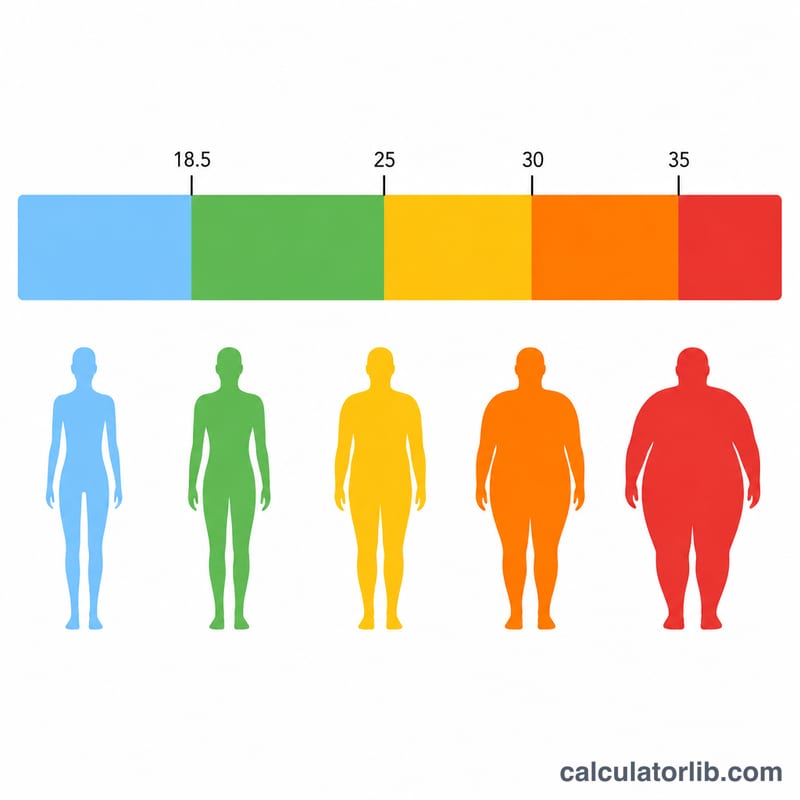
The Body Mass Index (BMI) Calculator estimates whether your weight is in a healthy range relative to your height. BMI is a simple, internationally recognized screening number used by health professionals worldwide. It does not measure body fat directly, but it gives a quick indication of whether you may be underweight, at a normal weight, overweight, or in the obese range.
How to Use It
Enter your weight in kilograms and your height in centimeters, then submit. The calculator converts your height to meters, applies the BMI formula, and shows both your numeric BMI and the matching weight category.
The Formula Explained
BMI is defined as weight in kilograms divided by the square of height in meters: \(\text{BMI} = \text{weight} \div \text{height}^2\). Since most people record height in centimeters, the tool first divides centimeters by 100 to get meters. The result is expressed in kg/m².
$$\text{BMI} = \frac{\text{Weight (kg)}}{\left(\dfrac{\text{Height (cm)}}{100}\right)^2}$$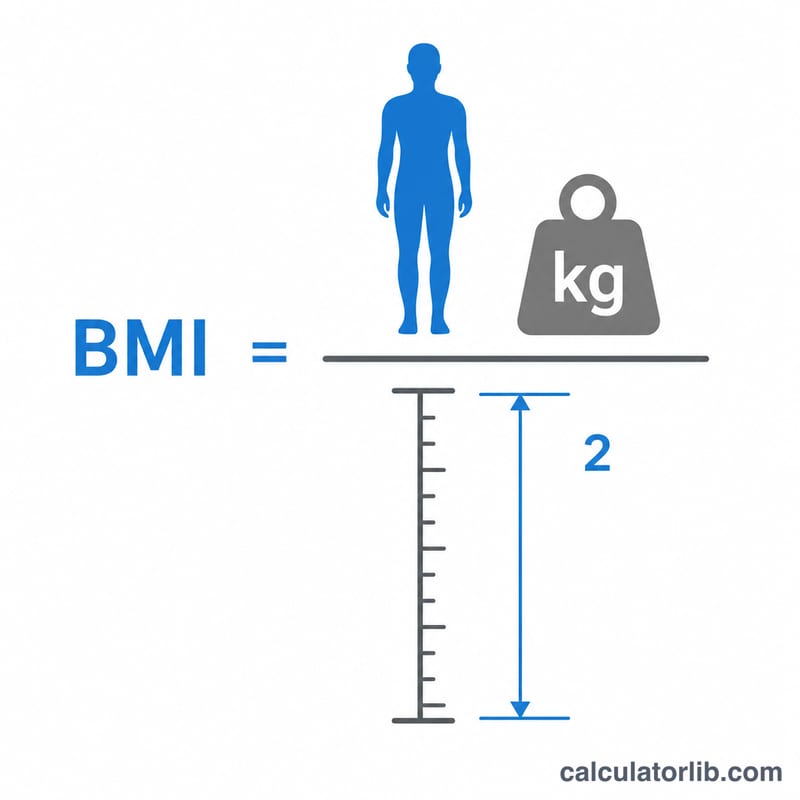
Worked Example
Suppose you weigh 70 kg and stand 175 cm tall. First convert height: 175 cm = 1.75 m. Square it: \(1.75 \times 1.75 = 3.0625\). Then divide: \(70 \div 3.0625 \approx 22.86\). A BMI of about 22.9 falls in the "Normal weight" range (18.5–24.9).
FAQ
What BMI is considered healthy? A BMI between 18.5 and 24.9 is generally considered a healthy weight for most adults.
Does BMI work for everyone? BMI is a general screening tool. It can misclassify very muscular athletes or older adults with reduced muscle mass, so use it as a guide rather than a diagnosis.
Is BMI the same for children? No. Children and teens use age- and sex-specific BMI percentiles, so this adult formula is not appropriate for them.