
What is stopping distance?
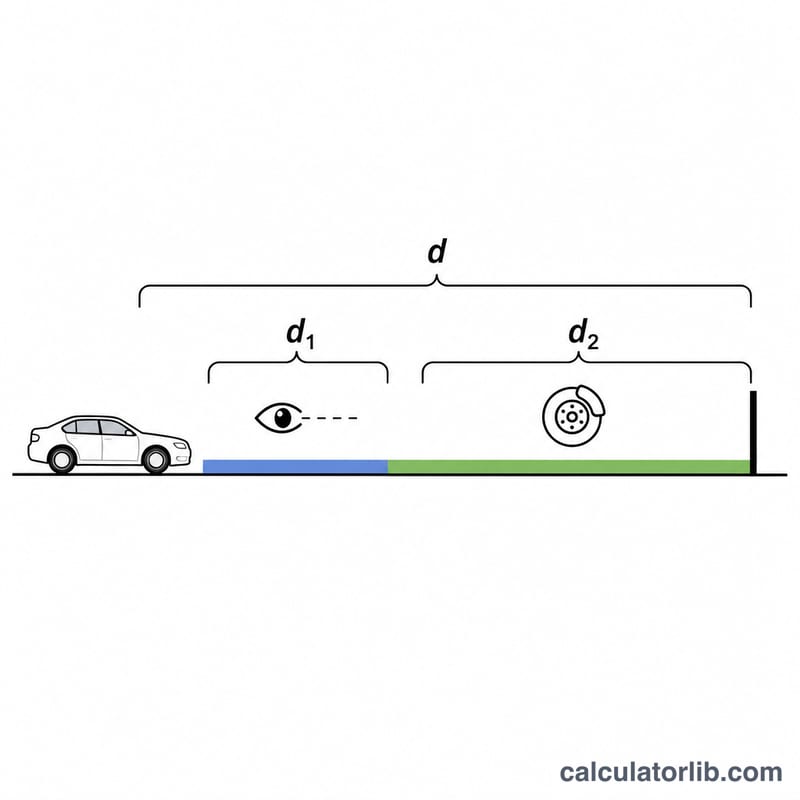
Stopping distance is the total distance a vehicle travels from the moment a hazard appears until it comes to a complete stop. It has two parts: the reaction distance covered while the driver perceives the hazard and moves to the brake, and the braking distance covered once the brakes are applied. This calculator is a universal physics model that works for any vehicle, road and unit-consistent inputs.
How to use it
Enter your travel speed in km/h, your reaction time in seconds (a typical alert driver is around 1.0–1.5 s), the friction coefficient between tires and road (about 0.7 on dry asphalt, 0.4 on wet roads, 0.1 on ice), and the gravitational acceleration (9.81 m/s²). The calculator converts speed to m/s and returns the reaction, braking and total distances in meters.
The formula explained
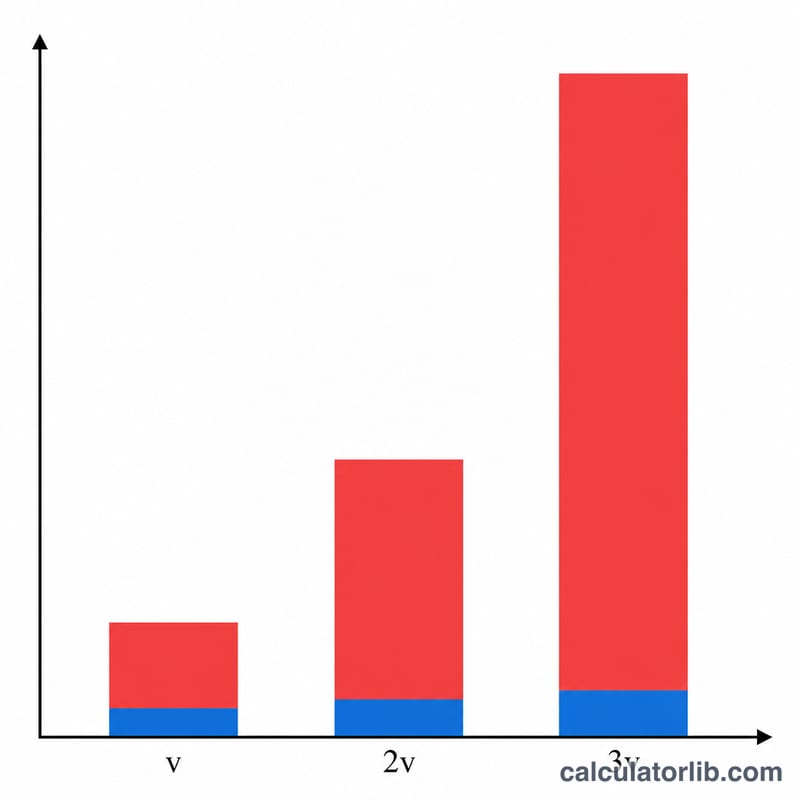
Braking distance comes from energy conservation: kinetic energy \(\tfrac{1}{2}mv^{2}\) equals the work done by friction \((\mu m g \cdot d)\), so \(d = \frac{v^{2}}{2\mu g}\). Reaction distance is simply speed multiplied by reaction time, \(v \cdot t\). Adding them gives total stopping distance $$d = v \cdot t + \frac{v^{2}}{2\mu g}.$$ Note that braking distance grows with the square of speed — doubling your speed roughly quadruples the braking distance.
Worked example
At 100 km/h (27.78 m/s) with a 1.5 s reaction time and \(\mu = 0.7\) on dry road: reaction distance $$= 27.78 \times 1.5 \approx 41.67 \text{ m}.$$ Braking distance $$= \frac{27.78^{2}}{2 \times 0.7 \times 9.81} \approx \frac{771.6}{13.734} \approx 56.19 \text{ m}.$$ Total stopping distance \(\approx 97.86 \text{ m}\).
FAQ
Does this account for road slope? No — it assumes a flat surface. Downhill grades increase distance.
What friction value should I use? Roughly 0.7 dry, 0.4 wet, 0.1–0.2 icy or snowy.
Why convert km/h to m/s? The physics formula uses SI units, so speed must be in meters per second (divide km/h by 3.6).