
What Is Braking Distance?
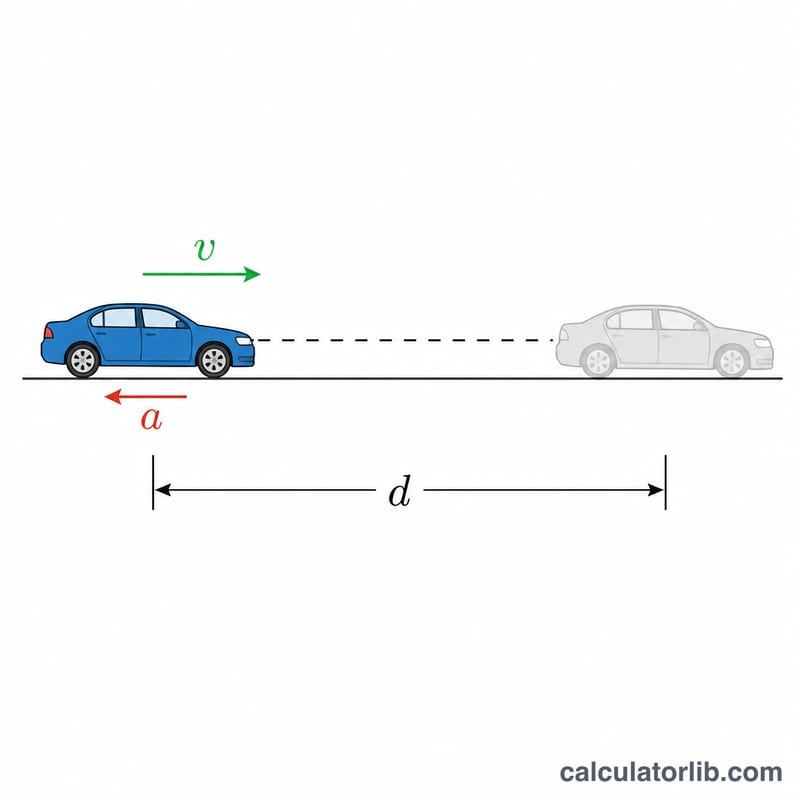
Braking distance is the distance an object travels while decelerating from its initial speed to a complete stop. Assuming a constant (uniform) deceleration, it depends only on the starting speed and the rate of deceleration. This calculator uses the kinematic equation \(d = v^2 / (2 \cdot a)\), where v is the initial speed and a is the magnitude of the deceleration.
How to Use It
Enter the initial speed in metres per second (m/s) and the deceleration in metres per second squared (m/s²). The calculator returns the braking distance in metres and the time it takes to come to a stop. To convert from km/h to m/s, divide by 3.6; to convert from mph, multiply by 0.447.
The Formula Explained
Starting from the equation of motion \(v^2 = v_0^2 - 2a \cdot d\) and setting the final speed v to zero, we solve for d to get
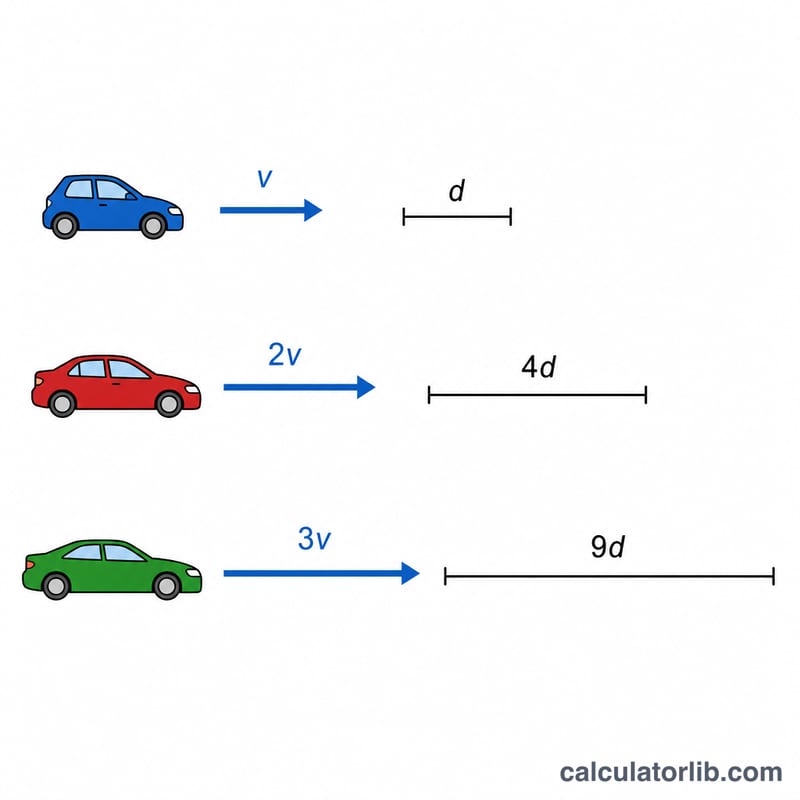
$$d = \frac{v_0^2}{2a}$$Because speed is squared, doubling your speed quadruples the braking distance — a key reason higher speeds are disproportionately dangerous. The stopping time follows from \(t = v / a\).
Worked Example
A car travelling at 20 m/s (about 72 km/h) brakes with a deceleration of 5 m/s². The braking distance is
$$d = \frac{20^2}{2 \times 5} = \frac{400}{10} = 40 \text{ metres}$$and the time to stop is
$$t = \frac{20}{5} = 4 \text{ seconds}$$FAQ
Does this include reaction distance? No. This is pure braking distance. Total stopping distance also includes the reaction distance travelled before the brakes are applied.
What deceleration value should I use? A typical car on dry asphalt decelerates at roughly 7–8 m/s²; on wet or icy roads it is much lower. Use a value appropriate to your conditions.
Why must deceleration be positive? The formula divides by \(2a\), so a zero or negative value is invalid (the object would never stop). The calculator guards against division by zero.