What Is a Significant Figures Calculator?
Significant figures (sig figs) are the digits in a number that carry real measurement meaning. This calculator does two jobs at once: it counts how many significant figures a number contains, and it rounds that number to a precision you choose. It's a universal math tool used in chemistry, physics, engineering and everyday science homework — no country or unit assumptions apply.
How to Use It
Enter the number exactly as written (keep trailing zeros and the decimal point, since they affect the count). Then choose how many significant figures you want to round to. The result shows the sig-fig count of your original number plus the rounded value.
The Rules Explained
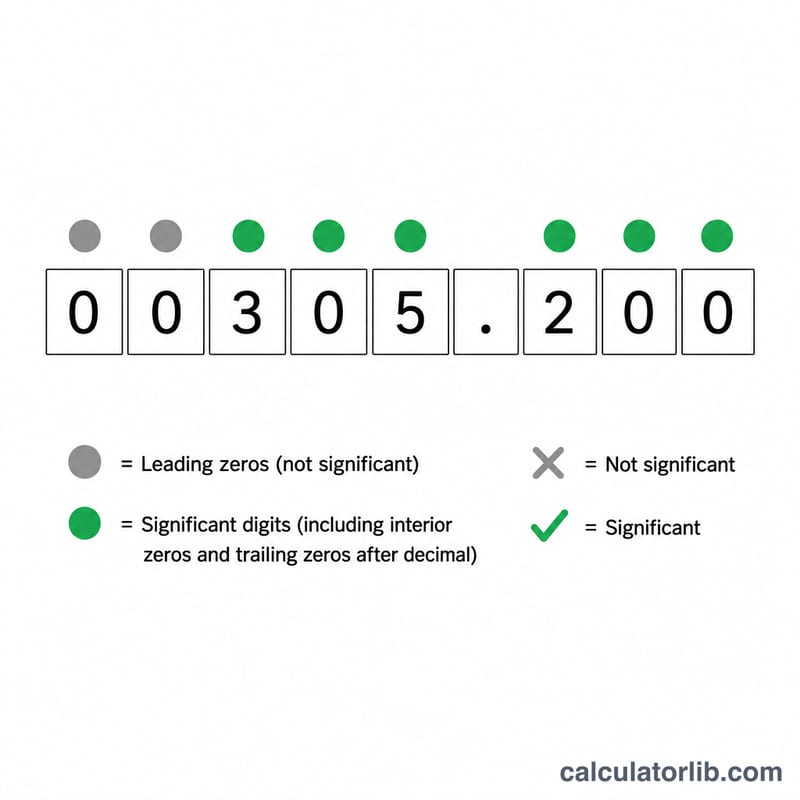
The counting rules are: (1) every non-zero digit is significant; (2) zeros between non-zero digits are significant; (3) leading zeros are never significant; (4) trailing zeros are significant only when the number contains a decimal point. For rounding, we find the power of ten needed so that the first n significant digits sit just before the decimal, round to the nearest whole number, then scale back.
$$\text{Rounded} = \frac{\operatorname{round}\!\left(\text{Number} \times 10^{\,p}\right)}{10^{\,p}} \qquad p = \text{Sig figs} - \left\lceil \log_{10}\left|\text{Number}\right| \right\rceil$$
Worked Example
Take 0.0045600. The leading zeros (0.00) are not significant. The remaining digits 4, 5, 6, 0, 0 are all significant because a decimal point is present, giving 5 significant figures. Rounding this same value to 3 sig figs scales it to \(4.56\), rounds, and scales back to 0.00456.
More Significant Figure Examples
Example 1: 1500 vs 1500. vs 1.500×10³
The same digits can carry different precision depending on how they are written. Under the usual textbook convention:
- 1500: no decimal point, so the trailing zeros are treated as placeholders. Only 1 and 5 are counted, giving 2 sig figs. This is ambiguous, because the measurement might really be good to 3 or 4 digits.
- 1500.: the decimal point marks every digit as measured: 1, 5, 0, 0 gives 4 sig figs.
- 1.500×10³: in scientific notation every digit in the coefficient counts: 1, 5, 0, 0 gives 4 sig figs.
To remove the ambiguity of 1500, write it in scientific notation: 1.5×10³ (2 sig figs), 1.50×10³ (3) or 1.500×10³ (4).
Example 2: Count and round 120.050
Count: the digits are 1, 2, 0, 0, 5, 0.
- The first 0 and second 0 are sandwiched between non-zero digits (2 and 5), so they count.
- The final 0 is a trailing zero after a decimal point, so it counts.
- Total: 6 sig figs.
Round to 4 sig figs: keep 1, 2, 0, 0 and look at what follows, which is 50. Using the formula with \(p = 4 - \lceil \log_{10} 120.05 \rceil = 4 - 3 = 1\):
$$\frac{\operatorname{round}(120.050 \times 10^{1})}{10^{1}} = \frac{\operatorname{round}(1200.5)}{10} = \frac{1201}{10} = 120.1$$
The discarded part is exactly half-way, and the round-half-up rule used here sends it up, giving 120.1. Some fields use round-half-to-even, which would give 120.0 for this value, so check which convention your course or lab requires.
Example 3: Rounding with a carry (98765 and 0.999)
98765 to 2 sig figs: \(p = 2 - \lceil \log_{10} 98765 \rceil = 2 - 5 = -3\).
$$\frac{\operatorname{round}(98765 \times 10^{-3})}{10^{-3}} = \frac{\operatorname{round}(98.765)}{10^{-3}} = 99 \times 1000$$
The dropped part (765) is more than half of 1000, so 98 rounds up to 99, and the result is 99000. The zeros are placeholders, so write it as 9.9×10⁴ to show clearly that it has 2 sig figs.
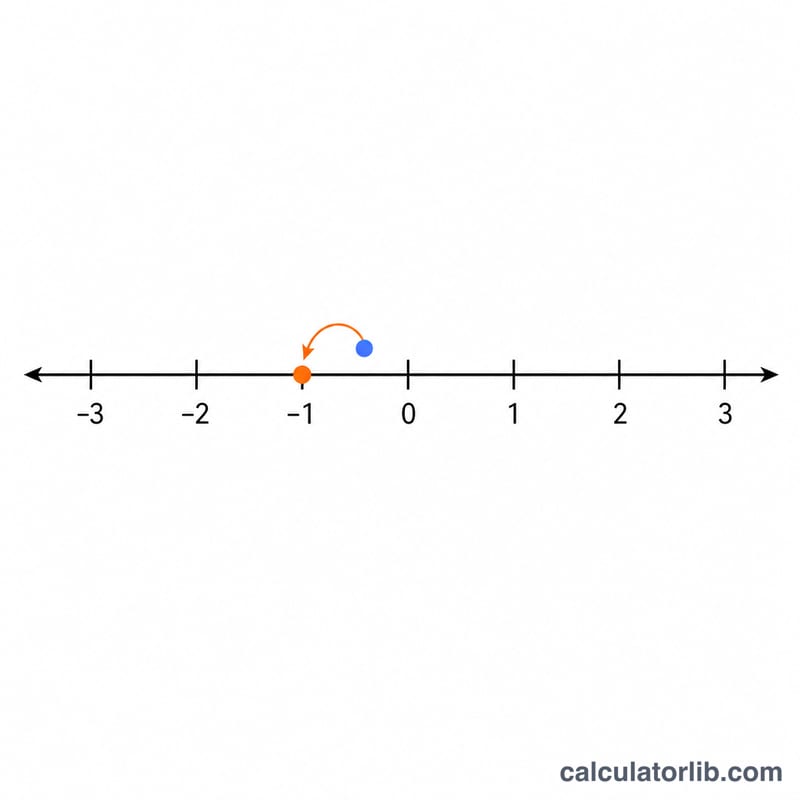
0.999 to 2 sig figs: \(\lceil \log_{10} 0.999 \rceil = 0\), so \(p = 2\).
$$\frac{\operatorname{round}(0.999 \times 10^{2})}{10^{2}} = \frac{\operatorname{round}(99.9)}{100} = \frac{100}{100} = 1$$
The rounding carries through both 9s and the result becomes 1. To keep 2 sig figs it must be written 1.0, because the trailing zero shows the second significant digit.
FAQ
Are trailing zeros always significant? Only when a decimal point is shown. "1500" counts as 2 sig figs, but "1500." or "1500.0" counts more.
Does the calculator handle negative numbers? Yes — the sign is ignored for counting and rounding, then preserved in the result.
Why does rounding 0.0045600 to 3 sig figs show 0.00456? Trailing display zeros may be dropped in plain decimal output, but the value and its 3-sig-fig precision are correct.