What It Is
The Single Usage Electricity Cost Calculator tells you exactly how much it costs to run an electrical appliance one time. Whether you're curious about a load of laundry, an hour of gaming, or boiling the kettle, this tool turns an appliance's wattage and run time into a clear figure on your bill.
How to Use It
Enter three values: the appliance's power rating in watts (usually printed on a label or in the manual), the number of hours you ran it, and your electricity price per kWh (found on your utility bill). The calculator returns the cost of that single usage along with the energy consumed in kilowatt-hours.
The Formula Explained
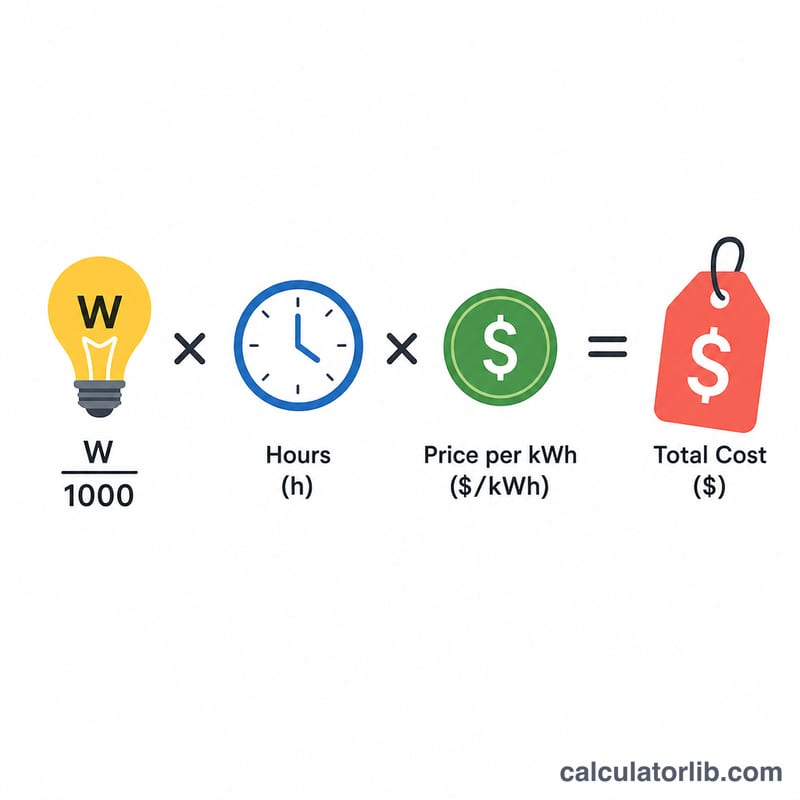
Electricity is billed in kilowatt-hours (kWh). Since power is given in watts, we first divide by 1000 to convert to kilowatts, then multiply by the hours used to get energy, and finally multiply by the price per kWh:
$$\text{Cost} = \frac{\text{Power (W)}}{1000} \times \text{Hours} \times \text{Price per kWh}$$
Worked Example
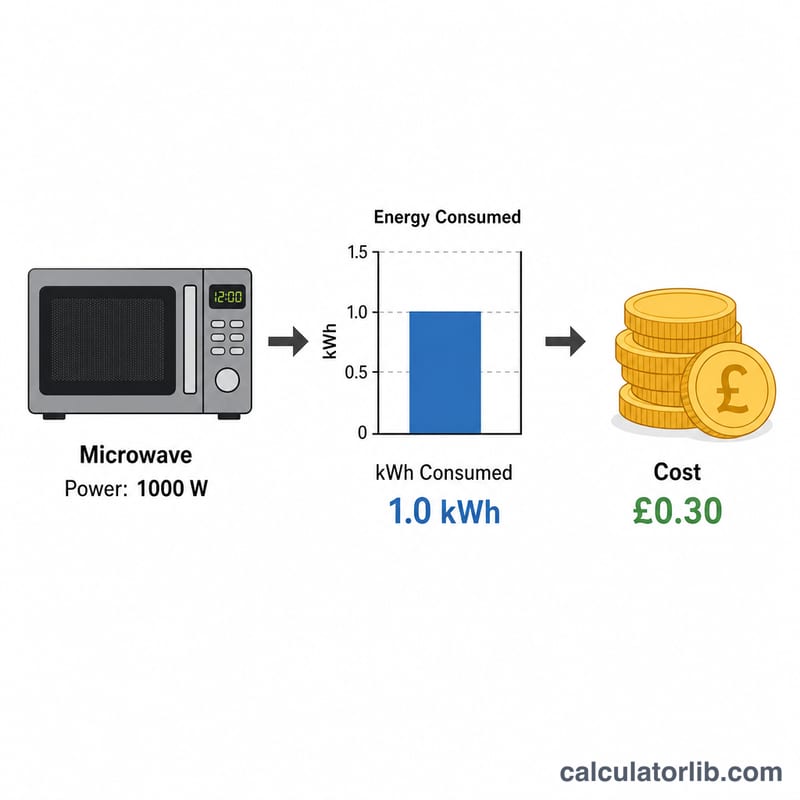
Suppose you run a 1500 W space heater for 3 hours and your electricity costs $0.20 per kWh. Energy used = $$\left(\frac{1500}{1000}\right) \times 3 = 4.5 \text{ kWh}.$$ Cost = $$4.5 \times 0.20 = \mathbf{\$0.90}$$ for that single use.
Typical Appliance Wattage Reference
Use this table to pick a starting value for the power field. The ranges are approximate and vary by model, age, size and settings. The rating label or manual on your appliance is the authoritative figure.
| Appliance | Approximate typical power (W) |
|---|---|
| LED bulb | 5–15 W |
| Laptop (in use) | 30–90 W |
| Television | 50–200 W |
| Microwave oven | 600–1200 W |
| Electric kettle | 1500–3000 W |
| Space heater | 750–1500 W |
| Washing machine | 500–2000 W (higher while heating water) |
| Hair dryer | 1000–1875 W |
Some appliances, such as washing machines, do not draw their maximum power for the whole cycle. The average draw is usually lower than the label's peak value, so the result is an upper-end estimate if you enter the label wattage.
Cost Comparison for Common Single Uses
The table uses an illustrative rate of $0.20 per kWh. Electricity prices differ widely between countries, regions and tariffs, so replace this with the rate on your own bill. The calculation is \(\text{kWh} = \frac{P}{1000} \times h\), then \(\text{Cost} = \text{kWh} \times \text{price}\).
| Scenario | Calculation | Energy (kWh) | Cost at $0.20/kWh |
|---|---|---|---|
| Kettle, 2000 W for 0.05 h (3 min) | \(\frac{2000}{1000} \times 0.05 = 0.1\) | 0.1 | 0.1 × 0.20 = $0.02 |
| Laptop, 60 W for 4 h | \(\frac{60}{1000} \times 4 = 0.24\) | 0.24 | 0.24 × 0.20 = $0.048 (about $0.05) |
| TV, 100 W for 3 h | \(\frac{100}{1000} \times 3 = 0.3\) | 0.3 | 0.3 × 0.20 = $0.06 |
| Space heater, 1500 W for 3 h | \(\frac{1500}{1000} \times 3 = 4.5\) | 4.5 | 4.5 × 0.20 = $0.90 |
| Washing machine, 1000 W for 1 h | \(\frac{1000}{1000} \times 1 = 1\) | 1 | 1 × 0.20 = $0.20 |
High-wattage heating appliances cost far more per use than electronics, even when they run for a similar length of time. The space heater here costs 15 times as much as the TV.
Time and Power Unit Conversions
The calculator expects hours as a decimal number, so convert minutes first (decimal hours = minutes ÷ 60).
| Minutes | Decimal hours |
|---|---|
| 3 | 0.05 |
| 15 | 0.25 |
| 30 | 0.5 |
| 45 | 0.75 |
| 90 | 1.5 |
| Relationship | Value |
|---|---|
| Kilowatts to watts | 1 kW = 1000 W (so 1.5 kW = 1500 W) |
| Power from voltage and current | \(W = V \times A\), e.g. 230 V × 10 A = 2300 W |
| Energy units | 1 kWh = 1000 Wh = 3.6 MJ |
FAQ
Where do I find an appliance's wattage? Look on the rating label (often on the back or bottom) or in the user manual. It may be listed in watts (W) or as volts \(\times\) amps.
What price per kWh should I enter? Use the rate from your most recent electricity bill. It is currency-neutral—enter your local rate and the answer is in your local currency.
Can I use minutes instead of hours? Convert minutes to hours first (divide by 60). For example, 30 minutes = 0.5 hours.