
What Is CAGR?
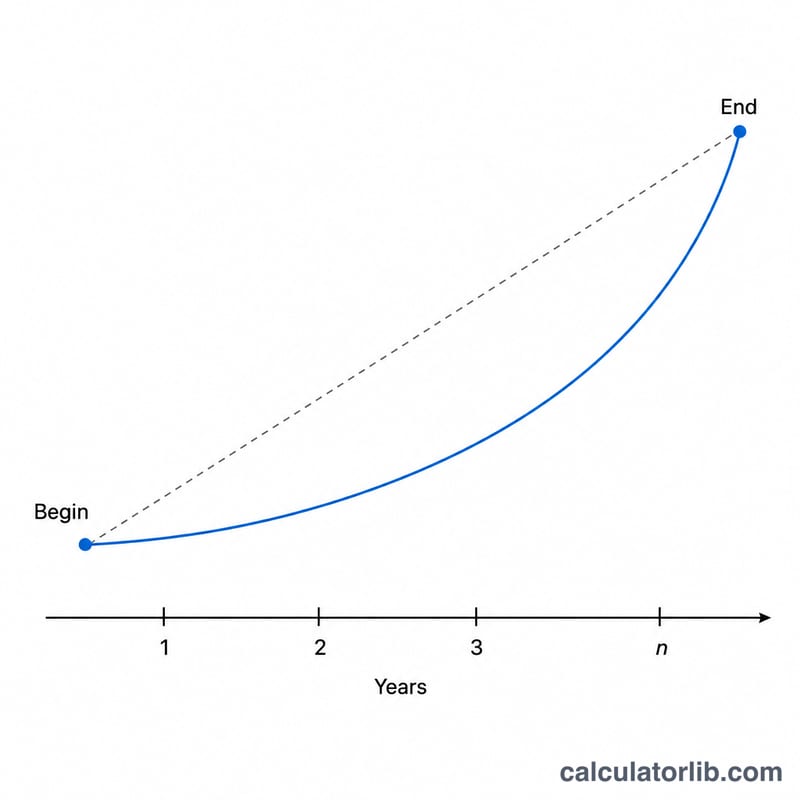
The Compound Annual Growth Rate (CAGR) is the constant yearly rate at which an investment or quantity would have grown to reach its ending value from its beginning value over a given number of years. Unlike a simple average, CAGR accounts for compounding, smoothing out year-to-year volatility into a single annualized figure. It is universal and applies to investments, revenue, populations, or any quantity that grows over time.
How to Use This Calculator
Enter the beginning value, the ending value, and the number of years between them. The calculator returns the CAGR as a percentage, the same rate as a decimal, and the total (non-annualized) growth over the period. The number of years can include fractions (for example, 2.5 years).
The Formula Explained
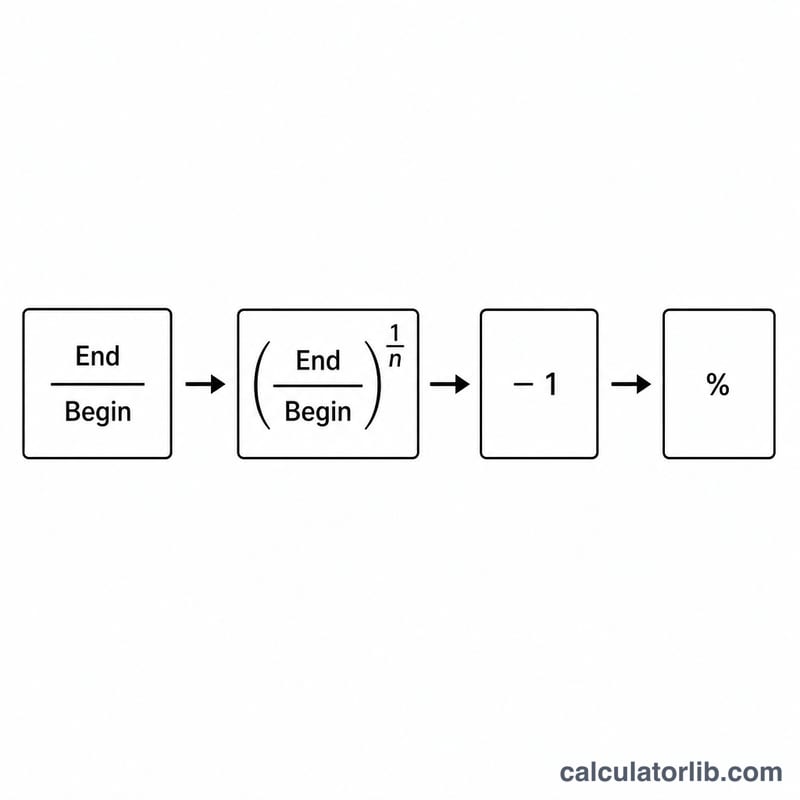
$$\text{CAGR} = \left( \frac{\text{End}}{\text{Begin}} \right)^{\frac{1}{n}} - 1$$ The ratio \(\text{End}/\text{Begin}\) is the total growth multiple. Raising it to the power \(1/n\) finds the equivalent per-year multiple, and subtracting 1 converts it to a rate. Multiply by 100 to express it as a percentage.
Worked Example
Suppose an investment grows from 1,000 to 2,000 over 5 years. $$\text{CAGR} = (2000/1000)^{1/5} - 1 = 2^{0.2} - 1 \approx 1.148698 - 1 = 0.148698$$ or about 14.87% per year. The total growth is \((2000 - 1000)/1000 = 100\%\).
FAQ
Why is CAGR lower than average annual return? Because CAGR reflects compounding and penalizes volatility, it is usually lower than the simple arithmetic average of yearly returns.
Can the beginning value be zero? No. Division by zero is undefined, so the beginning value must be greater than zero.
Does it work for declines? Yes. If the ending value is smaller than the beginning value, CAGR is negative, representing an annual rate of decline.