What It Does
The Temperature Conversion Calculator converts a temperature you enter into all three of the most common scales: Celsius (°C), Fahrenheit (°F) and Kelvin (K). Simply type a value, pick the scale it is currently in, and the calculator returns the equivalent in every other scale at once. It works for any temperature — body temperature, weather, cooking, science labs or engineering.
How to Use It
Enter the numeric temperature in the value field, then choose its current unit from the dropdown (Celsius, Fahrenheit, or Kelvin). The result panel shows the equivalent Celsius value as the main figure, with Fahrenheit and Kelvin listed below. Negative numbers and decimals are fully supported.
The Formula Explained
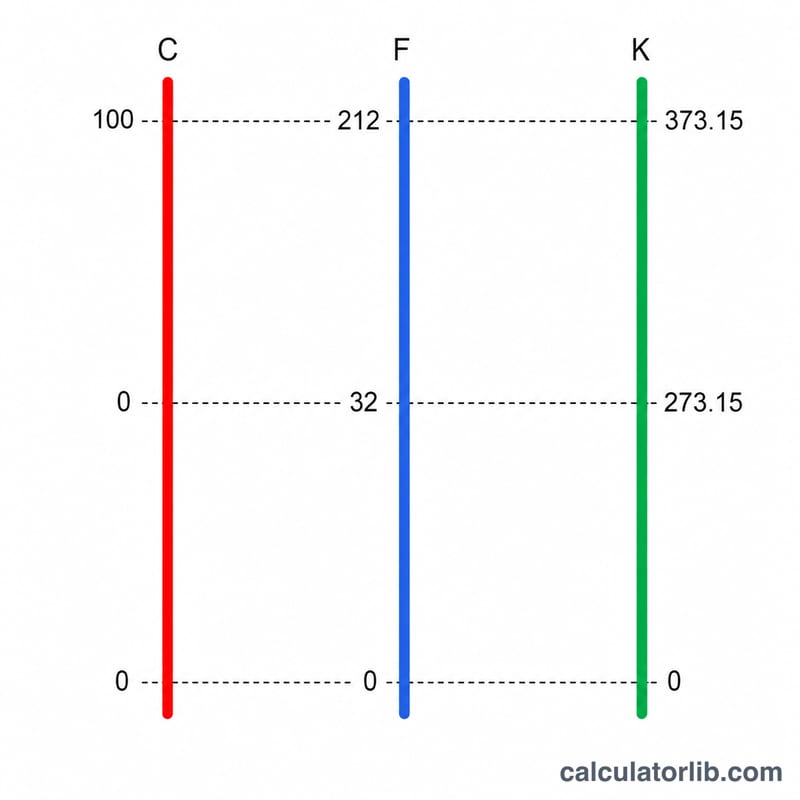
All conversions route through Celsius as a common base. Celsius converts to Fahrenheit with \(\text{F} = \text{C} \times \frac{9}{5} + 32\) and to Kelvin with \(\text{K} = \text{C} + 273.15\). Going the other way, Fahrenheit becomes Celsius via \(\text{C} = (\text{F} - 32) \times \frac{5}{9}\), and Kelvin becomes Celsius by subtracting 273.15. The factor \(\frac{9}{5}\) reflects that one Celsius degree spans 1.8 Fahrenheit degrees, while 32 is the freezing point of water on the Fahrenheit scale. Kelvin shares the same degree size as Celsius but starts at absolute zero (−273.15 °C).
Worked Example
Suppose you enter 100 with the unit set to Celsius — the boiling point of water at sea level. $$\text{Fahrenheit} = 100 \times \frac{9}{5} + 32 = 180 + 32 = 212 \text{ °F}$$ $$\text{Kelvin} = 100 + 273.15 = 373.15 \text{ K}$$ So 100 °C equals 212 °F and 373.15 K.
Common Temperature Reference Values
The table lists well-known reference points on the Celsius (°C), Fahrenheit (°F) and Kelvin (K) scales. Values marked "≈" are approximate or vary with conditions.
| Reference point | °C | °F | K |
|---|---|---|---|
| Absolute zero | −273.15 | −459.67 | 0 |
| Water freezing point (standard pressure) | 0 | 32 | 273.15 |
| Average human body temperature (≈, conventional value; varies by person and time of day) | ≈ 37 | ≈ 98.6 | ≈ 310.15 |
| Room temperature (≈, a typical comfortable range) | ≈ 20–25 | ≈ 68–77 | ≈ 293.15–298.15 |
| Water boiling point at sea level (standard atmospheric pressure, 1 atm) | 100 | 212 | 373.15 |
| Crossover point where °C and °F are equal | −40 | −40 | 233.15 |
Note: the boiling point of water drops as altitude increases because air pressure is lower, so 100 °C applies only at standard sea-level pressure.
Quick Conversion Table
Each row converts a Celsius value using \(F = C \times \tfrac{9}{5} + 32\) and \(K = C + 273.15\).
| °C | °F | K |
|---|---|---|
| −40 | −40 | 233.15 |
| −20 | −4 | 253.15 |
| −10 | 14 | 263.15 |
| 0 | 32 | 273.15 |
| 10 | 50 | 283.15 |
| 20 | 68 | 293.15 |
| 30 | 86 | 303.15 |
| 37 | 98.6 | 310.15 |
| 50 | 122 | 323.15 |
| 75 | 167 | 348.15 |
| 100 | 212 | 373.15 |
Example check for 37 °C: \(37 \times \tfrac{9}{5} + 32 = 66.6 + 32 = 98.6\) °F, and \(37 + 273.15 = 310.15\) K.
To convert back: \(C = (F - 32) \times \tfrac{5}{9}\) and \(C = K - 273.15\).
FAQ
What is absolute zero? Absolute zero is 0 K, equal to −273.15 °C or −459.67 °F — the lowest theoretically possible temperature.
At what temperature do Celsius and Fahrenheit equal each other? They meet at −40°: −40 °C is exactly −40 °F.
Why does Kelvin have no degree symbol? By scientific convention Kelvin is an absolute thermodynamic scale, so it is written simply as "K" (e.g. 300 K), without the ° symbol.