What the Triangle Height Calculator Does
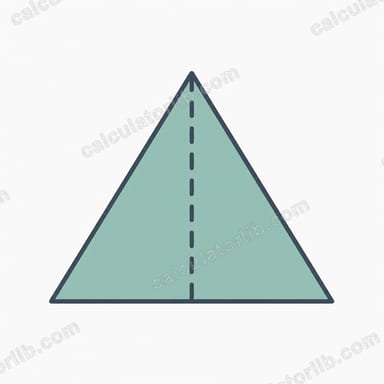
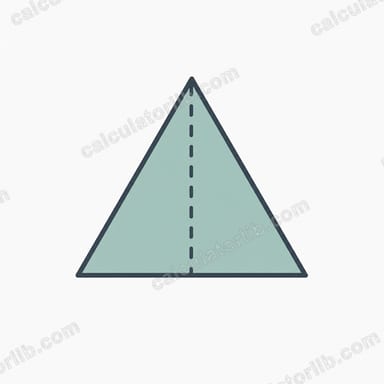
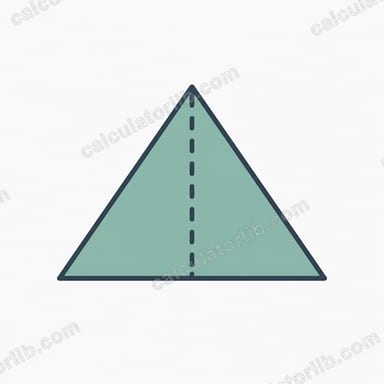
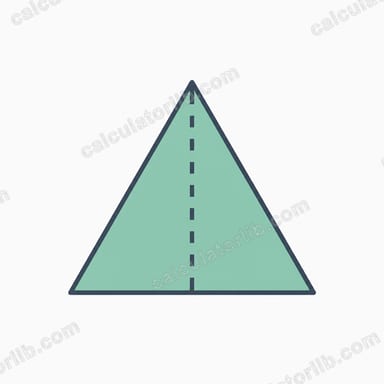
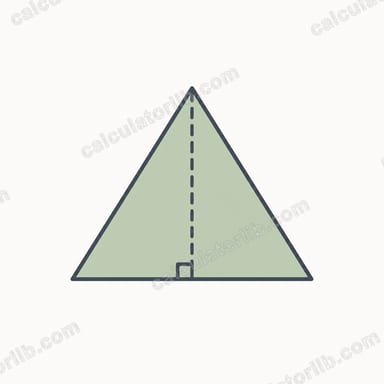
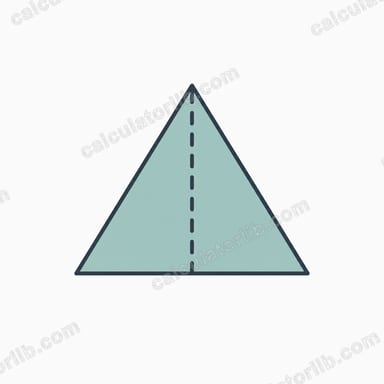
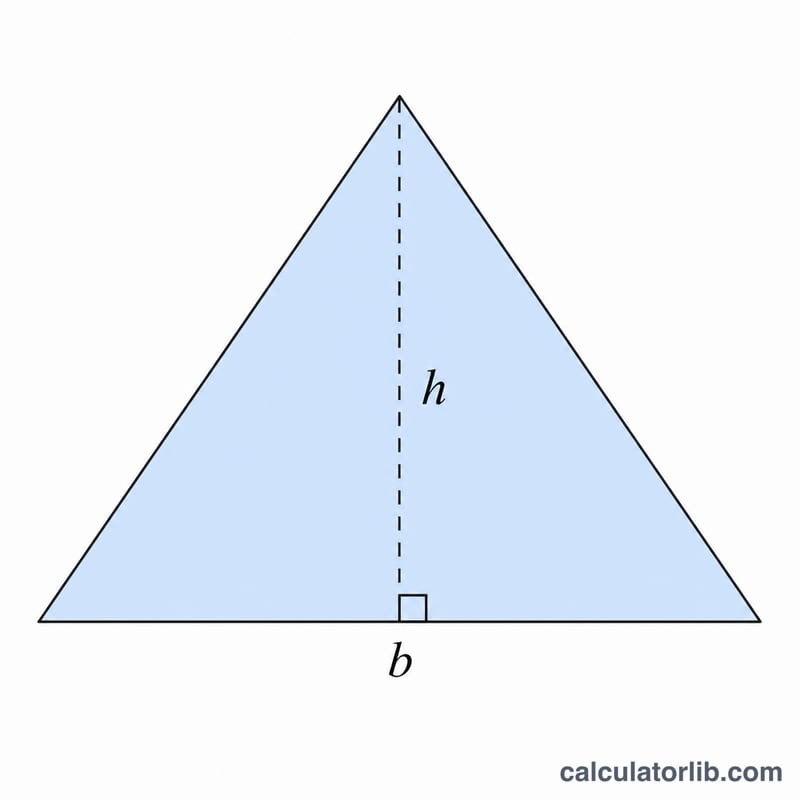
This calculator finds the height (also called the altitude) of a triangle when you already know its area and the length of one side used as the base. The height is the perpendicular distance from that base to the opposite vertex. Instead of rearranging the area formula by hand, you simply enter two values and get the height instantly. It works for any triangle — scalene, isosceles, equilateral or right-angled — as long as the area and base refer to matching units.
The Inputs You Provide
- Base Length: the length of the side you are treating as the base of the triangle (e.g. in cm, m or inches).
- Area: the total area enclosed by the triangle, in squared units that match the base (e.g. cm², m²).
The calculator divides twice the area by the base length to return the corresponding height.
The Formula Explained
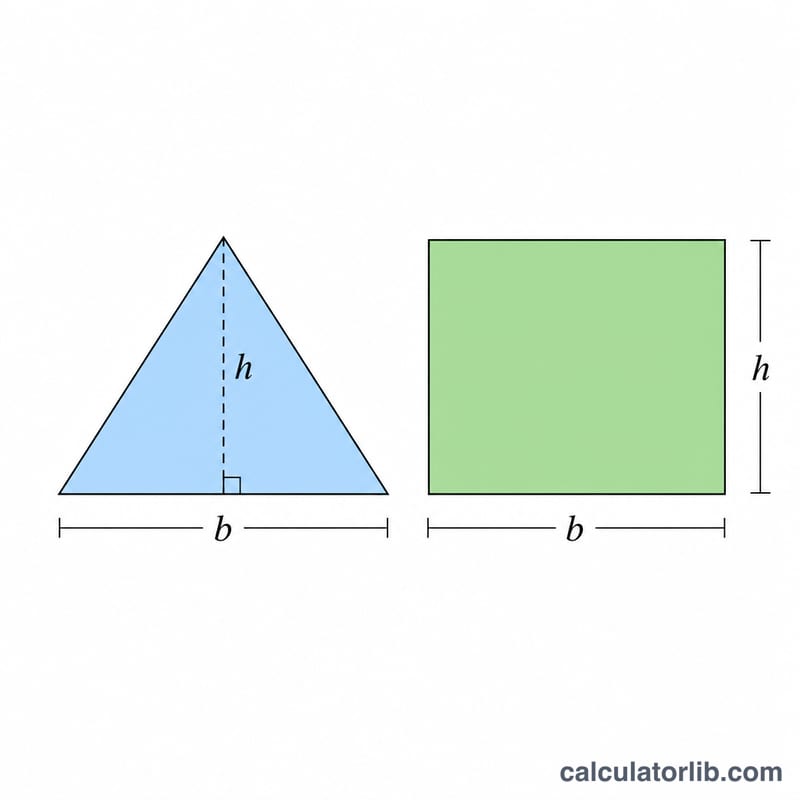
The standard area of a triangle is \(A = \tfrac{1}{2} \times b \times h\). Rearranging that equation to solve for the height gives the formula this tool uses:
$$h = \frac{2A}{b}$$
Here \(h\) is the height, \(A\) is the area and \(b\) is the base length. Because the area already accounts for the ½ factor, we multiply the area by 2 and then divide by the base to isolate the height.
Worked Example
Suppose a triangle has an area of 30 cm² and a base of 12 cm. Plugging the numbers into the formula:
- \(h = (2 \times 30) \div 12\)
- \(h = 60 \div 12\)
- \(h = 5 \text{ cm}\)
So the perpendicular height from the 12 cm base to the opposite vertex is 5 cm.
More Worked Examples
Each example below uses the same formula, which comes from rearranging the area formula \(A = \tfrac{1}{2} b h\):
$$h = \frac{2A}{b}$$Example 1: Decimal values in metres
A triangular garden bed has an area of 7.5 m² and a base of 4 m. Find its height.
- Write the formula: \(h = \dfrac{2A}{b}\).
- Substitute the values: \(h = \dfrac{2 \times 7.5\ \text{m}^2}{4\ \text{m}}\).
- Multiply the numerator: \(2 \times 7.5 = 15\), so \(h = \dfrac{15\ \text{m}^2}{4\ \text{m}}\).
- Divide: \(15 \div 4 = 3.75\). Dividing m² by m leaves m.
Result: h = 3.75 m.
Example 2: Base in mm, area in cm²
A triangle has a base of 80 mm and an area of 24 cm². The units do not match, so convert the base to centimetres before using the formula.
- Convert the base: 1 cm = 10 mm, so \(b = 80\ \text{mm} \div 10 = 8\ \text{cm}\).
- Substitute: \(h = \dfrac{2 \times 24\ \text{cm}^2}{8\ \text{cm}}\).
- Multiply the numerator: \(2 \times 24 = 48\), so \(h = \dfrac{48\ \text{cm}^2}{8\ \text{cm}}\).
- Divide: \(48 \div 8 = 6\).
Result: h = 6 cm (or 60 mm).
If you had used 80 as the base without converting, you would get \(48 \div 80 = 0.6\), which is wrong by a factor of 10. The calculator does not convert units for you, so enter the base and the area in matching units, for example cm and cm².
Example 3: Same area, different base sides
A right triangle has legs of 6 cm and 8 cm and a hypotenuse of 10 cm. Its area is \(\tfrac{1}{2} \times 6 \times 8 = 24\ \text{cm}^2\). Any side can be the base, and each side has its own height.
- Base = 6 cm: \(h = \dfrac{2 \times 24}{6} = \dfrac{48}{6} = 8\) cm. This is the 8 cm leg, which is 8 cm.
- Base = 8 cm: \(h = \dfrac{2 \times 24}{8} = \dfrac{48}{8} = 6\) cm. This is the 6 cm leg.
- Base = 10 cm (the hypotenuse): \(h = \dfrac{2 \times 24}{10} = \dfrac{48}{10} = \) 4.8 cm.
Result: It is one triangle with one area, but it has three heights: 8 cm, 6 cm and 4.8 cm. The height depends on which side you choose as the base. In every case, base × height = 48 cm², which is twice the area.
Interpreting Your Result
The calculator gives the height (altitude) for the side you entered as the base. These geometry facts help you check the answer and use it correctly:
- The height is always perpendicular to the base line. It is the shortest distance from the opposite vertex to the straight line that contains the base. It meets that line at 90°. It is not the length of a slanted side, unless that side happens to be perpendicular to the base.
- In an obtuse triangle, some heights fall outside the triangle. If the base is one of the two sides next to the obtuse angle, the foot of the height lands on the base line extended past the triangle. The formula \(h = 2A/b\) still gives the correct length. Only the place where the height meets the base line is outside the triangle.
- In a right triangle, the height to one leg is the other leg. The two legs are perpendicular, so each leg is the height to the other. Only the height to the hypotenuse needs a separate calculation, and it is always shorter than either leg.
- Base and height are inversely proportional for a fixed area. Because \(b \times h = 2A\) stays constant, doubling the base halves the height. That is why the longest side of a triangle always has the shortest height.
- The height can be longer than the base. A tall, narrow triangle, such as one with base 2 cm and area 10 cm², has a height of \(2 \times 10 / 2 = 10\) cm, five times the base. A result larger than the base is not an error.
- Equilateral triangle quick check: For a triangle with all sides equal to \(s\), the height is \(h = \frac{\sqrt{3}}{2}\, s \approx 0.866\, s\). For example, a side of 10 cm gives about 8.66 cm. If your result for an equilateral triangle is far from 0.866 × side, check the area and base you entered.
Also check that the units make sense. With the area in cm² and the base in cm, the height is in cm. A negative or zero result means an input is wrong, because both the base and the area must be positive.
Frequently Asked Questions
Does the height correspond to a specific base?
Yes. Each side of a triangle has its own associated height. The result you get is the altitude drawn to the exact base length you entered, so always pair the correct base with the area.
What units does the answer use?
The height comes out in the linear unit of your base. If your area is in cm² and base in cm, the height is in cm. Always keep units consistent.
What if I enter zero or leave the base blank?
Dividing by zero is undefined, so the base must be a positive number. Enter a valid non-zero base length to get a meaningful height.