
What Is the VA Disability Calculator?
This calculator applies the official U.S. Department of Veterans Affairs (VA) method for combining multiple disability ratings into a single percentage. Because VA disability ratings do not simply add up, two 50% ratings do not equal 100% — they combine to 75%. This tool uses the "whole person" approach to give you the correct combined rating used to determine compensation. It applies only to U.S. veterans and reflects the VA's standard combined ratings table method.
How to Use It
Enter each of your individual disability ratings (0–100%) in the fields provided. You can enter up to five ratings; leave unused fields blank or at zero. The calculator automatically sorts your ratings from highest to lowest, combines them, and rounds the result to the nearest 10% as the VA does.
The Formula Explained
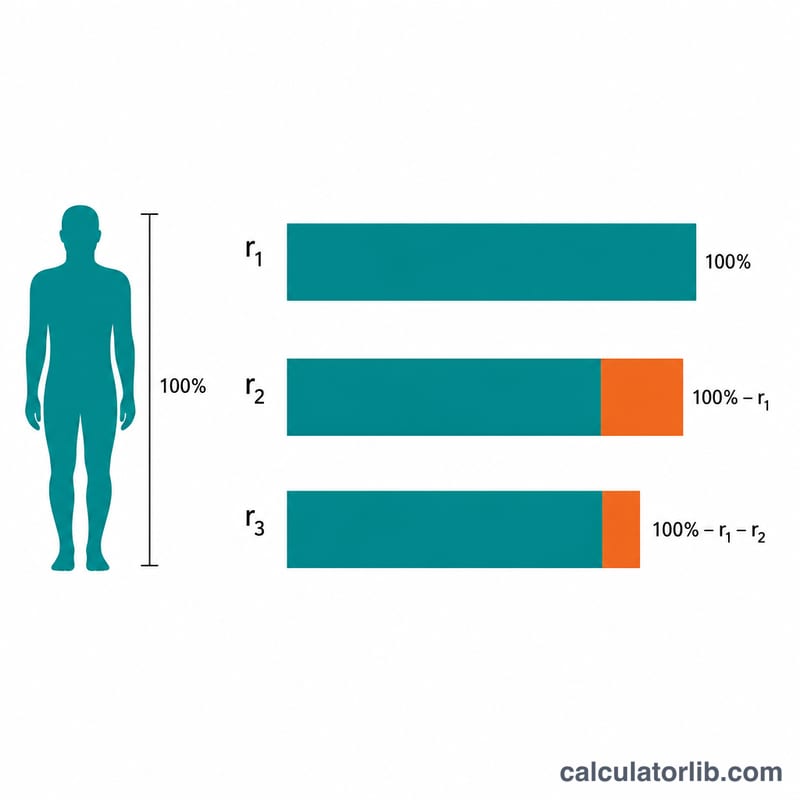
Start with 100% of a healthy "whole person." The largest rating is applied first, leaving a remaining efficiency. Each subsequent rating is applied only to what remains. Mathematically the remaining efficiency is the product of (1 − rating) for every disability, so the combined value is:
$$C = 100 - 100\prod_{i}\left(1 - \frac{r_i}{100}\right)$$
The final value is rounded to the nearest multiple of 10.
Worked Example
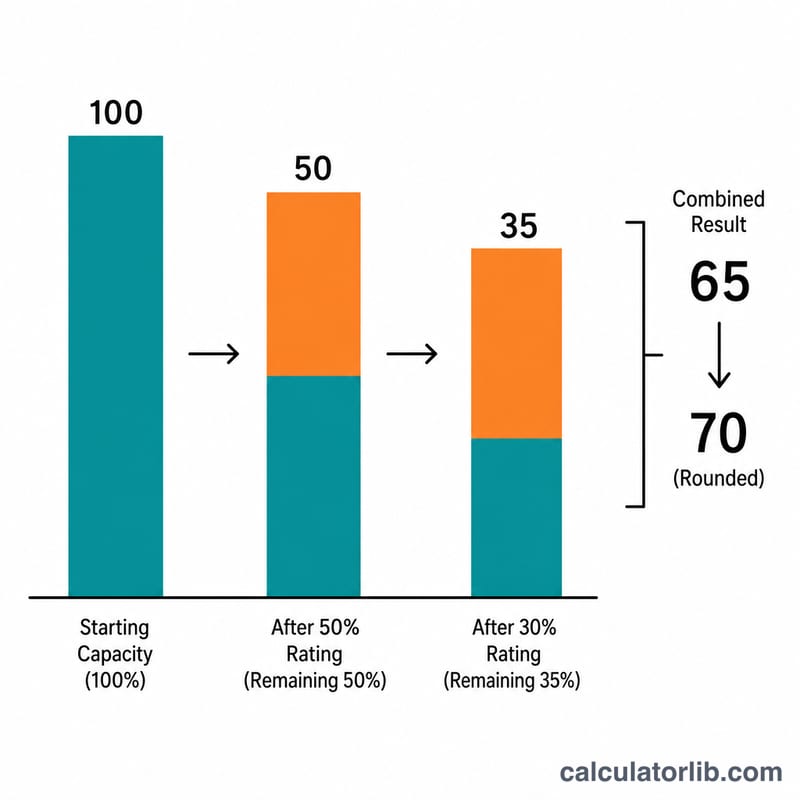
Suppose you have ratings of 50%, 30%, and 20%. Process them in descending order:
- Start: 100% efficient.
- Apply 50%: \(100 \times 0.50 = 50\%\) remains (50% disabled).
- Apply 30%: \(50 \times 0.70 = 35\%\) remains (65% disabled).
- Apply 20%: \(35 \times 0.80 = 28\%\) remains → 72% disabled.
The exact value is 72%, which rounds to a 70% combined VA disability rating.
Combined Rating Scenarios Compared
The US Department of Veterans Affairs does not add disability ratings together. It combines them with the whole-person method: \(C = 100 - 100\prod_{i}\left(1 - \frac{r_i}{100}\right)\). The exact result is then rounded once, to the nearest 10% (a value ending in 5 rounds up). The table compares the simple sum with the exact and rounded combined values.
| Individual ratings | Simple sum | Exact combined value | Rounded VA rating |
|---|---|---|---|
| 50% + 50% | 100% | 100 − 100(0.5 × 0.5) = 75% | 80% |
| 60% + 30% | 90% | 100 − 100(0.4 × 0.7) = 72% | 70% |
| 30% + 30% + 30% | 90% | 100 − 100(0.7 × 0.7 × 0.7) = 65.7% | 70% |
| 40% + 20% + 10% | 70% | 100 − 100(0.6 × 0.8 × 0.9) = 56.8% | 60% |
| 70% + 50% + 30% | 150% | 100 − 100(0.3 × 0.5 × 0.7) = 89.5% | 90% |
| 10% + 10% | 20% | 100 − 100(0.9 × 0.9) = 19% | 20% |
The combined value is always lower than the simple sum and never exceeds 100%. This is why 70% + 50% + 30% gives 90% rather than 150%.
Interpreting Your Combined Rating
The rounded combined rating, from 0% to 100% in 10% steps, is the figure the US VA uses to set the level of disability compensation. The decimal value, such as 65.7% or 56.8%, is only an intermediate result.
- Rounding happens once. It is applied only to the final combined value, never to intermediate steps.
- Individual ratings are not rounded before combining. Each rating is used as entered.
- This is an estimate. It does not include the bilateral factor, dependents, or special monthly compensation, which can change the official outcome.
- Only the VA can make an official determination. Use this tool to understand how the math works, not as a decision on your claim.
This is general information, not personal or financial advice. For questions about your own claim, contact the VA or an accredited Veterans Service Officer.
Key VA Rating Terms
- Combined rating
- The single overall percentage the VA derives from all of a veteran's individual ratings using the whole-person method, rounded to the nearest 10%.
- Individual (disability) rating
- The percentage the VA assigns to one service-connected condition, usually in 10% steps from 0% to 100%.
- Whole-person concept
- The idea that a person is 100% efficient before disability. Each rating reduces what is left rather than being added to the total, so combined ratings cannot exceed 100%.
- Remaining efficiency
- The part of the whole person not yet rated as disabled. After a 60% rating, 40% remains. A 30% rating then applies to that 40%: 0.30 × 40 = 12, so the combined value is 60 + 12 = 72%.
- Rounding to the nearest 10%
- The final combined value is rounded to the nearest multiple of 10, with values ending in 5 rounded up. For example, 75% becomes 80% and 72% becomes 70%.
- Bilateral factor
- A US VA rule that adds 10% of the combined value of disabilities affecting both arms, both legs, or paired skeletal muscles. The result is treated as one disability when combining with others. This calculator does not apply it.
- Combined rating vs. compensation amount
- The combined rating is a percentage. The compensation amount is the monthly payment tied to that percentage. It also depends on factors such as dependents and annually adjusted rate tables, and this calculator does not compute it.
FAQ
Why don't my ratings just add up? The VA uses a whole-person concept: once part of you is rated disabled, later ratings only apply to the healthy remainder, so totals are always lower than a simple sum.
How does rounding work? After combining, the value is rounded to the nearest 10%. Values ending in 5 or above round up (e.g., 75 → 80), below 5 round down (e.g., 72 → 70).
Does this include the bilateral factor or dependents? No. This tool computes the basic combined rating only. The bilateral factor and dependent adjustments are separate and may change your final compensation.