What This Calculator Does
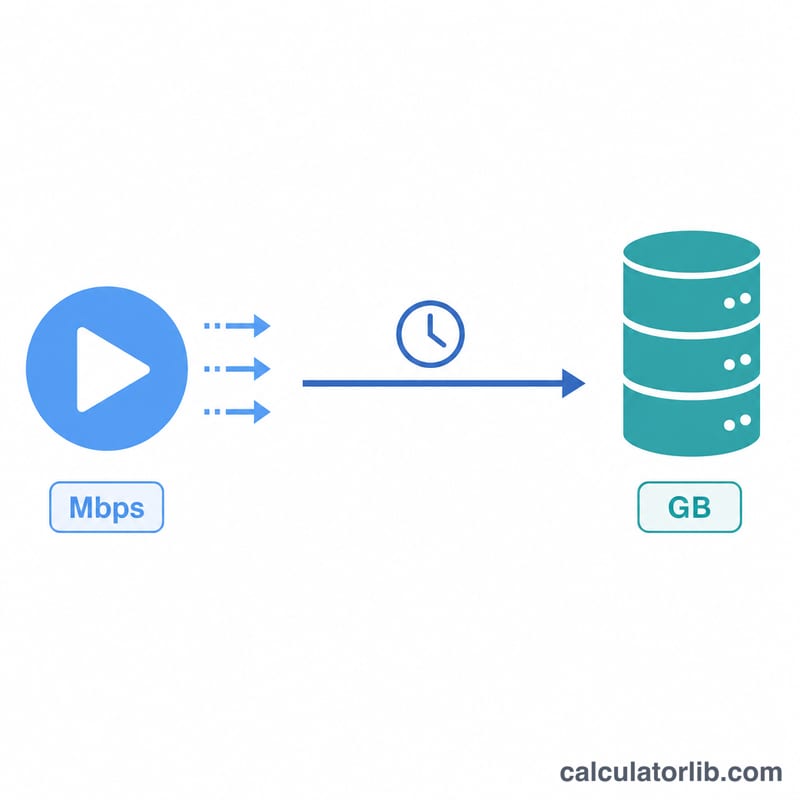
The Video Streaming Bandwidth Calculator estimates how much data your internet connection consumes while watching streaming video. Streaming services deliver video at a steady bitrate measured in megabits per second (Mbps). Multiply that rate by how long you watch and you get the total data transferred — useful for managing capped data plans, mobile hotspots, or simply understanding your monthly usage.
How To Use It
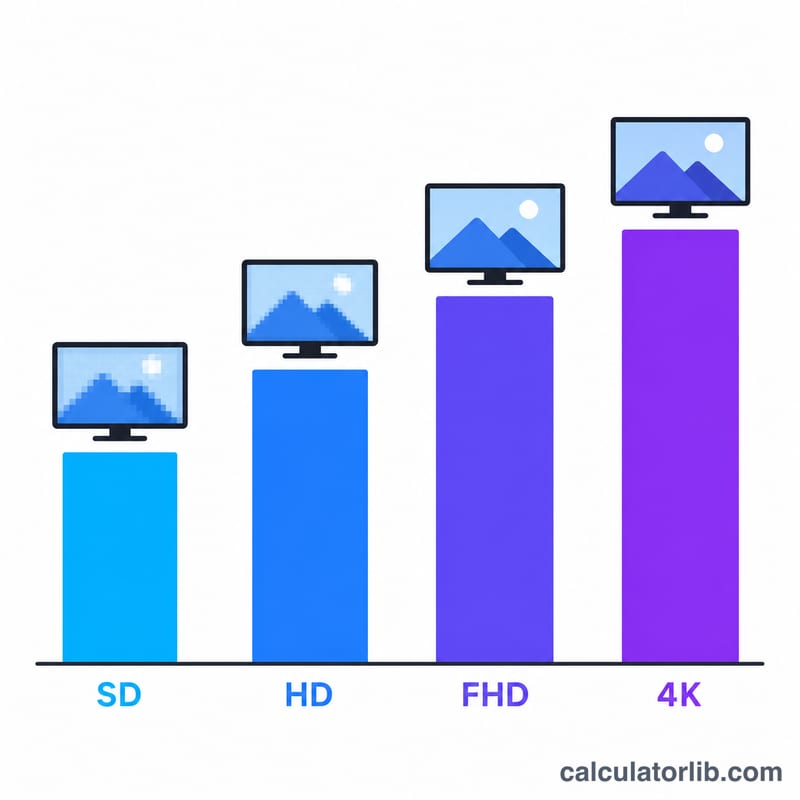
Enter the stream's average bitrate in Mbps and how many hours you plan to watch. Not sure of the bitrate? Use the quality preset menu to load a typical value for SD 480p, HD 720p, Full HD 1080p, or 4K UHD. The result shows total data in gigabytes and megabytes, plus the data consumed per hour so you can scale to any session length.
The Formula Explained
The core conversion is: $$\text{Data (GB)} = \frac{\text{Bitrate (Mbps)} \times \text{Hours} \times 3600}{8 \times 1000}$$ Multiplying by 3600 converts hours to seconds, dividing by 8 converts megabits to megabytes (8 bits = 1 byte), and dividing by 1000 converts megabytes to gigabytes. The result is decimal (base-1000) gigabytes, which matches how ISPs typically bill data.
Worked Example
Streaming Full HD 1080p at 8 Mbps for 2 hours: \(8 \times 2 \times 3600 = 57{,}600\) megabits. Divide by 8 to get 7,200 megabytes, then divide by 1000 to get 7.2 GB. At one hour the same stream uses 3.6 GB.
Typical Streaming Bitrates and Data Use by Resolution
The table shows typical streaming bitrates and the data they use, in decimal units (1 GB = 1000 MB). Data per hour is Mbps × 0.45, because \(3600 \div 8000 = 0.45\). These are typical averages. Real bitrates vary by service, codec (H.264, HEVC, AV1), frame rate and how complex the content is, and many services adapt the bitrate as your connection changes.
| Quality | Typical bitrate (Mbps) | Approx. GB per hour | Approx. GB for 2 hours |
|---|---|---|---|
| SD 480p | 1 – 2 | 0.45 – 0.9 | 0.9 – 1.8 |
| HD 720p | 2.5 – 4 | 1.1 – 1.8 | 2.3 – 3.6 |
| Full HD 1080p | 5 – 8 | 2.25 – 3.6 | 4.5 – 7.2 |
| 4K UHD | 15 – 25 | 6.75 – 11.25 | 13.5 – 22.5 |
| 4K UHD with HDR (optional) | 20 – 25 | 9 – 11.25 | 18 – 22.5 |
Treat these as planning estimates, not guarantees. Use the calculator with your service's actual bitrate for a closer figure.
Data Usage Scenarios Compared
Each row uses \(\text{GB} = \text{Mbps} \times \text{hours} \times 3600 \div 8000\). The bitrates are example values within the typical ranges above.
| Scenario | Bitrate (Mbps) | GB per session | Total over 30 days |
|---|---|---|---|
| 1 hr of 480p | 1.5 | 1.5 × 1 × 0.45 = 0.675 | Single session (not repeated) |
| 1 hr of 720p | 3 | 3 × 1 × 0.45 = 1.35 | Single session (not repeated) |
| 2 hrs of 1080p | 5 | 4.5 | Single session (not repeated) |
| 3 hrs of 4K | 16 | 21.6 | Single session (not repeated) |
| 2 hrs/day of 1080p | 5 | 4.5 per day | 4.5 × 30 = 135 GB |
| 2 hrs/day of 1080p (higher quality) | 8 | 8 × 2 × 0.45 = 7.2 per day | 7.2 × 30 = 216 GB |
Daily viewing adds up quickly. If your internet plan has a monthly data cap, a modest drop in resolution can save a lot of data.
Bitrate and Data Unit Conversions
| Conversion | Value |
|---|---|
| 1 byte | 8 bits |
| 1 Mbps (megabit per second) | 0.125 MB/s (decimal) |
| 1 Mbps sustained for 1 hour | 0.45 GB |
| 1 GB (decimal) | 1000 MB |
| 1 GiB (binary) | 1024 MiB ≈ 1.074 GB |
| 1000 kbps | 1 Mbps |
| 1.5 Mbps | 1500 kbps |
Mbps to GB per hour
| Bitrate (Mbps) | GB per hour |
|---|---|
| 1 | 0.45 |
| 3 | 1.35 |
| 5 | 2.25 |
| 8 | 3.6 |
| 16 | 7.2 |
| 25 | 11.25 |
Operating systems and some tools report sizes in GiB but label them GB, so a figure shown on your device may differ slightly from this calculator's decimal result.
FAQ
Is this using base-1000 or base-1024? This calculator uses base-1000 (decimal) gigabytes, the convention used by most ISPs and data plans.
What bitrate does my service actually use? It varies with content and adaptive streaming, but 4K is roughly 15–25 Mbps, 1080p around 5–8 Mbps, and 720p around 3–5 Mbps. The presets give safe averages.
Does audio count? Bitrate figures typically include the audio stream, so the estimate already covers it.