
What is the ACB Home/Mortgage Loan Calculator?
This calculator estimates the fixed monthly payment on an amortizing home or mortgage loan. Given the loan amount (principal), the annual interest rate, and the loan term in years, it computes how much you will pay each month toward principal and interest, plus the total amount repaid and the total interest over the life of the loan.
How to use it
Enter the loan amount you plan to borrow, the annual interest rate offered by your lender as a percentage, and the repayment term in years. The result shows your monthly payment along with a breakdown of total payments and total interest. Adjust the inputs to compare scenarios such as shorter terms or different rates.
The formula explained
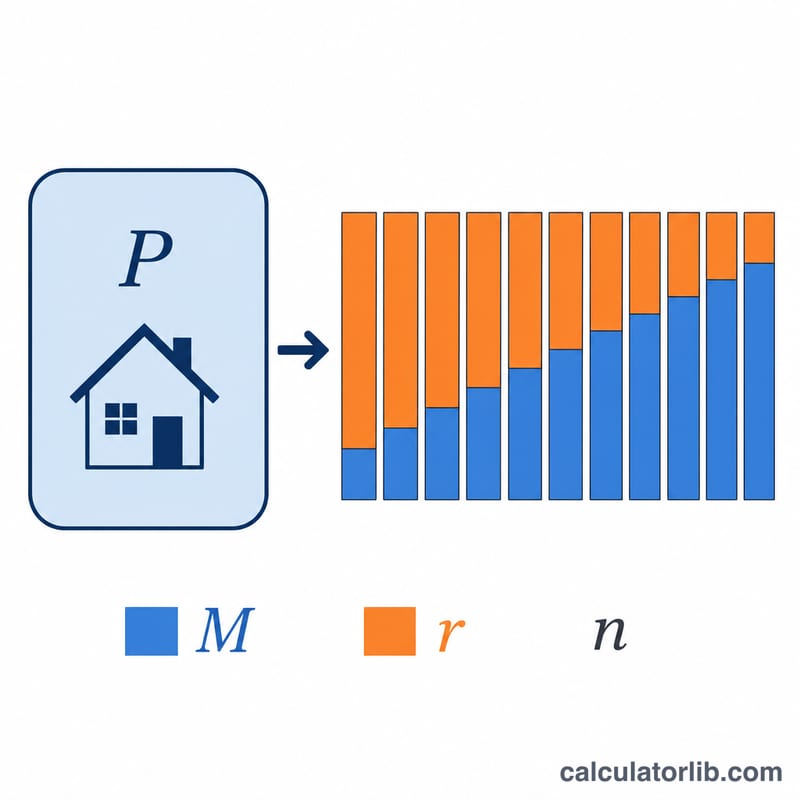
The standard amortization formula is $$M = P \cdot \frac{r(1+r)^n}{(1+r)^n - 1}$$ Here \(P\) is the principal, \(r\) is the monthly interest rate (annual rate \(\div 1200\), since dividing by 100 converts percent to decimal and by 12 converts annual to monthly), and \(n\) is the number of monthly payments (years \(\times 12\)). If the rate is 0%, the payment is simply the principal divided by the number of months.
Worked example
For a $300,000 loan at 6% annual interest over 30 years: \(r = 6 / 1200 = 0.005\) and \(n = 360\). Then \((1.005)^{360} \approx 6.02258\), so $$M = 300000 \times 0.005 \times \frac{6.02258}{6.02258 - 1} \approx \$1{,}798.65$$ per month. Over 360 payments that totals about $647,515, of which roughly $347,515 is interest.
Comparing Loan Scenarios
The tables below use the standard amortization formula \( M = P \cdot \dfrac{r(1+r)^{n}}{(1+r)^{n}-1} \) with a fixed loan amount of \(P = \$300{,}000\). The only variables are the annual interest rate and the term, so you can see exactly how each affects the monthly payment, total interest paid over the life of the loan, and total cost (principal plus interest).
30-Year Term (n = 360 payments)
| Annual Rate | Monthly Payment (M) | Total Interest | Total Cost |
|---|---|---|---|
| 5% | $1,610.46 | $279,767 | $579,767 |
| 6% | $1,798.65 | $347,515 | $647,515 |
| 7% | $1,995.91 | $418,527 | $718,527 |
15-Year Term (n = 180 payments)
| Annual Rate | Monthly Payment (M) | Total Interest | Total Cost |
|---|---|---|---|
| 5% | $2,372.38 | $127,029 | $427,029 |
| 6% | $2,531.57 | $155,683 | $455,683 |
| 7% | $2,696.48 | $185,367 | $485,367 |
Two patterns stand out. First, a higher rate raises both the monthly payment and the total interest at every term. Second, the shorter 15-year term carries a noticeably higher monthly payment but a far smaller total interest cost — for example, at 7% the 15-year loan costs about $233,160 less in interest than the 30-year loan, despite the higher monthly outlay.
Key Mortgage Terms Defined
- Principal (P)
- The amount borrowed — the original loan balance before any interest is added. In the formula this is the starting value that is paid down over time.
- Annual interest rate
- The yearly nominal rate charged on the outstanding balance, expressed as a percentage (for example, 6%). It is the figure quoted by lenders before any fees.
- Monthly rate (r)
- The annual rate converted to a per-month decimal, computed as \( r = \dfrac{\text{annual rate (\%)}}{1200} \). A 6% annual rate gives \( r = 0.005 \).
- Term
- The length of the loan in years. Multiplied by 12 it gives \( n \), the total number of monthly payments — a 30-year term means \( n = 360 \).
- Amortization
- The process of repaying a loan through fixed periodic payments that cover both interest and principal, so the balance reaches zero by the end of the term.
- Monthly payment (M)
- The fixed amount paid each month, combining interest on the current balance and a portion of principal. It is the output of the amortization formula.
- Total interest
- The sum of all interest paid over the life of the loan, equal to \( (M \times n) - P \).
- Total cost
- Principal plus total interest, equal to \( M \times n \) — the full amount repaid over the term.
- PMI & escrow (excluded)
- This calculator estimates principal and interest only. It does not include private mortgage insurance (PMI), property taxes, or homeowners insurance, which are often collected through an escrow account and can add meaningfully to the actual monthly bill.
Interpreting Your Result
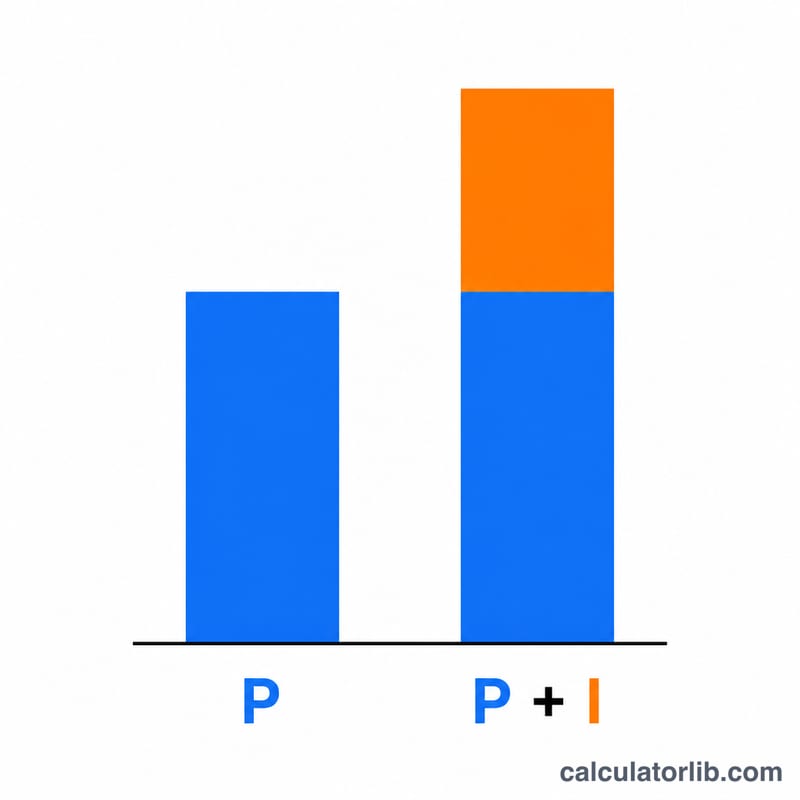
The monthly payment (M) is the fixed amount you would pay each month for the entire term to fully repay the loan. The total interest is everything you pay above the borrowed principal, and the total cost is principal plus interest — the complete sum repaid over all \( n \) payments.
Although the payment is constant, its composition changes over time. Early in an amortized loan most of each payment goes toward interest, because interest is charged on a large outstanding balance. As the balance shrinks, a growing share of each payment goes toward principal. This is why making extra principal payments early reduces total interest more than the same extra payment made later. A detailed month-by-month breakdown can be produced with an amortization schedule.
Two structural factors lower the interest you pay: a lower interest rate reduces the cost of borrowing each month, and a shorter term means fewer payments and less time for interest to accrue — though a shorter term raises the monthly payment. The scenario tables above illustrate both effects directly.
Keep in mind that this figure is an estimate of principal and interest only. Your actual housing payment may be higher once property taxes, homeowners insurance, and PMI are added, and it excludes any lender fees or points. This is general information, not financial advice; consult a qualified mortgage professional for guidance specific to your situation.
FAQ
Does this include taxes and insurance? No. It covers only principal and interest. Property taxes, homeowners insurance, and PMI are additional.
Can I use it for car or personal loans? Yes — any fixed-rate amortizing loan with monthly payments works with the same formula.
Why does total interest seem so high? On long-term loans, compounding interest accumulates significantly. Shortening the term or lowering the rate reduces total interest substantially.