
What is the Acceleration Conversion Calculator?
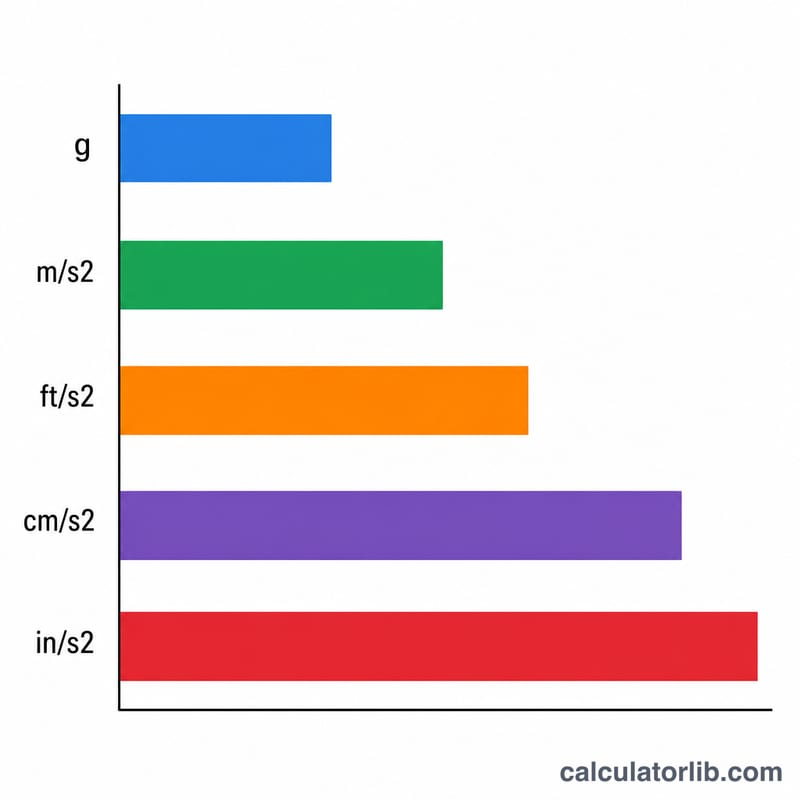
This tool converts a value of acceleration from one unit to another. It supports the most common acceleration units: standard gravity (g), metres per second squared (m/s²), feet per second squared (ft/s²), centimetres per second squared (cm/s², also called the Gal), and inches per second squared (in/s²). It is universal — the physics is the same everywhere.
How to use it
Enter the numeric value you want to convert, choose the unit you are converting from, then choose the unit you want to convert to. The calculator instantly returns the converted value and also shows the equivalent in m/s² as a reference.
The formula explained
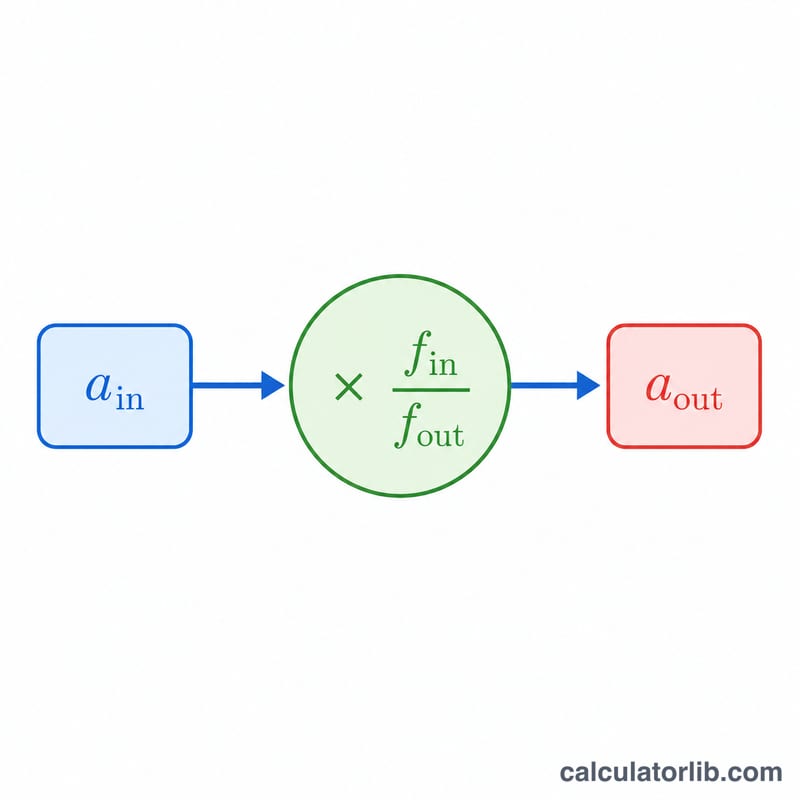
Every unit is stored as the number of m/s² it represents. For example, 1 g = 9.80665 m/s² and 1 ft/s² = 0.3048 m/s². To convert, first turn the input into the base SI unit, then divide by the target factor:
$$a_{out} = a_{in} \times \frac{f_{in}}{f_{out}}$$
where \(f_{in}\) and \(f_{out}\) are the m/s² values of one unit of the source and target respectively.
Worked example
Convert 9.80665 m/s² to g. Here \(f_{in} = 1\) (m/s²) and \(f_{out} = 9.80665\) (g). So $$a_{out} = 9.80665 \times \frac{1}{9.80665} = 1 \text{ g}$$ — exactly one standard gravity, as expected.
Typical Acceleration Values
Acceleration is most intuitively expressed in multiples of standard gravity, where \(1\ \text{g} = 9.80665\ \text{m/s}^2\). The table below lists common real-world accelerations in both g and m/s² so you can gauge how everyday and extreme situations compare. To convert any value in g to m/s², multiply by 9.80665 — for example, a 4 g roller-coaster loop equals 39.2266 m/s².
| Situation | Acceleration (g) | Acceleration (m/s²) |
|---|---|---|
| Free fall (Earth gravity) | 1 g | 9.81 |
| Gravity on the Moon | ~0.165 g | ~1.62 |
| Commercial jet takeoff | ~0.3 g | ~2.94 |
| Passenger car hard braking | ~0.8 g | ~7.85 |
| Roller coaster (peak) | ~4 g | ~39.23 |
| Fighter jet maneuver | ~9 g | ~88.26 |
Note that the g-forces felt on a roller coaster or in a fighter jet are sustained or transient values that can momentarily exceed these typical figures. Values are rounded and represent order-of-magnitude references rather than fixed constants.
FAQ
What is 1 g in m/s²? By definition, standard gravity g equals 9.80665 m/s².
What is a Gal? The Gal (galileo) is a CGS unit equal to 1 cm/s² = 0.01 m/s², common in gravimetry and seismology.
How do I convert ft/s² to m/s²? Multiply by 0.3048, since one foot equals 0.3048 metres.