
What Is Corrected (Adjusted) Age?
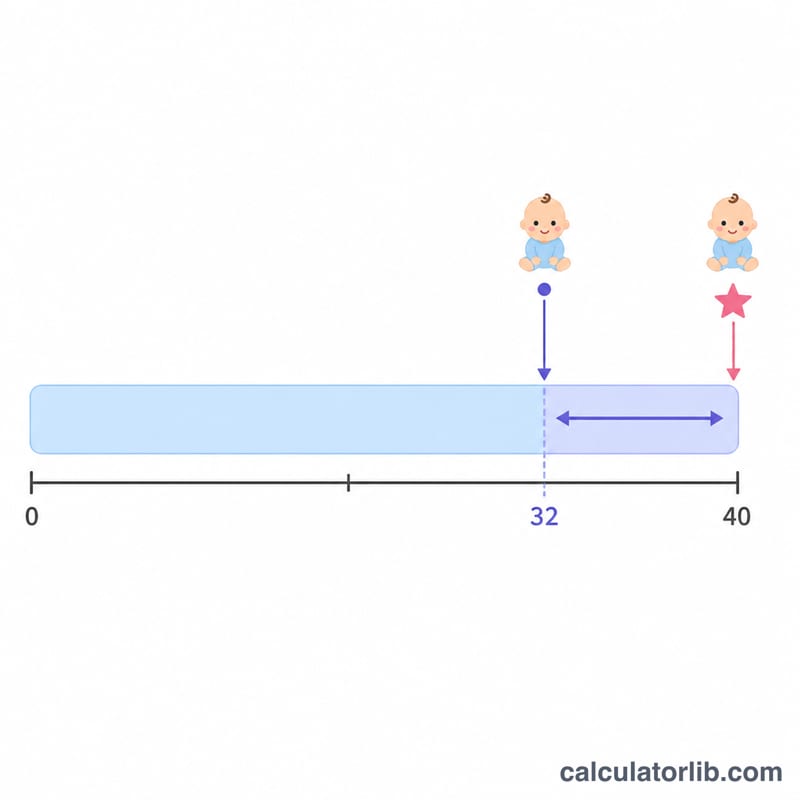
Corrected age — also called adjusted age — is the age a premature baby would be if they had been born on their due date. Because preemies arrive before completing the typical 40 weeks of gestation, their development is best compared against this adjusted timeline rather than their calendar (chronological) age. Pediatricians use corrected age when assessing growth, milestones, and feeding for babies born early, generally until around 2 years of age.
How to Use This Calculator
Enter two numbers: the baby's chronological age in weeks (weeks elapsed since the birth date) and the gestational age at birth in weeks (how many weeks pregnant the mother was at delivery). The calculator subtracts the weeks of prematurity and returns the corrected age in both weeks and approximate months.
The Formula Explained
A full-term pregnancy is treated as 40 weeks. The number of weeks a baby is premature equals \(40 - \text{gestational age at birth}\). The corrected age is then the chronological age minus that prematurity:
$$\text{Corrected age} = \text{chronological age} - (40 - \text{gestational age at birth})$$

Worked Example
Suppose a baby was born at 32 weeks gestation and is now 16 weeks old chronologically. Weeks of prematurity = \(40 - 32 = 8\). Corrected age = \(16 - 8 = 8\) weeks, which is roughly 1.84 months. So while the baby is 16 weeks old by the calendar, developmentally they are tracked as an 8-week-old.
Corrected Age Across Different Gestational Ages
The table compares babies who are all 20 weeks old in chronological age (counted from the birth date) but were born at different gestational ages. It uses \(\text{Corrected age} = \text{Chronological age} - (40 - \text{GA})\), with a 40-week term pregnancy as the reference. Months are approximate (weeks ÷ 4.345).
| Gestational age at birth (wk) | Weeks of prematurity (40 − GA) | Chronological age (wk) | Corrected age (wk) | Corrected age (approx. months) |
|---|---|---|---|---|
| 24 | 16 | 20 | 4 | 0.9 |
| 28 | 12 | 20 | 8 | 1.8 |
| 32 | 8 | 20 | 12 | 2.8 |
| 34 | 6 | 20 | 14 | 3.2 |
| 36 | 4 | 20 | 16 | 3.7 |
Example for the 28-week row: \(20 - (40 - 28) = 20 - 12 = 8\) weeks, and \(8 \div 4.345 \approx 1.8\) months. The earlier the birth, the larger the gap between chronological and corrected age.
Prematurity Categories by Gestational Age
The World Health Organization (WHO) classifies preterm birth (birth before 37 completed weeks of gestation) into the subcategories below. The last column shows how early the birth was relative to a 40-week due date.
| Category (WHO) | Gestational age at birth | Weeks early relative to 40 weeks |
|---|---|---|
| Extremely preterm | Under 28 weeks | More than 12 weeks early |
| Very preterm | 28 to under 32 weeks | More than 8, up to 12 weeks early |
| Moderate to late preterm | 32 to under 37 weeks | More than 3, up to 8 weeks early |
| Term | 37 weeks or more | 3 weeks early or less |
Source: World Health Organization definitions of preterm birth. Practices for applying age correction can vary between clinicians and countries.
Interpreting Your Result
- Reference point: Corrected (adjusted) age estimates how old a baby would be if born on the due date. It is commonly used as the reference when comparing growth and developmental milestones such as smiling, rolling or sitting, because a preterm baby has had less time to develop.
- Zero or negative result: If the corrected age is 0 or below, the baby has not yet reached the 40-week due date. For example, a baby 6 weeks old born at 32 weeks gives \(6 - (40 - 32) = -2\), meaning about 2 weeks before the due date.
- Duration of correction: Correction is commonly applied until about 24 months of chronological age, although the exact approach varies with the clinician and the baby's circumstances.
- Months are approximate: Converting weeks to months divides by about 4.345 (average weeks per month), so month figures are rounded estimates.
- Gestational age matters: The result assumes a 40-week reference and an accurately known gestational age at birth.
This calculator is for educational purposes only and is not a diagnosis. Questions about a baby's growth or development should be discussed with a pediatrician or other qualified healthcare professional.
FAQ
Until what age should I use corrected age? Most pediatricians use corrected age until about 24 months, after which the small gap becomes developmentally insignificant.
What if my baby was born after 40 weeks? Term and post-term babies do not need an age correction; this tool is intended for babies born before 40 weeks.
Is this a substitute for medical advice? No. This calculator is an educational aid. Always discuss your baby's development with your pediatrician.