What this calculator does
This calculator converts a value between basis points, percent and decimal form. It also applies a move of N basis points to a current rate and shows the resulting rate, plus the change in yearly interest on a principal. It suits borrowers, savers, investors and students who read central bank decisions, bond yields or loan quotes, where changes are stated in basis points.
How to use it
Fill in the fields in this order:
- Value to convert: the number you want to convert.
- Unit of the value: basis points, percent or decimal.
- Current rate: the rate in percent before the change.
- Rate change: the move in basis points; use a negative number for a cut, such as -25.
- Principal amount: the loan or investment balance used for the yearly amount change.
The results show the three conversions, the new rate, and the yearly interest at the old and new rates.
Formulas
$$bp = 100\,p \qquad d = \frac{bp}{10000} \qquad r_{new} = r + \frac{n}{100} \qquad \Delta A = \frac{P\,n}{10000}$$
Here \(p\) = value in percent, \(bp\) = value in basis points, \(d\) = value as a decimal, \(r\) = current rate in percent, \(n\) = rate change in basis points, \(r_{new}\) = new rate in percent, \(P\) = principal and \(\Delta A\) = yearly amount change.

Conventions and assumptions
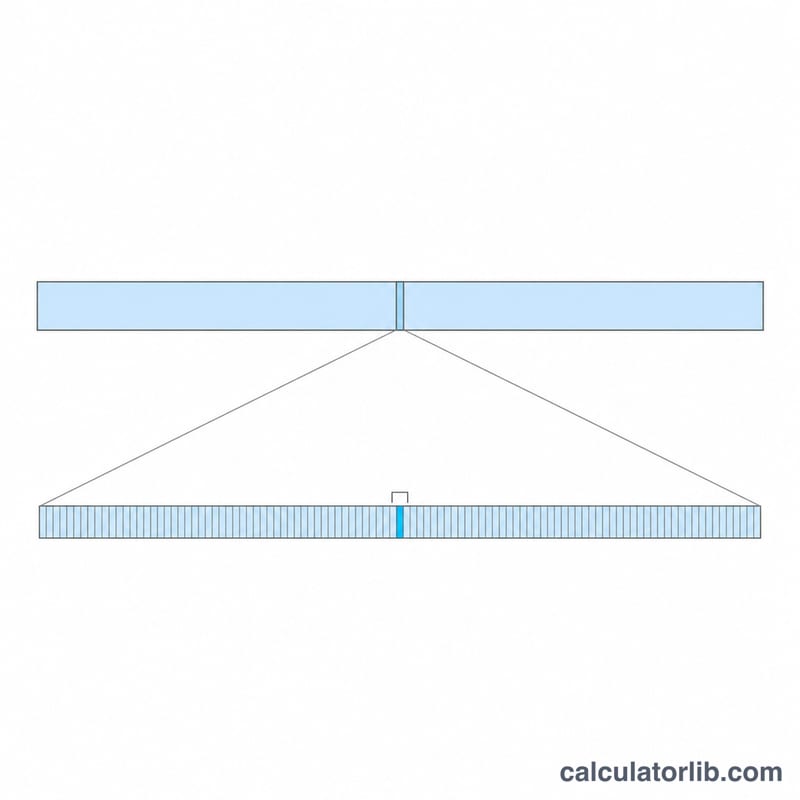
- One basis point is 0.01 percentage point, or 0.0001 as a decimal, following the SEC glossary definition. So 8% equals 800 bp.
- A move of N bp is added to the base rate in percentage points. It is not treated as a relative change.
- The yearly amount change is simple one-year interest on a constant principal: no compounding and no term.
- Negative basis points, percentages and resulting rates are accepted and computed as entered.
- Results are calculated unrounded. Display shows basis points to 4 decimals, percent to 6, decimals to 8 and money to 2, with trailing zeros trimmed.
The additive rule and the simple-interest rule are design choices consistent with the definition, not statements from the cited source.

Worked example
Convert 25 bp, with a current rate of 5%, a change of 25 bp and a principal of 10,000.
$$bp = 25 \qquad p = \frac{25}{100} = 0.25\% \qquad d = \frac{25}{10000} = 0.0025$$
$$r_{new} = 5 + \frac{25}{100} = 5.25\%$$
The relative change of the rate is \(\frac{0.25}{5} \times 100 = 5\%\), shown for information only.
$$\text{Old interest} = 10000 \times \frac{5}{100} = 500 \qquad \text{New interest} = 10000 \times \frac{5.25}{100} = 525$$
$$\Delta A = \frac{10000 \times 25}{10000} = 25$$
Reading the result and limitations
The change in percentage points is the figure to compare with announced rate moves. The relative change is empty when the current rate is 0, because division by zero is undefined. The yearly amount change is a quick estimate of the value of N bp. Amortising loans, compounding, variable balances and bond price sensitivity (DV01) give different figures. This tool is informational and not financial advice.
FAQ
How many basis points are in one percent?
One percent equals 100 basis points, so 0.25% equals 25 bp.
What does a 25 bp rate hike mean?
The rate rises by 0.25 percentage point. A 5% rate becomes 5.25%.
Is a basis point change relative to the rate?
No. It is an absolute move in percentage points. A 25 bp rise on 5% is a 5% relative increase, but the rate moves by 0.25 points.
How do I convert basis points to a decimal?
Divide by 10,000. For example, 25 bp is 0.0025.
Can I enter fractional or negative basis points?
Yes. Values such as 0.5 bp or -25 bp are accepted. A negative move is a rate cut.
Sources
- Basis Point (Investor.gov glossary), U.S. Securities and Exchange Commission, 2026