What this calculator does
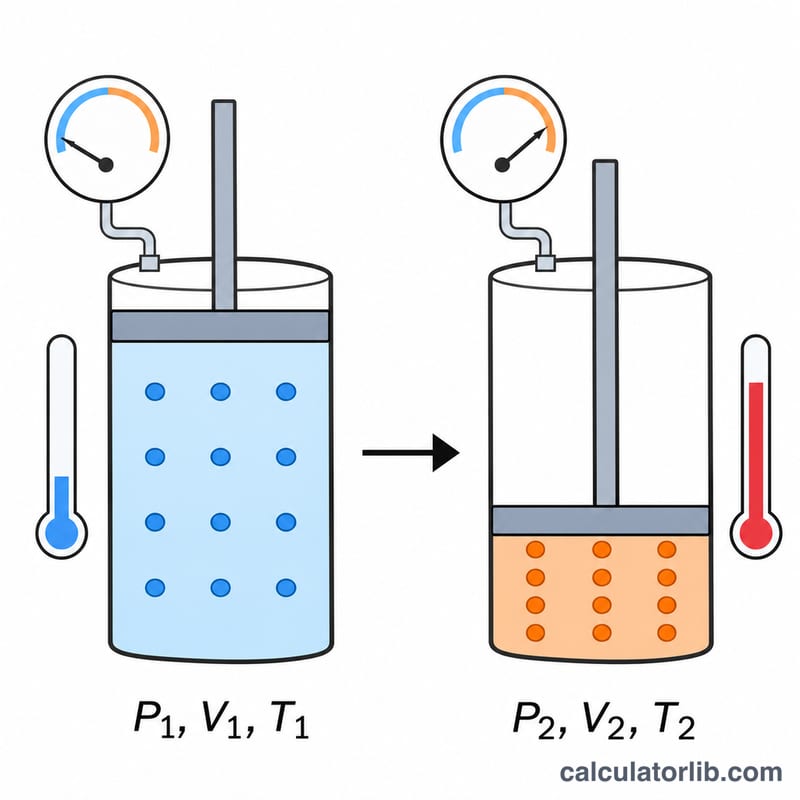
This calculator solves the combined gas law for any one of six quantities: initial or final pressure, volume or temperature. It applies to a fixed amount of ideal gas that moves from one set of conditions to another. Students, lab workers and anyone comparing a gas sample under two conditions can use it. Temperatures are converted to kelvin internally, and temperatures at or below absolute zero are refused.
How to use it
Pick the quantity to solve for. Enter the five known values: initial pressure P1, initial volume V1, initial temperature T1, final pressure P2, final volume V2 and final temperature T2. The box of the quantity being solved is ignored. Then choose the pressure unit (atm, kPa, Pa, bar or torr), the volume unit (L, mL, cm3 or m3) and the temperature unit (degrees Celsius, kelvin or degrees Fahrenheit). Each unit applies to both states. Pressures and volumes must be greater than zero.
The formula
For a fixed amount of gas the ratio of pressure times volume to temperature is the same in both states:
$$\frac{P_1 V_1}{T_1} = \frac{P_2 V_2}{T_2}$$Solving for the final volume gives:
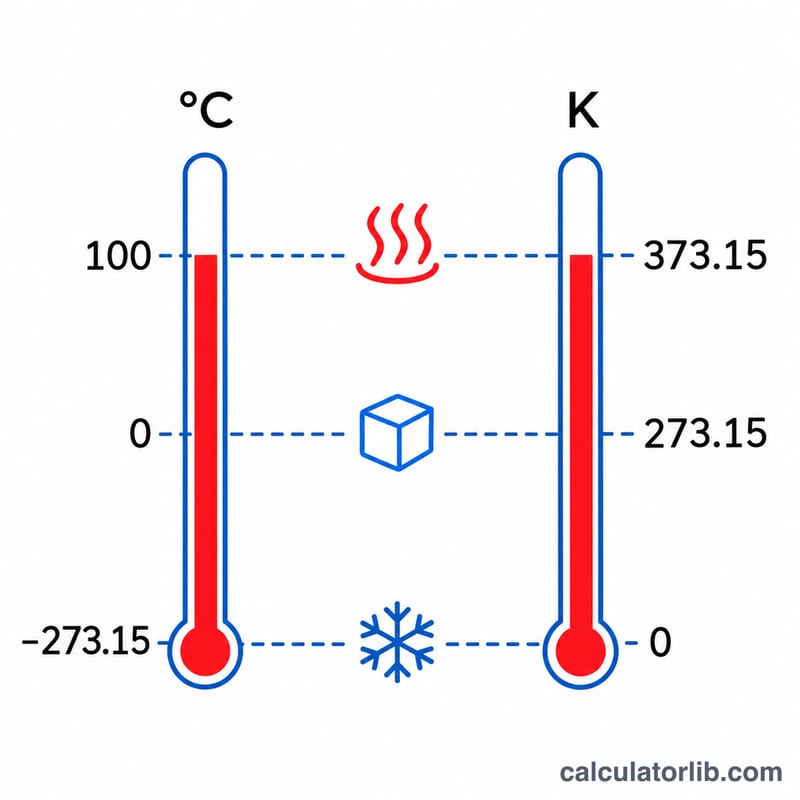
$$V_2 = \frac{P_1 V_1 T_2}{P_2 T_1}$$Here \(P\) is pressure, \(V\) is volume and \(T\) is absolute temperature in kelvin; subscript 1 is the initial state and subscript 2 the final state. The other five quantities are rearranged in the same way. Celsius is converted with \(T_K = T_C + 273.15\), and Fahrenheit with \(T_K = (T_F - 32)\times \tfrac{5}{9} + 273.15\).
Conventions and assumptions
- Law used: the combined gas law, valid when the moles of an ideal gas are constant between the two states (OpenStax Chemistry 2e).
- All temperatures are converted to kelvin before any arithmetic, because gas law calculations require the kelvin scale. A solved temperature is converted back to your chosen unit.
- The Celsius offset is exactly 273.15, not the rounded 273, so the last digit can differ from textbook answers that round to 273.
- Pressure conversions to atm: 1 atm = 101.325 kPa = 101325 Pa = 760 torr, and 1 bar = 100 kPa.
- Volume conversions to litres: 1 mL = 1 cm3 = 0.001 L and 1 m3 = 1000 L.
- The Fahrenheit conversion is the standard exact definition, offered for convenience.
- The gas is assumed ideal. Results are estimates at high pressure or low temperature, where real gases deviate.
- Defaults are atm, L and degrees Celsius, which reproduce the textbook ammonia example.
- The result is shown to 4 significant figures, in scientific notation if it is below 0.0001 or at least 1,000,000,000.
Worked example
A gas has \(P_1 = 0.85\) atm, \(V_1 = 0.25\) L and \(T_1 = 27\) °C. It is brought to \(P_2 = 1\) atm and \(T_2 = 0\) °C. Find \(V_2\). First convert the temperatures:
$$T_1 = 27 + 273.15 = 300.15\,\text{K},\quad T_2 = 0 + 273.15 = 273.15\,\text{K}$$$$V_2 = \frac{0.85 \times 0.25 \times 273.15}{1 \times 300.15} = 0.19338\,\text{L}$$The displayed result is 0.1934 L, which matches the textbook answer of 0.193 L. The common ratio is \(PV/T = 0.0007080\) atm·L/K, and the base-unit result is the same 0.1934 L.
Reading the result and limitations
The result is given in the unit you selected for the solved quantity, with the base-unit value (atm, L or K) and the constant ratio P·V/T alongside. A result that is not finite or not greater than zero is rejected. The calculation assumes the amount of gas does not change and that the gas behaves ideally. The ideal assumption is reasonable at relatively low pressure and high temperature; at high pressure the answer is a ballpark estimate. The textbook flags its own high-pressure scuba tank example this way: with \(P_1 = 153\) atm, \(V_1 = 13.2\) L, \(T_1 = 27\) °C, \(P_2 = 3.13\) atm and \(T_2 = 37\) °C, this method gives about 667 L.
FAQ
Why must temperature be in kelvin?
The source states that temperatures must be on the kelvin scale for any gas law calculation. This calculator converts Celsius and Fahrenheit automatically.
Can I use negative Celsius or Fahrenheit values?
Yes, as long as the equivalent kelvin value is above zero. Values at or below 0 K (-273.15 °C, -459.67 °F) are refused.
Do the pressure and volume units need to match between states?
The same unit is applied to both states, so the ratio stays consistent. You only pick one pressure unit and one volume unit.
Why does my answer differ slightly from a textbook?
Some textbook examples round the offset to 273 K. This calculator uses 273.15, so the last digit can differ.
What if the amount of gas changes?
The combined gas law does not apply. Use an ideal gas law calculator that includes the number of moles.
Sources
- 9.2 Relating Pressure, Volume, Amount, and Temperature: The Ideal Gas Law, Chemistry 2e - OpenStax (Rice University), 2019