What this calculator does
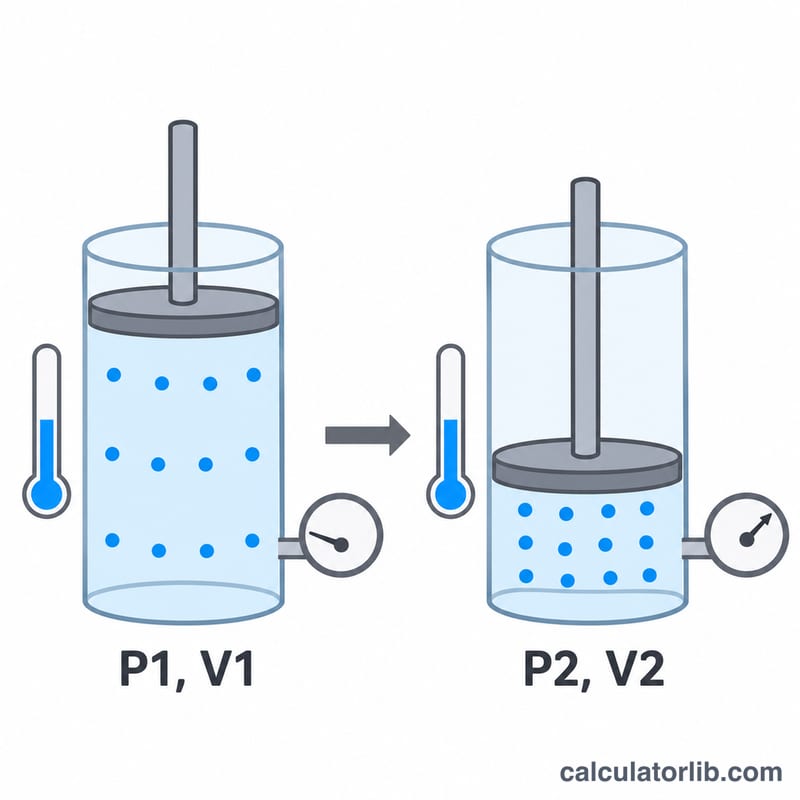
This calculator applies Boyle's law to a fixed amount of gas held at constant temperature. Enter three of the four quantities (initial pressure, initial volume, final pressure, final volume) and it solves for the fourth. It also reports the product \(P \times V\), the pressure ratio and the volume ratio. It suits chemistry students, lab workers and anyone checking how a gas responds when it is compressed or expanded.
How to use it
Follow the form order:
- Solve for: choose P1, V1, P2 or V2. The value typed in that field is ignored.
- Pressure unit: atm, kPa, Pa, bar, torr, mmHg or psi. It applies to both states.
- Volume unit: L, mL, m³ or cm³. It applies to both states.
- P1, V1, P2, V2: enter the three known values. Each must be greater than 0, and pressures must be absolute, not gauge.
Results are calculated as full-precision numbers and displayed to 4 significant figures, so a value such as 17.727 is shown as 17.73.
The formula
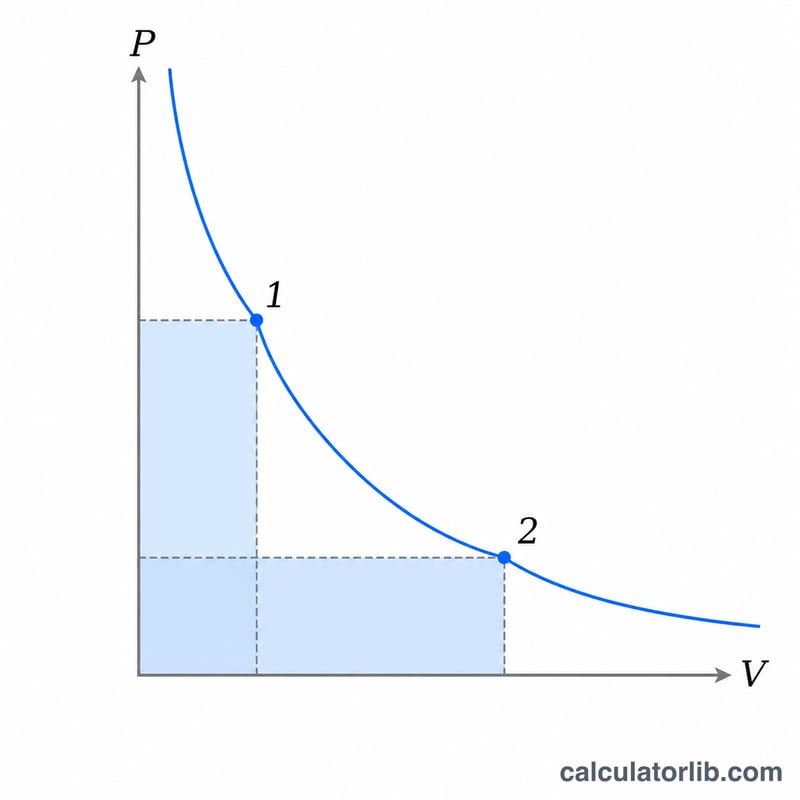
Boyle's law states that pressure and volume are inversely proportional at constant temperature and amount of gas:
$$P_1 V_1 = P_2 V_2$$
Rearranged for each unknown:
$$P_2 = \frac{P_1 V_1}{V_2}, \quad V_2 = \frac{P_1 V_1}{P_2}, \quad P_1 = \frac{P_2 V_2}{V_1}, \quad V_1 = \frac{P_2 V_2}{P_1}$$
Here \(P_1\) and \(V_1\) are the initial absolute pressure and volume, and \(P_2\) and \(V_2\) are the final values. The constant \(k = P_1 V_1\) is also reported.
Conventions and assumptions
- Ideal gas, constant T and n: the law holds for a fixed amount of ideal gas at constant temperature. Ideal behaviour is reasonable only at relatively low pressure and high temperature.
- Absolute pressure: gauge pressure must not be entered.
- No unit conversion: one pressure unit and one volume unit apply to both states. The units cancel in the ratio, so the result is returned in the unit you selected.
- Temperature changes: temperature is not an input. If it changes, use a combined gas law tool.
- Rounding: calculations use full-precision values and the display shows 4 significant figures. The answer is only as accurate as the measurements.

Worked example
A gas at \(P_1 = 13\) psi occupies \(V_1 = 15\) mL. It is compressed to \(V_2 = 7.5\) mL. Find \(P_2\).
$$P_2 = \frac{P_1 V_1}{V_2} = \frac{13 \times 15}{7.5} = 26\ \text{psi}$$
The product is \(k = 13 \times 15 = 195\) (psi·mL). The pressure ratio is \(P_2/P_1 = 2\) and the volume ratio is \(V_2/V_1 = 0.5\). Halving the volume doubles the pressure.
Reading the result and limitations
The main result is the solved quantity in your chosen unit. A pressure ratio above 1 with a volume ratio below 1 indicates compression, and the two ratios are always reciprocals. Real gases deviate from the law at high pressure or low temperature, so treat those results as approximations. If a result overflows to a non-finite number, it is shown as an error.
FAQ
Does temperature matter?
Yes. The law requires constant temperature. If temperature changes, a combined gas law calculation is needed.
Can I enter gauge pressure?
No. Use absolute pressure. Gauge pressure ignores atmospheric pressure and gives wrong results.
Do I need to convert units?
No, as long as both pressures share one unit and both volumes share one unit. The units cancel.
What happens to the value in the solved field?
It is ignored, even if it is zero or invalid.
What if two pressures are equal?
Then the volumes are equal and both ratios equal 1.
Sources
- 9.2 Relating Pressure, Volume, Amount, and Temperature: The Ideal Gas Law, Chemistry 2e – OpenStax (Rice University), 2019