What is year-end tax settlement (yeonmal jeongsan)?
In Korea your employer withholds income tax from every paycheck using the simplified withholding table. In February of the next year it recalculates the tax you really owe for the whole year (the final tax) and compares it with what was withheld. If the final tax is lower you get the difference back as a refund; if it is higher, the difference is taken from your February pay. You can choose the tax year: the default is the 2026 tax year (pay received in 2026, settled in early 2027), and the 2025 tax year (settled in early 2026) is still available.
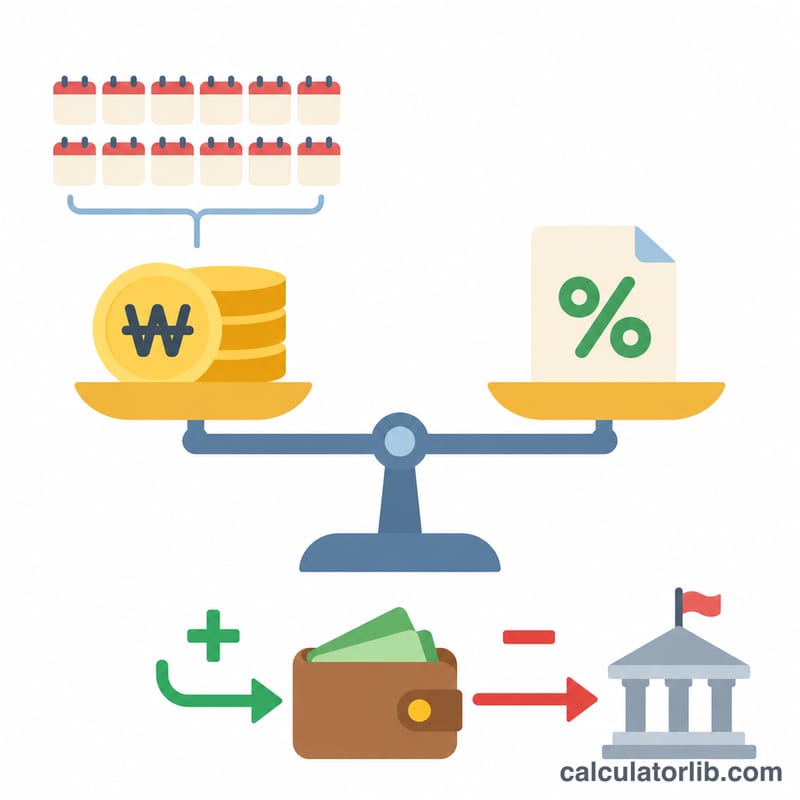
How the tax is calculated
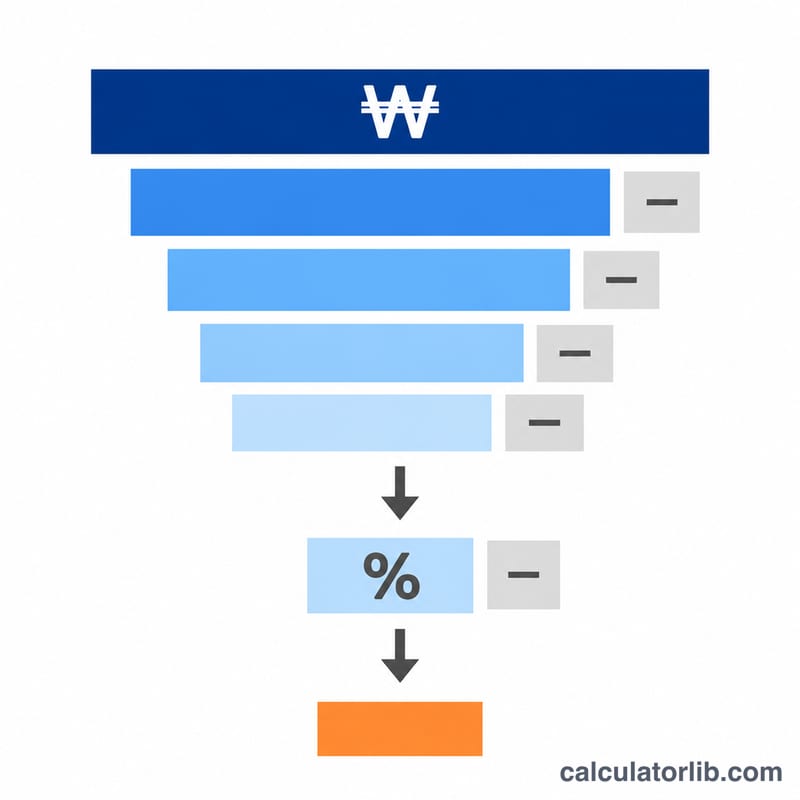
- Total pay = annual pay − non-taxable pay (for example a meal allowance up to KRW 200,000 a month).
- Earned income deduction (Income Tax Act Art. 47): a sliding deduction by total pay, at most KRW 20 million. Earned income amount = total pay − this deduction.
- Personal deductions: KRW 1,500,000 for you and each eligible dependent (Art. 50), plus KRW 1,000,000 for each person aged 70 or over and KRW 2,000,000 for each person with a disability (Art. 51).
- National pension paid by you is deducted in full (Art. 51-3), and so are health, long-term care and employment insurance (Art. 52(1)).
- Calculated tax = tax base × the basic rates of Art. 55 (8 brackets, 6% to 45%).
- Tax credits: the earned income tax credit (Art. 59, limited to between KRW 740,000 and 200,000 depending on total pay) and the child tax credit for children aged 8 or over (9 or over for the 2026 tax year): KRW 250,000 for one, 550,000 for two and 400,000 more for each further child (Art. 59-2).
- Standard tax credit of KRW 130,000 (Art. 59-4(9)): only when you claim no special income deduction (the insurance deduction counts as one) and no special tax credit. The National Tax Service says the two cannot be combined and you take whichever is better, so the calculator works out both and uses the lower tax.
- Local income tax = 10% of the final income tax (Local Tax Act Art. 103-13).
- Refund or additional payment = final tax − tax withheld, amounts below KRW 10 dropped (National Treasury Management Act Art. 47).
Earned income deduction: Income Tax Act Art. 47, at most KRW 20 million
Additional deduction: 70 or over KRW 1,000,000, disability KRW 2,000,000 (Art. 51)
Health and employment insurance deduction: Art. 52(1); 0 when the standard tax credit is better
Child tax credit: Art. 59-2: 1 child KRW 250,000, 2 children KRW 550,000, +KRW 400,000 each after
The KRW 130,000 standard tax credit gives a lower tax than deducting health and employment insurance, so it is used. The two cannot be combined.
Worked example
Annual pay KRW 50,000,000 with a non-taxable meal allowance of 2,400,000, no dependents, national pension 2,142,000, health, long-term care and employment insurance 2,100,000, and 2,000,000 of income tax withheld during the year.
| Step | Amount (KRW) |
|---|---|
| Total pay (50,000,000 − 2,400,000) | 47,600,000 |
| Earned income deduction 12,000,000 + (47,600,000 − 45,000,000) × 5% | 12,130,000 |
| Earned income amount | 35,470,000 |
| Tax base (− 1,500,000 − 2,142,000 − 2,100,000) | 29,728,000 |
| Calculated tax 840,000 + (29,728,000 − 14,000,000) × 15% | 3,199,200 |
| Earned income tax credit (limit 660,000) | 660,000 |
| Final income tax / local income tax | 2,539,200 / 253,920 |
| Additional payment (539,200 + 53,920) | 593,120 |
Taking the KRW 130,000 standard credit instead of the insurance deduction would give a final tax of 2,724,200, so here the insurance deduction is better.
What this estimate leaves out
This is an estimate. It does not include the credit card spending deduction, housing fund and housing subscription deductions, credits for insurance premiums, medical, education and donations, the monthly rent credit, pension savings and retirement pension credits, the marriage credit, the birth or adoption child credit, the female householder and single parent deductions, or the SME employee tax reduction. All of them can only lower your tax, so your real refund can be larger. Check the exact figure in the Hometax year-end settlement preview or on the withholding receipt from your employer.
What changes for the 2026 tax year
| Item | 2025 tax year | 2026 tax year |
|---|---|---|
| National pension rate (employee share) | 9% (4.5%) | 9.5% (4.75%) |
| National pension monthly income floor–ceiling | Jan–Jun KRW 390,000–6,170,000; Jul–Dec KRW 400,000–6,370,000 | Jan–Jun KRW 400,000–6,370,000; Jul–Dec KRW 410,000–6,590,000 |
| Health insurance rate (employee share) | 7.09% (3.545%) | 7.19% (3.595%) |
| Long-term care insurance | 12.95% of the health premium | 13.14% of the health premium (0.9448% of pay) |
| Monthly health premium floor–ceiling | KRW 19,780–9,008,340 | KRW 20,160–9,183,480 |
| Child tax credit age | 8 or older | 9 or older (children born in 2017 excluded) |
The income tax rates (Article 55), the earned income deduction (Article 47), the earned income tax credit and its limits (Article 59), the child tax credit amounts (Article 59-2), the personal deductions (Articles 50 and 51) and the KRW 130,000 standard tax credit (Article 59-4) did not change for 2026. The employee's employment insurance rate stays at 0.9%.
With the same inputs as the worked example above (pay KRW 50,000,000 with KRW 2,400,000 non-taxable, no dependents, KRW 2,000,000 income tax withheld) for the 2026 tax year and the social insurance boxes left blank, the calculator estimates national pension at KRW 2,260,560 and health, long-term care and employment insurance at KRW 2,364,240. The tax base is KRW 29,345,200, the calculated tax KRW 3,141,780, the earned income tax credit KRW 660,000, the final income tax KRW 2,481,780 and local income tax KRW 248,178, so you pay KRW 529,950 more (KRW 481,780 + KRW 48,170).
Sources: National Pension Service, contributions, Enforcement Decree of the National Health Insurance Act, Article 44(1), Ministry of Health and Welfare, 2026 long-term care insurance rate, Notice on the monthly health premium ceiling and floor (in force 1 January 2026).
Child age rule changes from the 2026 tax year
The Income Tax Act amendment [Act No. 21548, 21 April 2026] changed "8 or older" in Article 59-2(1) to "13 or older", in force on the day of promulgation. Addenda Article 2 reads, in the original Korean:
부칙 제2조(자녀세액공제의 연령기준에 관한 적용례 등) ① 제59조의2제1항의 개정규정은 이 법 시행일이 속하는 과세기간분부터 적용한다. ② 제59조의2제1항의 개정규정에도 불구하고 2026년부터 2029년까지의 과세기간분의 자녀세액공제 공제대상자녀 및 손자녀의 연령기준에 관하여는 다음 각 호의 구분에 따른다. 1. 2026년 1월 1일부터 2026년 12월 31일까지의 과세기간분: 9세 이상 2. 2027년 1월 1일부터 2027년 12월 31일까지의 과세기간분: 10세 이상 3. 2028년 1월 1일부터 2028년 12월 31일까지의 과세기간분: 11세 이상 4. 2029년 1월 1일부터 2029년 12월 31일까지의 과세기간분: 12세 이상 ③ 2017년 1월 1일부터 2017년 12월 31일까지 출생한 자녀세액공제 공제대상자녀 및 손자녀에 대해서는 제2항을 적용하지 아니한다.
So the amendment applies from the 2026 tax year, and no provision reaches back to 2025. The settlement of 2025 income (early 2026) still uses the old rule, children aged 8 or older. This calculator uses 8 or older when you choose the 2025 tax year and 9 or older when you choose 2026. The age is 10 for 2027, 11 for 2028, 12 for 2029 and 13 or older from 2030. Paragraph 2 does not apply to children born in 2017, so they follow the amended rule of 13 or older and do not count for 2026: the children who count for 2026 are those born from 2006 to 2016 (a child counts if they reach the age on any day of the tax year, Article 53(5)). We will check this again when the National Tax Service publishes its 2026 guide.
Income Tax Act enactment and amendment texts, National Law Information Center
Checked against
The articles were read on the National Law Information Center on 31 October and 8 November 2026 (Income Tax Act, up to Act No. 21548). The social insurance estimate uses the rates of the tax year you choose: for 2025, pension 4.5%, health insurance half of 7.09%, long-term care 12.95% of the health premium and employment insurance 0.9%; for 2026, pension 4.75%, health insurance half of 7.19%, long-term care 13.14% of the health premium and employment insurance 0.9%. The National Tax Service has not yet published its guide for the 2026 tax year (as of 8 November 2026).