What is BMI?
Body Mass Index (BMI) is a numerical value calculated from a person's weight and height. It provides a simple measure to categorize individuals as underweight, normal weight, overweight, or obese.
When to Use BMI Calculator
BMI calculations are valuable in the following scenarios:
- Health assessments to identify potential weight-related health risks
- Population studies to track weight trends across different demographics
- Personal weight management goals to establish a baseline and track progress
How to Calculate BMI
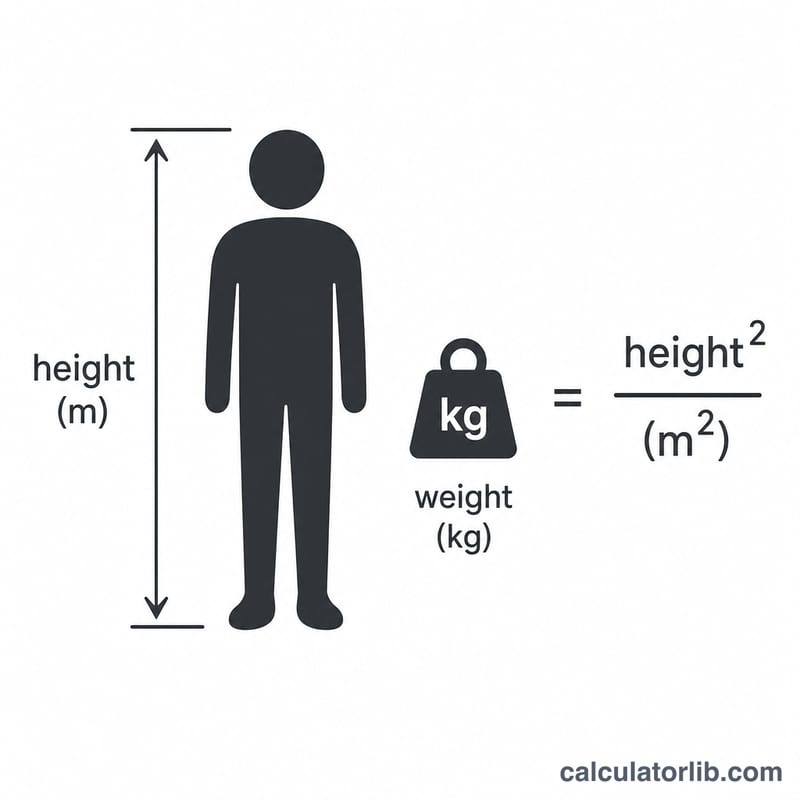
The BMI formula varies depending on the measurement system used:
Metric Units: \( \text{BMI} = \frac{\text{weight (kg)}}{\text{height}^2 \text{ (m}^2)} \)
Imperial Units: \( \text{BMI} = 703 \times \frac{\text{weight (lb)}}{\text{height}^2 \text{ (in}^2)} \)
BMI Categories
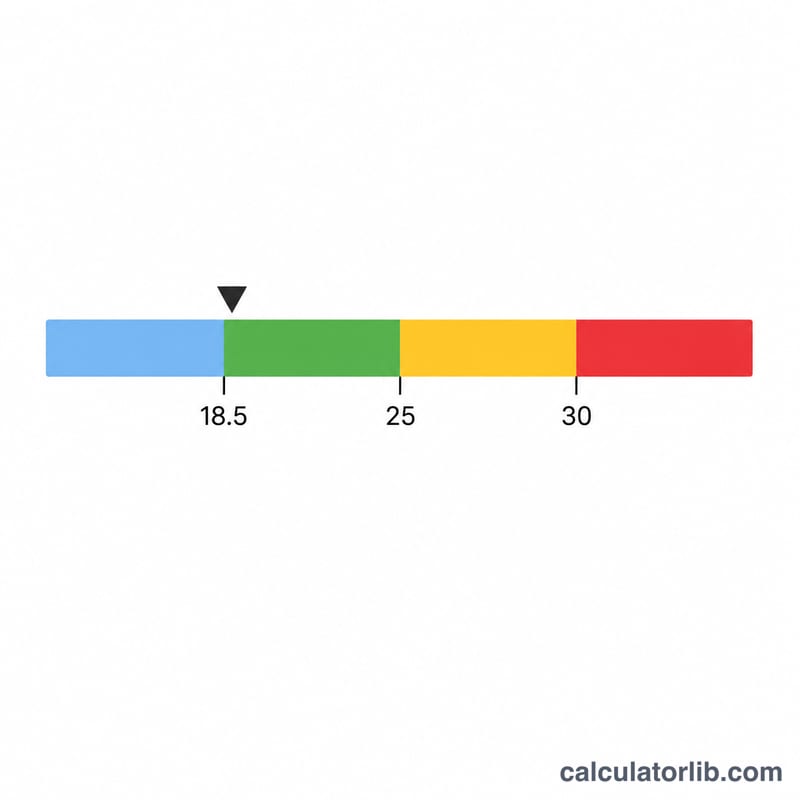
| BMI Range | Weight Category |
|---|---|
| Below 18.5 | Underweight |
| 18.5 - 24.9 | Normal weight |
| 25.0 - 29.9 | Overweight |
| 30.0 and above | Obesity |
BMI Calculation Example
Let's calculate the BMI for someone who weighs 70 kg and is 1.75 m tall:
$$ \text{BMI} = \frac{70}{1.75 \times 1.75} = \frac{70}{3.0625} = 22.86 $$
With a BMI of 22.86, this person falls within the normal weight category.
BMI Limitations
BMI doesn't distinguish between muscle and fat mass. Athletes or muscular individuals may have a high BMI despite having healthy body composition. BMI may not be suitable for children, elderly, pregnant women, or certain ethnic groups.
Interpreting Your BMI Result
Body Mass Index (BMI) is a screening measure that relates your weight to your height. The metric formula divides weight in kilograms by the square of height in metres: \(\text{BMI} = \frac{\text{weight (kg)}}{(\text{height (m)})^2}\). The result is expressed in units of \(\text{kg/m}^2\).
The World Health Organization (WHO) classifies BMI for adults into the following categories:
| BMI range (kg/m²) | WHO category |
|---|---|
| Below 18.5 | Underweight |
| 18.5 – 24.9 | Normal weight |
| 25.0 – 29.9 | Overweight (pre-obesity) |
| 30.0 and above | Obesity |
BMI reflects an estimate of total body mass relative to height across a population. It is a simple, inexpensive screening tool that is useful for comparing groups and tracking trends.
BMI does not directly measure body fat percentage, and it does not distinguish between muscle, bone, water and fat. As a result it can misclassify muscular athletes, older adults with reduced muscle mass, pregnant people, and some ethnic groups for whom different cut-off points may apply. It also does not indicate where fat is distributed on the body, which is independently relevant to health.
This calculator is for general informational purposes only and is not medical advice. For an assessment of your individual health, consult a qualified healthcare professional.
BMI Across Different Height and Weight Scenarios
The table below shows BMI values computed for several realistic height and weight combinations, with the corresponding WHO category. Each BMI is rounded to one decimal place. Values are shown in both metric and approximate imperial equivalents.
| Height | Weight | BMI (kg/m²) | WHO category |
|---|---|---|---|
| 1.70 m (5'7") | 65 kg (143 lb) | 22.5 | Normal weight |
| 1.80 m (5'11") | 95 kg (209 lb) | 29.3 | Overweight |
| 1.68 m (5'6") | 63.5 kg (140 lb) | 22.5 | Normal weight |
| 1.83 m (6'0") | 95.3 kg (210 lb) | 28.5 | Overweight |
| 1.60 m (5'3") | 45 kg (99 lb) | 17.6 | Underweight |
| 1.75 m (5'9") | 98 kg (216 lb) | 32.0 | Obesity |
Worked check for the first row: \(\text{BMI} = \frac{65}{(1.70)^2} = \frac{65}{2.89} = 22.5\,\text{kg/m}^2\), which falls in the normal range.
Height and Weight Unit Conversions
If you only know your measurements in one system of units, the factors below let you convert before calculating BMI. The metric formula needs kilograms and metres; the imperial formula uses pounds, inches and the multiplier 703.
| Conversion | Factor / formula |
|---|---|
| Kilograms to pounds | \(\text{lb} = \text{kg} \times 2.20462\) |
| Pounds to kilograms | \(\text{kg} = \text{lb} \div 2.20462\) |
| Centimetres to inches | \(\text{in} = \text{cm} \div 2.54\) |
| Inches to centimetres | \(\text{cm} = \text{in} \times 2.54\) |
| Centimetres to metres | \(\text{m} = \text{cm} \div 100\) |
| Feet and inches to inches | \(\text{in} = (\text{ft} \times 12) + \text{in}\) |
The imperial BMI formula incorporates a multiplier of 703 to convert pounds-per-inch-squared into the standard \(\text{kg/m}^2\) scale:
$$\text{BMI} = \frac{\text{weight (lb)}}{(\text{height (in)})^2} \times 703$$
Common height conversions for reference:
| Height (ft/in) | Inches | Centimetres | Metres |
|---|---|---|---|
| 5'0" | 60 | 152.4 | 1.524 |
| 5'6" | 66 | 167.6 | 1.676 |
| 5'9" | 69 | 175.3 | 1.753 |
| 6'0" | 72 | 182.9 | 1.829 |
| 6'3" | 75 | 190.5 | 1.905 |
BMI Across Common Height and Weight Combinations
Body mass index is defined as mass in kilograms divided by the square of height in metres:
$$\text{BMI} = \frac{\text{Weight (kg)}}{\left(\text{Height (m)}\right)^2}$$The table below recomputes BMI directly from that formula for a range of realistic height–weight pairs, rounded to one decimal place. Imperial equivalents use 1 kg = 2.20462 lb and 1 m = 39.3701 in, and are rounded, so the metric column is the exact basis of each calculation. Categories follow the World Health Organization (WHO) classification for adults (underweight < 18.5; normal 18.5–24.9; pre-obesity 25.0–29.9; obesity class I 30.0–34.9, class II 35.0–39.9, class III ≥ 40.0). These cut-offs are intended for adults aged roughly 20 and over; they are not used for children, adolescents or pregnancy, and some national guidelines — for example WHO's additional Asian action points at 23.0 and 27.5 — apply lower thresholds.
| Height (m) | Height (ft/in) | Weight (kg) | Weight (lb) | BMI (kg/m²) | WHO category (adults) |
|---|---|---|---|---|---|
| 1.65 | 5 ft 5 in | 45 | 99.2 | 16.5 | Underweight |
| 1.60 | 5 ft 3 in | 50 | 110.2 | 19.5 | Normal weight |
| 1.70 | 5 ft 7 in | 60 | 132.3 | 20.8 | Normal weight |
| 1.60 | 5 ft 3 in | 70 | 154.3 | 27.3 | Pre-obesity (overweight) |
| 1.75 | 5 ft 9 in | 85 | 187.4 | 27.8 | Pre-obesity (overweight) |
| 1.85 | 6 ft 1 in | 95 | 209.4 | 27.8 | Pre-obesity (overweight) |
| 1.70 | 5 ft 7 in | 100 | 220.5 | 34.6 | Obesity class I |
| 1.75 | 5 ft 9 in | 110 | 242.5 | 35.9 | Obesity class II |
| 1.80 | 5 ft 11 in | 130 | 286.6 | 40.1 | Obesity class III |
Worked check for the 1.75 m / 85 kg row, with every substitution shown:
$$\text{BMI} = \frac{85}{(1.75)^2} = \frac{85}{3.0625} = 27.755\ldots \approx 27.8$$Two rows in the table illustrate a property of the index that is easy to miss: 85 kg at 1.75 m and 95 kg at 1.85 m both give a BMI of about 27.8. Because height is squared, a 10 cm difference in stature absorbs roughly 10 kg of body mass at the same index value. The same arithmetic explains why 70 kg lands in the pre-obesity band at 1.60 m (BMI 27.3) but in the normal band at 1.85 m, where \(70 / 1.85^2 = 70 / 3.4225 = 20.5\).
If the calculator is set to imperial units, the equivalent formula is \(\text{BMI} = 703 \times \text{weight (lb)} / \text{height (in)}^2\); the factor 703 is simply the unit conversion, so both routes give the same number.
This section is general information about how the index is computed and classified, not professional medical advice. BMI is a population-level screening measure and does not, on its own, describe an individual's health; interpretation for a specific person belongs with a qualified clinician.
Key BMI Terms Defined
The definitions below are descriptive only — they state what each term means and how it is measured, without giving health advice.
- Body mass index (BMI) — a ratio of body mass to the square of body height, expressed in kilograms per square metre (kg/m²): \(\text{BMI} = \text{kg} / \text{m}^2\). It was popularised as the "Quetelet index" and is a simple index of relative weight for height, not a measurement of body composition.
- Weight (body mass) — the quantity of body mass, measured in kilograms (kg) or pounds (lb); 1 kg = 2.20462 lb. For consistency it is usually recorded on a calibrated scale with light clothing and no shoes.
- Height (stature) — standing height measured in metres or centimetres (or feet and inches), taken without shoes with the head in a neutral position. Because height is squared in the formula, a 1 cm measurement error changes BMI by roughly 0.3–0.4 units for a typical adult.
- Body fat percentage — the proportion of total body mass that is adipose tissue, expressed as a percentage. It is estimated by methods such as DXA scanning, air-displacement plethysmography, bioelectrical impedance or skinfold calipers — never by the BMI formula, which has no way to distinguish fat from other tissue.
- Lean mass and fat mass — the two components body mass is usually split into. Fat mass is adipose tissue; lean (fat-free) mass covers muscle, bone, organs and body water. Two people with identical BMI can have very different lean-to-fat ratios, which is why highly muscular individuals can score in the pre-obesity range without excess adiposity.
- Screening tool vs diagnostic test — a screening tool sorts a population into groups that may warrant further assessment; a diagnostic test establishes whether a specific condition is present in an individual. BMI is a screening tool: a value above or below a cut-off indicates that further measurement or clinical assessment may be appropriate, and does not by itself diagnose anything.
- WHO pre-obesity (overweight) — the World Health Organization label for an adult BMI of 25.0 to 29.9 kg/m². "Pre-obesity" is the WHO's own terminology for this band; "overweight" is used in many national guidelines for the same range.
- Obesity class I — adult BMI of 30.0 to 34.9 kg/m² in the WHO classification.
- Obesity class II — adult BMI of 35.0 to 39.9 kg/m².
- Obesity class III — adult BMI of 40.0 kg/m² or above; sometimes described in clinical literature as severe obesity.
- Adult cut-off caveat — the fixed thresholds above are the WHO international adult standard. WHO also describes additional public-health action points of 23.0 and 27.5 kg/m² for some Asian populations, and several countries publish their own adjusted thresholds, so the band a given BMI falls into can depend on which national guideline is being applied.
- BMI-for-age percentile (children and adolescents) — for people under about 20, BMI is not compared with fixed numbers but plotted on sex- and age-specific growth reference charts (for example the WHO growth references, or the CDC charts used in the United States). The result is a percentile: a BMI-for-age at the 60th percentile means the value is higher than that of 60% of the reference population of the same age and sex.
- Waist circumference — the girth of the abdomen measured with a tape at a defined landmark (commonly the midpoint between the lowest rib and the top of the iliac crest, or at the level of the navel, depending on the protocol). It is a complementary measure because it reflects central (abdominal) fat distribution, which BMI cannot capture.
- Waist-to-height ratio (WHtR) — waist circumference divided by height in the same units, so it is dimensionless: \(\text{WHtR} = \text{waist} / \text{height}\). A person with a 84 cm waist and 175 cm height has \(84 / 175 = 0.48\). A boundary of 0.5 is widely cited — the UK's NICE guidance, for example, uses "keep your waist to less than half your height" as a simple message — and the ratio is used alongside BMI rather than instead of it.
- Metric vs imperial input — the same index computed two ways. Metric: kilograms divided by metres squared. Imperial: \(703 \times \text{lb} / \text{in}^2\), where 703 is the conversion constant that reconciles pounds and inches with kg/m².
These entries are general reference information, not professional medical advice. What any particular BMI value means for an individual depends on age, sex, ethnicity, body composition and clinical history, and should be interpreted with a qualified health professional.
How to Calculate BMI with Kilograms and Centimetres, Step by Step
The BMI formula uses height in metres, but most people know their height in centimetres. Here is the whole calculation for an adult who weighs 60 kg and is 165 cm tall:
- Convert the height to metres by dividing by 100: 165 cm = 1.65 m.
- Square the height: \(1.65 \times 1.65 = 2.7225\).
- Divide the weight by the squared height: \(60 \div 2.7225 = 22.04\).
- Round to one decimal place: the BMI is 22.0 kg/m².
You can also skip the conversion to metres. The U.S. Centers for Disease Control and Prevention (CDC) gives an equivalent form that works directly with centimetres:
$$\text{BMI} = \frac{\text{weight (kg)}}{\text{height (cm)} \times \text{height (cm)}} \times 10\,000$$For the same person: \(60 \div (165 \times 165) \times 10\,000 = 60 \div 27\,225 \times 10\,000 = 22.04\), so again 22.0.
With pounds, feet and inches
First turn the height into inches only: 5 ft 9 in = \(5 \times 12 + 9 = 69\) in. Then use the U.S. customary formula with the factor 703: \(703 \times 160 \div 69^2 = 703 \times 160 \div 4761 = 23.63\). For someone who weighs 160 lb and is 5 ft 9 in tall, the BMI is 23.6. The calculator converts pounds and inches to kilograms and centimetres exactly instead of using 703, and shows the same 23.6.
Common mistakes
- Dividing by the height only once instead of by the height squared.
- Putting centimetres into the metre formula without the factor 10,000: \(60 \div 165^2\) gives about 0.0022, not 22.
- Entering feet and inches as a decimal: 5 ft 9 in is 5.75 ft, not 5.9 ft.
The calculation is the same for everyone. For children and teens, the result is then read on sex- and age-specific BMI-for-age charts rather than against the adult cut-offs, as described above. This is general information, not medical advice.
Sources: CDC, BMI Frequently Asked Questions: How is BMI calculated?; World Health Organization, Obesity and overweight (fact sheet, 2026).