
What Is Brewster's Angle?
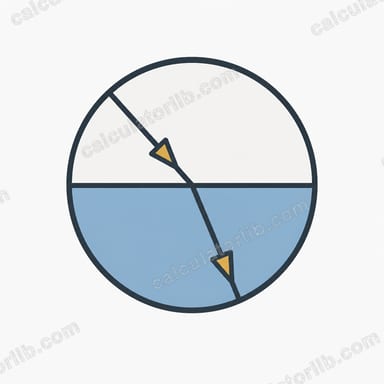
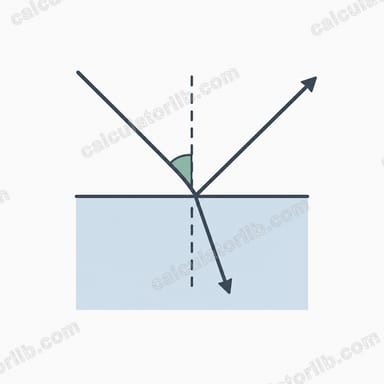
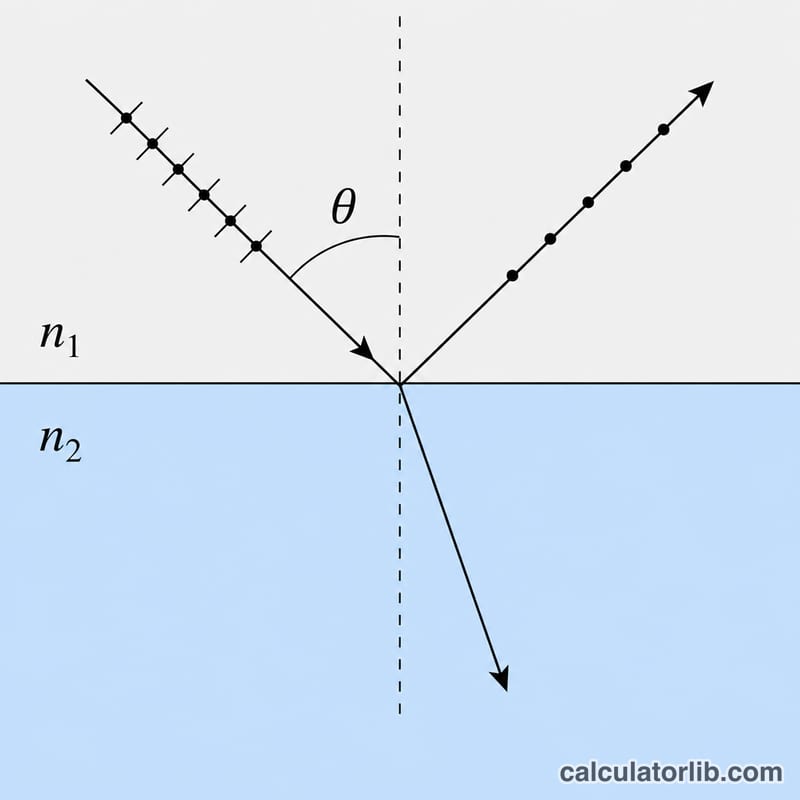
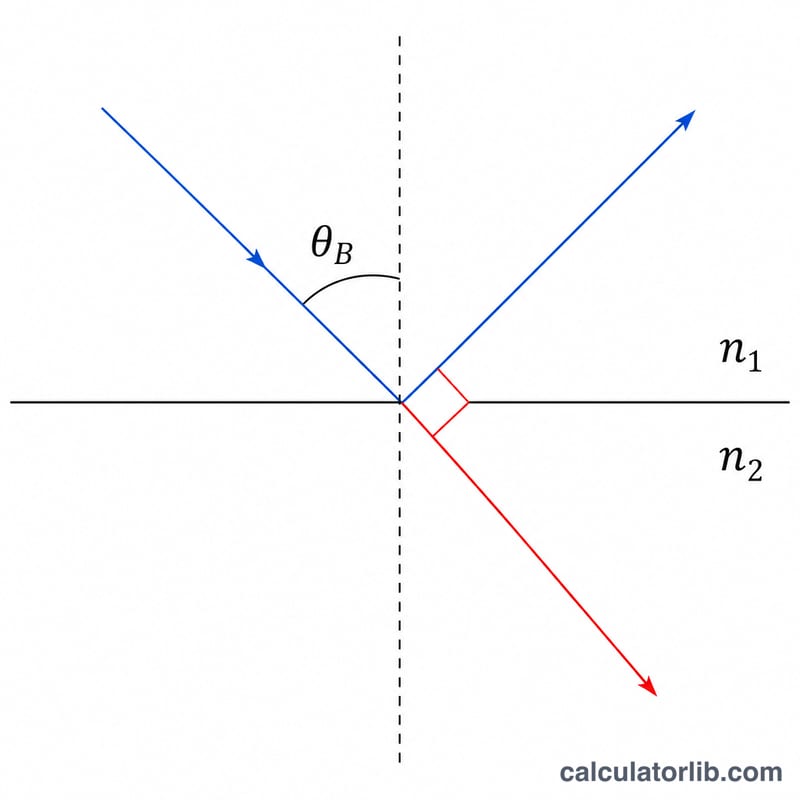
Brewster's angle (also called the polarization angle) is the angle of incidence at which light with a specific polarization — the component parallel to the plane of incidence — is perfectly transmitted through a transparent surface with no reflection. At this angle the reflected light is completely polarized perpendicular to the plane of incidence. The effect is named after Scottish physicist Sir David Brewster, who discovered it in 1815.
How to Use This Calculator
Enter the refractive index of the medium the light starts in (n₁) and the refractive index of the medium it enters (n₂). For light traveling from air into glass, use n₁ = 1.0 and n₂ ≈ 1.5. Press calculate to get Brewster's angle in degrees and radians, plus the corresponding angle of refraction.
The Formula Explained
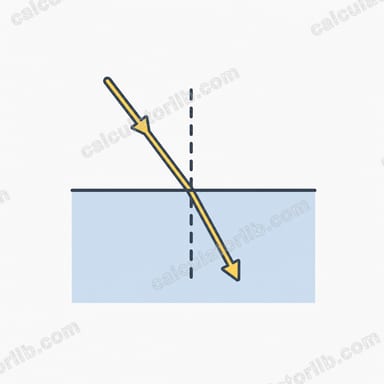
Brewster's angle is given by $$\theta_B = \arctan\left(\frac{n_2}{n_1}\right)$$. It comes from combining Snell's law with the condition that the reflected and refracted rays are exactly 90° apart. Because of that perpendicular relationship, the refraction angle is simply \(90° - \theta_B\).
Worked Example
For an air-to-glass interface with n₁ = 1.0 and n₂ = 1.5: $$\theta_B = \arctan\left(\frac{1.5}{1.0}\right) = \arctan(1.5) \approx 56.31°$$ The reflected light at 56.31° is fully polarized, and the refracted ray travels at \(90° - 56.31° \approx 33.69°\).
Refractive Indices of Common Materials
Brewster's angle depends on the ratio of refractive indices of the two media at an interface, \(\theta_B = \arctan\left(\frac{n_2}{n_1}\right)\). The table below lists typical refractive indices for common transparent media measured at visible wavelengths (around 589 nm, the sodium D-line). Values vary slightly with wavelength (dispersion) and with the exact composition of glasses and plastics.
| Material | Refractive index (n) |
|---|---|
| Air | 1.00 |
| Water | 1.33 |
| Acrylic (PMMA) | 1.49 |
| Fused silica | 1.46 |
| Crown glass | 1.52 |
| Polycarbonate | 1.58 |
| Flint glass | 1.62 |
| Diamond | 2.42 |
As a worked example, light traveling from air (\(n_1 = 1.00\)) into crown glass (\(n_2 = 1.52\)) has a Brewster's angle of \(\theta_B = \arctan\left(\frac{1.52}{1.00}\right) \approx\) 56.66°. For an air–water interface (\(n_1 = 1.00\), \(n_2 = 1.33\)) the angle is about 53.06°, which is why polarized sunglasses effectively cut glare reflected from water surfaces.
Definitions & Glossary
- Brewster's angle (\(\theta_B\))
- The angle of incidence at which light with p-polarization is perfectly transmitted through a surface with no reflection. At this angle the reflected light is completely s-polarized. It is given by \(\theta_B = \arctan\left(\frac{n_2}{n_1}\right)\) and is also called the polarization angle.
- Polarization
- The orientation of the oscillations of a light wave's electric field. Unpolarized light contains all orientations; polarized light has a preferred direction.
- Plane of incidence
- The plane that contains both the incoming (incident) ray and the normal (perpendicular) line to the surface at the point of incidence. Reflected and refracted rays also lie in this plane.
- Refractive index (\(n_1\), \(n_2\))
- A dimensionless number describing how fast light travels in a medium relative to vacuum, \(n = c/v\). Here \(n_1\) is the index of the medium the light starts in (incident side) and \(n_2\) is the index of the medium it enters.
- Angle of incidence
- The angle between the incoming ray and the normal to the surface, measured from the normal (not the surface).
- Angle of refraction
- The angle between the transmitted (bent) ray and the normal, on the far side of the interface. At Brewster's angle the reflected and refracted rays are exactly 90° apart.
- p-polarization vs s-polarization
- p-polarized (parallel) light has its electric field oscillating within the plane of incidence; s-polarized (senkrecht/perpendicular) light oscillates perpendicular to that plane. At Brewster's angle, p-polarized light is fully transmitted while reflected light is purely s-polarized.
- Snell's law
- The relationship governing refraction at an interface: \(n_1 \sin\theta_1 = n_2 \sin\theta_2\). Combined with the 90° condition between reflected and refracted rays, it yields the Brewster's angle formula.
FAQ
Why does Brewster's angle matter? It is used in polarizing filters, laser windows (Brewster windows), and photography to reduce glare from reflective surfaces.
Does it depend on wavelength? Yes, indirectly — refractive index varies with wavelength (dispersion), so Brewster's angle shifts slightly for different colors of light.
What if both indices are equal? If n₁ = n₂ there is no real interface, and \(\theta_B = 45°\), though no reflection occurs to polarize.