
What this calculator does
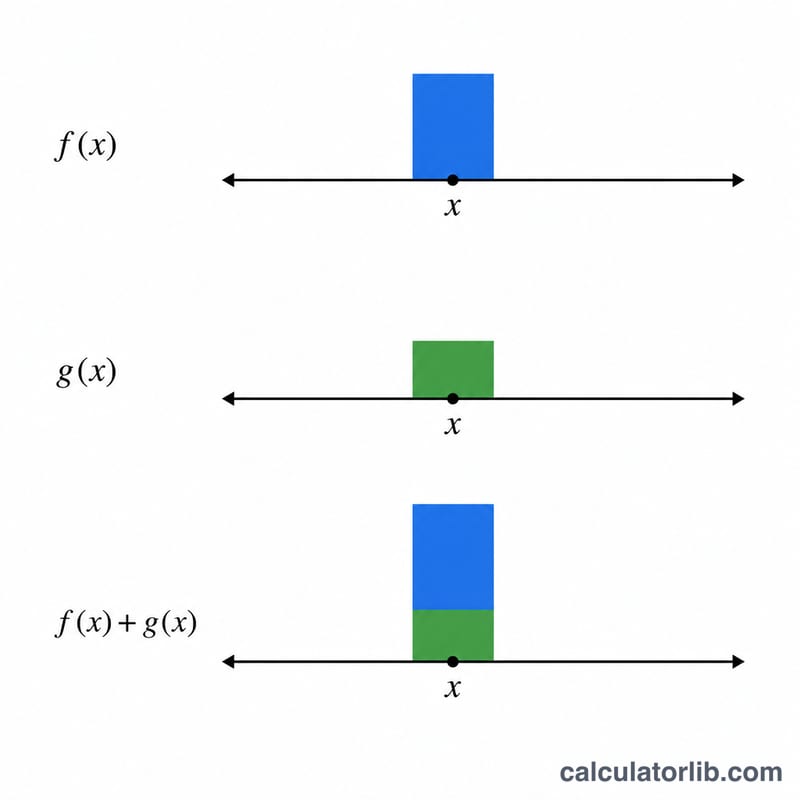
The Function Operations Calculator combines two functions evaluated at the same input value x. Given f(x) and g(x), it returns the sum, difference, product, or quotient of those values. This is a core skill in algebra and pre-calculus, often appearing in "complete the table" problems where you fill in a new column built from two existing function columns.
How to use it
Pick the operation you want — addition, subtraction, multiplication, or division. Enter the value of f(x) and the value of g(x) at the chosen x. The calculator instantly displays the combined result. For tables, just repeat the process for each row of x-values.
The formulas explained
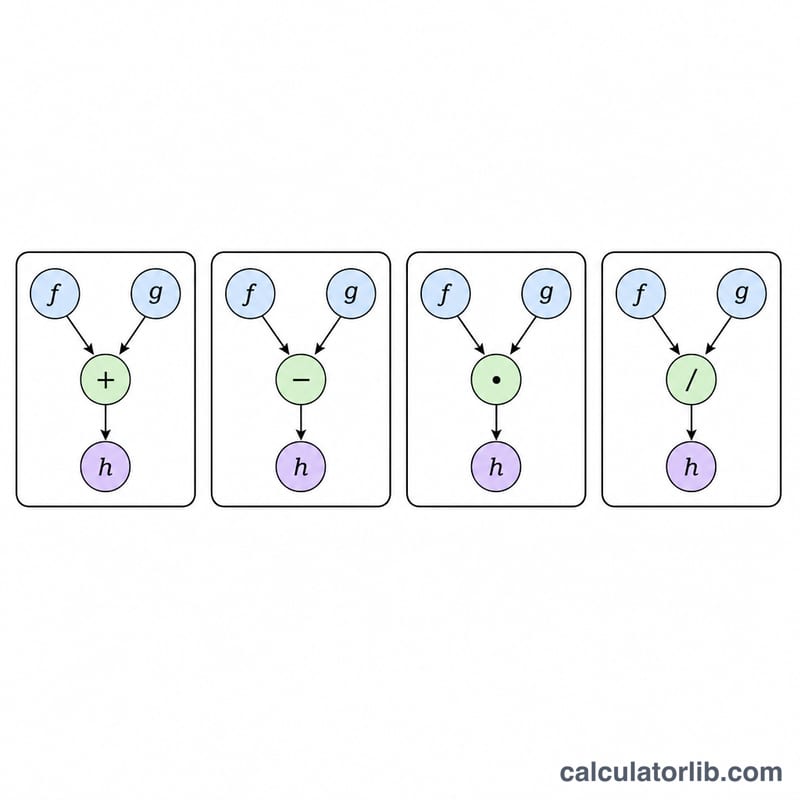
The four standard function operations are defined pointwise, meaning they act on the output values at each x:
$$(f+g)(x) = \text{f(x)} + \text{g(x)}$$ $$(f-g)(x) = \text{f(x)} - \text{g(x)}$$ $$(f \cdot g)(x) = \text{f(x)} \times \text{g(x)}$$ and $$(f / g)(x) = \dfrac{\text{f(x)}}{\text{g(x)}}$$ The quotient is only defined when \(\text{g(x)} \neq 0\), because division by zero is undefined.
Worked example
Suppose f(x) = 5 and g(x) = 3 at x = 2. Then $$(f+g)(x) = 5 + 3 = 8$$ $$(f-g)(x) = 5 - 3 = 2$$ $$(f \cdot g)(x) = 5 \times 3 = 15$$ and \((f/g)(x) = 5 \div 3 \approx 1.6667\). Each operation simply applies basic arithmetic to the two output values.
FAQ
When is (f/g)(x) undefined? Whenever \(\text{g(x)} = 0\), since division by zero has no value. Exclude those x-values from the domain.
Does the order matter? For subtraction and division, yes: \((f-g)(x)\) is not generally equal to \((g-f)(x)\), and likewise for the quotient. Addition and multiplication are commutative.
Can I use this for a full table of values? Yes. Evaluate f and g at each x in your table, then run the calculator once per row to complete the new column.