
What this calculator does
This tool solves any quadratic equation of the form \(ax^2 + bx + c = 0\) using the quadratic formula. Enter the three coefficients a, b and c, and the calculator returns the discriminant and both roots — including complex roots when the discriminant is negative. It works for any real coefficients, making it useful for algebra homework, physics problems, and engineering checks.
How to use it
Type the coefficient of x² into the a field, the coefficient of x into b, and the constant term into c. For example, the equation \(x^2 - 5x + 6 = 0\) has a = 1, b = −5, c = 6. Press calculate to see the discriminant and the two solutions.
The formula explained
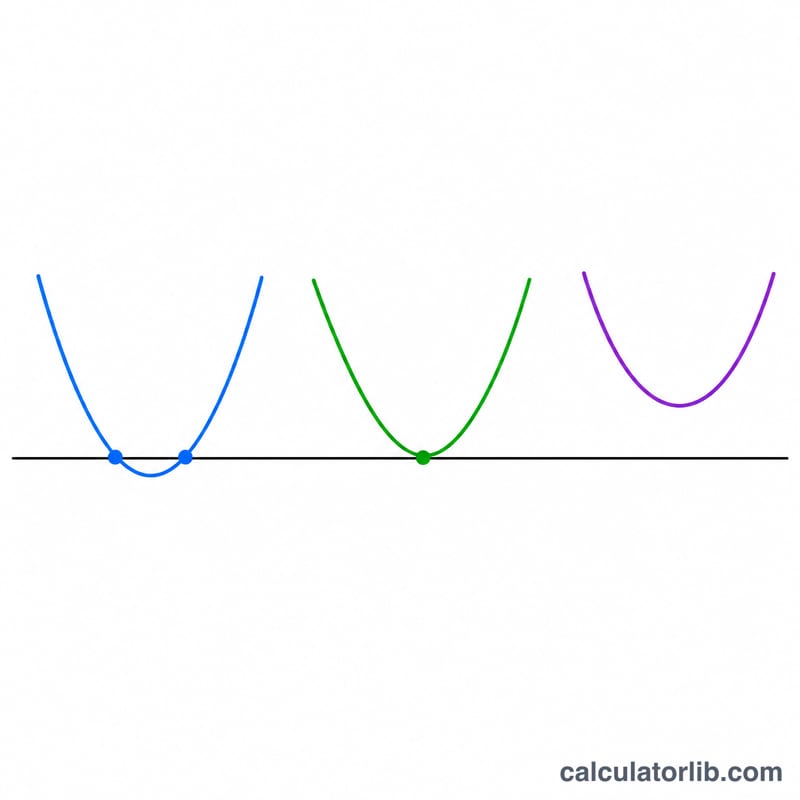
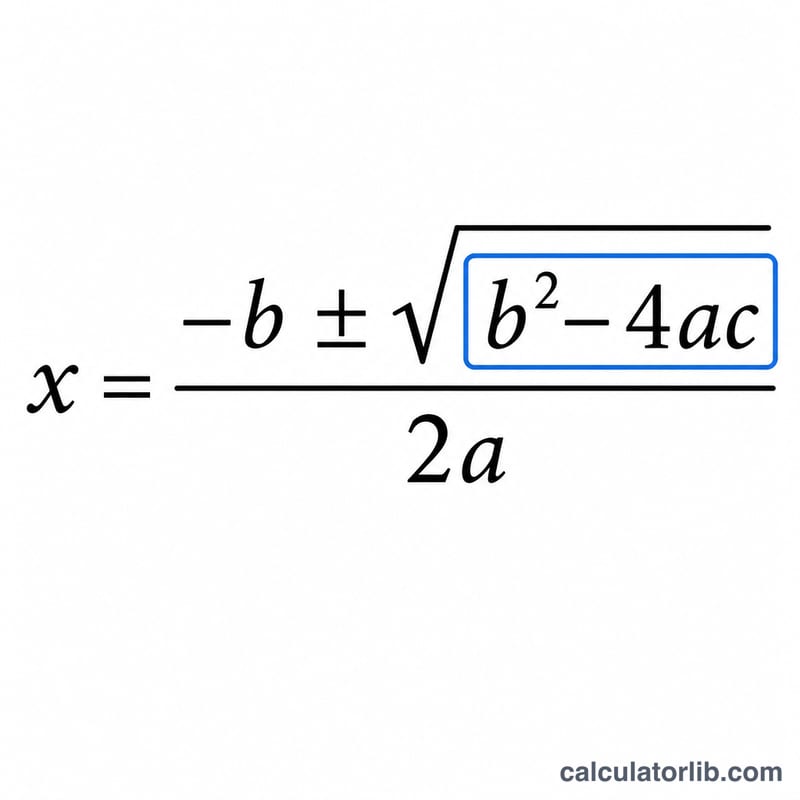
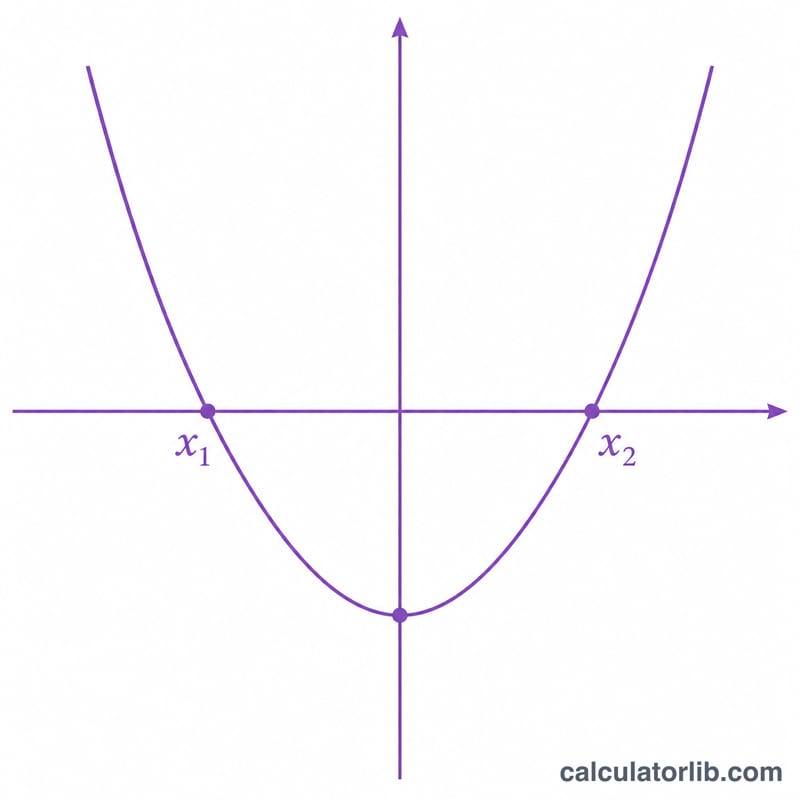
The quadratic formula is $$x = \frac{-b \pm \sqrt{b^2 - 4ac}}{2a}.$$ The expression under the square root, \(b^2 - 4ac\), is called the discriminant (\(\Delta\)). If \(\Delta > 0\) there are two distinct real roots; if \(\Delta = 0\) there is one repeated real root; if \(\Delta < 0\) the roots are a complex conjugate pair of the form \(\left(-\frac{b}{2a}\right) \pm \frac{\sqrt{-\Delta}}{2a}i\). When a = 0 the equation is not quadratic, so the tool falls back to the linear solution \(x = -\frac{c}{b}\).
Worked example
For \(x^2 - 5x + 6 = 0\): the discriminant is $$(-5)^2 - 4(1)(6) = 25 - 24 = 1.$$ So $$x = \frac{5 \pm \sqrt{1}}{2} = \frac{5 \pm 1}{2},$$ giving \(x_1 = 3\) and \(x_2 = 2\). You can verify by factoring: \((x - 2)(x - 3) = 0\).
FAQ
What does a negative discriminant mean? It means the parabola never crosses the x-axis, so the two roots are complex conjugates rather than real numbers.
Can a be zero? If a = 0 the equation is linear, not quadratic; the calculator then reports the single solution \(x = -\frac{c}{b}\).
Why are my two roots the same? When the discriminant equals zero, the ± term vanishes and both roots coincide at \(x = -\frac{b}{2a}\), a repeated root where the parabola just touches the x-axis.