
What Is the Continuity Correction?
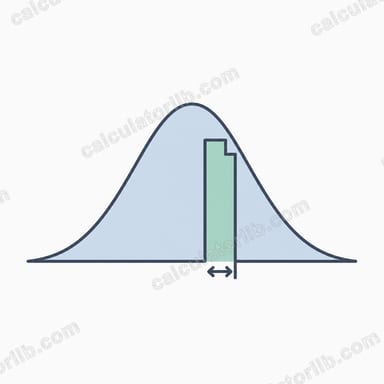
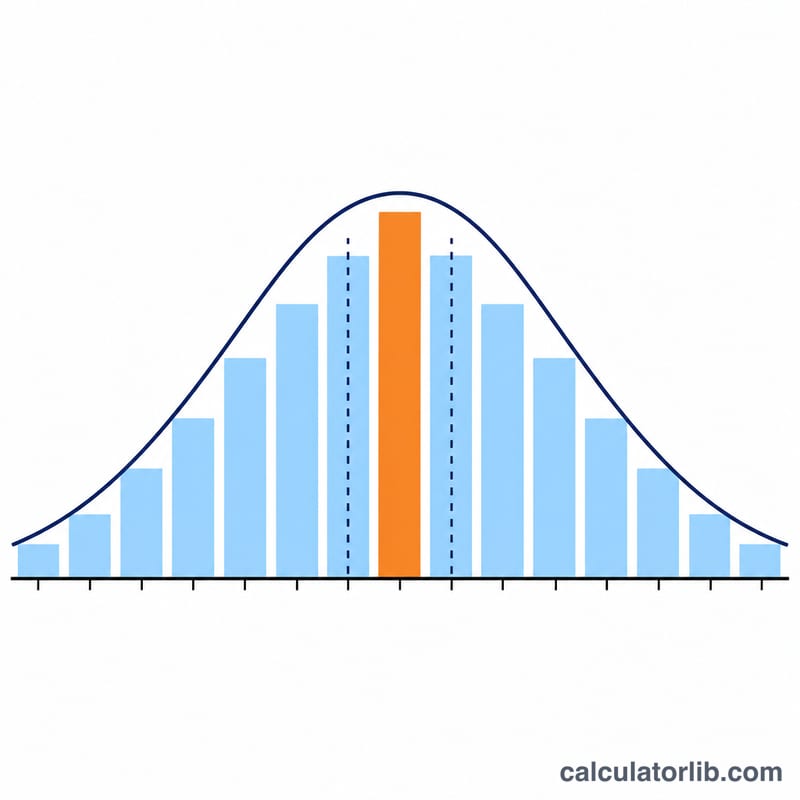
When you approximate a discrete binomial distribution with the continuous normal distribution, the probability mass that sits exactly on integer values gets "smeared" across a smooth curve. The continuity correction compensates by shifting the boundary value by ±0.5 before computing the z-score, which makes the normal approximation noticeably more accurate—especially for small to moderate sample sizes.
How to Use This Calculator
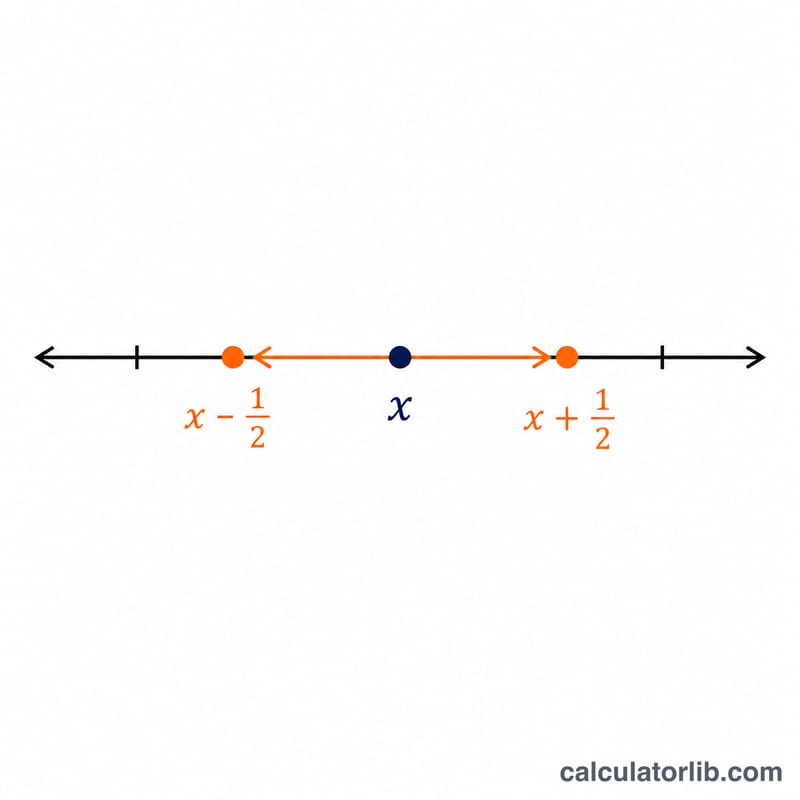
Enter the number of trials n, the probability of success p, and the value x you are interested in. Then pick the type of probability you want to approximate: \(P(X \le x)\) adds 0.5 to x, \(P(X \ge x)\) subtracts 0.5, and \(P(X = x)\) returns both boundary z-scores. The calculator reports the corrected z-score along with the mean \((np)\) and standard deviation \(\sqrt{np(1-p)}\).
The Formula Explained
The binomial mean is \(\mu = np\) and its standard deviation is \(\sigma = \sqrt{np(1-p)}\). The continuity-corrected z-score is
$$z = \frac{(\text{x} \pm 0.5) - np}{\sqrt{np(1-p)}}$$You then look up this z in a standard normal table (or use a normal CDF) to obtain the approximate probability.
Worked Example
Suppose \(n = 100\), \(p = 0.5\), and you want \(P(X \le 60)\). The mean is \(np = 50\) and
$$\sigma = \sqrt{100 \cdot 0.5 \cdot 0.5} = \sqrt{25} = 5$$Applying the correction:
$$z = \frac{60 + 0.5 - 50}{5} = \frac{10.5}{5} = 2.1$$So \(P(X \le 60) \approx \Phi(2.1) \approx 0.9821\).
FAQ
When should I add vs. subtract 0.5? Add 0.5 when the inequality includes the value from below (\(P(X \le x)\)); subtract 0.5 when it includes the value from above (\(P(X \ge x)\)).
When is the normal approximation valid? A common rule of thumb is that both \(np \ge 5\) and \(n(1-p) \ge 5\).
Why use the correction at all? Without it, the normal approximation systematically under- or over-states tail probabilities for discrete data; the ±0.5 shift removes most of that bias.