What this calculator does
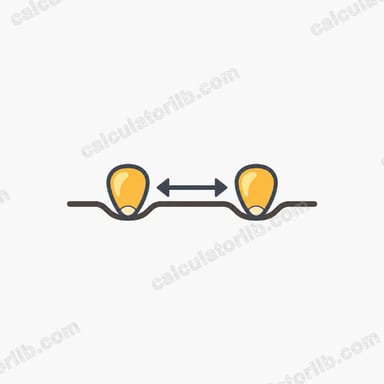
Corn yield depends heavily on hitting the right plant population with even spacing in the row. This calculator converts a target final stand (plants per acre) and your row width into the in-row seed spacing your planter must achieve, the seeding rate needed after germination losses, and the number of seeds per foot of row, which is handy for checking planter calibration in the field. It uses acres and inches, but the geometry works anywhere.
How to use it
Enter your row width in inches (30 inches is the most common), your target plant population, and the expected germination or emergence percentage. Seed tags usually list germination near 95%; lower it if you expect cold or crusted soils.
The formula
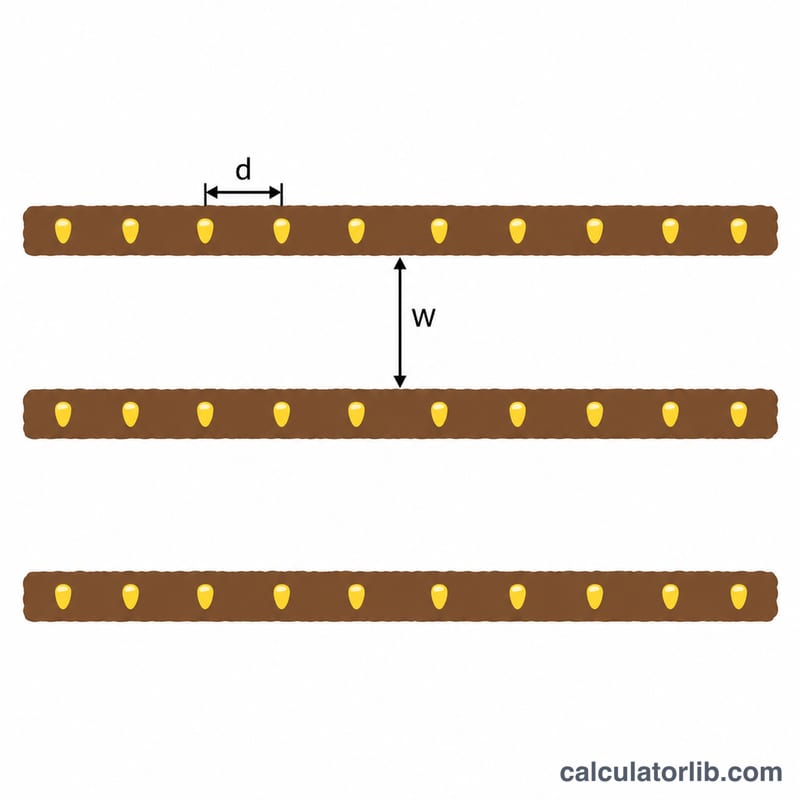
One acre is 43,560 square feet, or 6,272,640 square inches. Each seed occupies a rectangle of row width times seed spacing, so:
$$S = \frac{6{,}272{,}640}{W \times N}, \qquad N = \frac{P}{g}$$where \(S\) is spacing in inches, \(W\) row width in inches, \(P\) target plants per acre, \(g\) germination as a fraction and \(N\) seeds per acre. Row length per acre is \(L = 522{,}720 / W\) feet.
Worked example
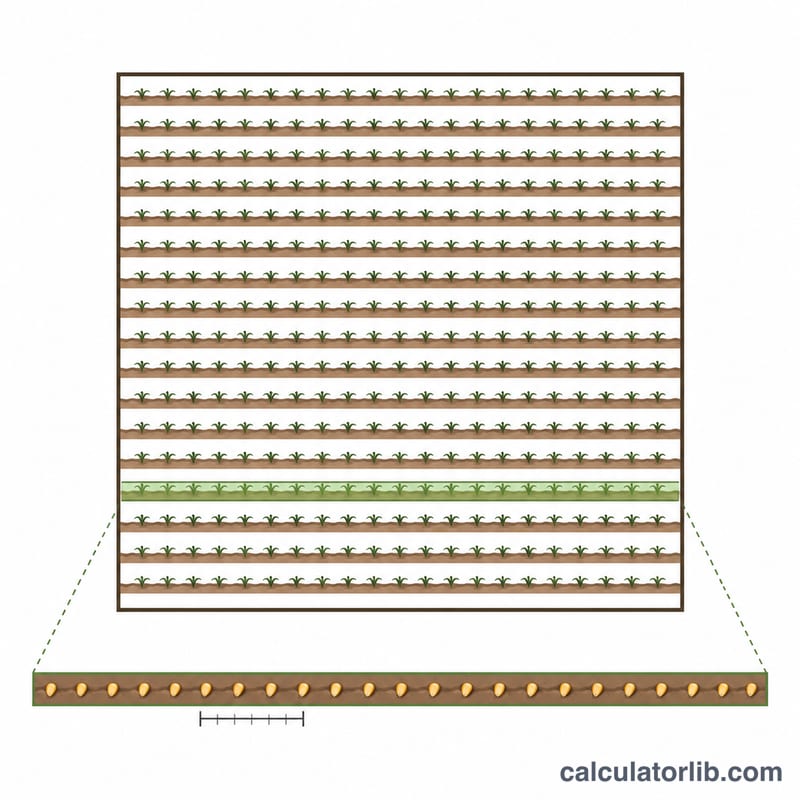
For 30-inch rows, a target of 32,000 plants per acre and 95% germination:
$$N = \frac{32{,}000}{0.95} = 33{,}684\ \text{seeds/acre}$$$$S = \frac{6{,}272{,}640}{30 \times 33{,}684} \approx 6.21\ \text{in}$$Row length is 17,424 ft per acre, giving about 1.93 seeds per foot of row.
Seed Spacing Chart by Row Width and Seeding Rate
Each cell gives the in-row distance between seeds in inches, followed by the number of seeds per foot of row in parentheses. The values use the acre and inch units common in the United States. One acre is 43,560 ft², which equals 6,272,640 in², so the spacing is:
$$S = \frac{6{,}272{,}640}{W \times N}$$Here \(S\) is the seed spacing in inches, \(W\) is the row width in inches and \(N\) is the seeding rate in seeds per acre. For example, 30-inch rows at 32,000 seeds/acre give \(6{,}272{,}640 \div (30 \times 32{,}000) = 6{,}272{,}640 \div 960{,}000 = 6.53\) in. Seeds per foot is \(12 \div S\).
| Row width | 24,000 seeds/ac | 28,000 seeds/ac | 32,000 seeds/ac | 36,000 seeds/ac | 40,000 seeds/ac |
|---|---|---|---|---|---|
| 15 in | 17.42 in (0.69/ft) | 14.93 in (0.80/ft) | 13.07 in (0.92/ft) | 11.62 in (1.03/ft) | 10.45 in (1.15/ft) |
| 20 in | 13.07 in (0.92/ft) | 11.20 in (1.07/ft) | 9.80 in (1.22/ft) | 8.71 in (1.38/ft) | 7.84 in (1.53/ft) |
| 22 in | 11.88 in (1.01/ft) | 10.18 in (1.18/ft) | 8.91 in (1.35/ft) | 7.92 in (1.52/ft) | 7.13 in (1.68/ft) |
| 30 in | 8.71 in (1.38/ft) | 7.47 in (1.61/ft) | 6.53 in (1.84/ft) | 5.81 in (2.07/ft) | 5.23 in (2.30/ft) |
| 36 in | 7.26 in (1.65/ft) | 6.22 in (1.93/ft) | 5.45 in (2.20/ft) | 4.84 in (2.48/ft) | 4.36 in (2.75/ft) |
| 38 in | 6.88 in (1.74/ft) | 5.90 in (2.04/ft) | 5.16 in (2.33/ft) | 4.59 in (2.62/ft) | 4.13 in (2.91/ft) |
Important: these figures are for seeds planted, not the final number of plants. Some seeds won't germinate or survive, so the final stand will be lower than the seeding rate. To reach a target plant population, divide it by the expected germination or emergence rate first. For example, 32,000 plants at 95% needs \(32{,}000 \div 0.95 \approx 33{,}684\) seeds/acre. Then use that higher rate to find the spacing. The calculator above does this step for you when you enter a germination percentage below 100.
Seeds per foot is \(12 \div S\), or the same thing as \(W \times N \div 522{,}720\). It is useful for checking planter output by counting seeds dropped over a measured length of row.
Row Length Equal to 1/1000 Acre for Stand Counts
A common way to check plant population, especially in the United States, is to count plants in a length of row that covers exactly 1/1000 of an acre. That area is 43.56 ft². If the row width \(W\) is in inches, the length is:
$$L = \frac{43.56 \times 12}{W} = \frac{522.72}{W}\ \text{ft}$$For example, 30-inch rows give \(522.72 \div 30 = 17.42\) ft.
| Row width | Length for 1/1000 acre (decimal ft) | Length for 1/1000 acre (ft-in) |
|---|---|---|
| 15 in | 34.85 ft | 34 ft 10 in |
| 20 in | 26.14 ft | 26 ft 2 in |
| 22 in | 23.76 ft | 23 ft 9 in |
| 30 in | 17.42 ft | 17 ft 5 in |
| 36 in | 14.52 ft | 14 ft 6 in |
| 38 in | 13.76 ft | 13 ft 9 in |
| 40 in | 13.07 ft | 13 ft 1 in |
How to use it:
- Measure the length for your row width along a single row.
- Count every plant in that length.
- Multiply the count by 1,000 to get plants per acre. For example, 31 plants in 17 ft 5 in of 30-inch row means \(31 \times 1{,}000 = 31{,}000\) plants/acre.
A single count can be off because of gaps or doubles in one spot. Count in several places across the field, in different rows and away from the headlands, and average the results. Five or more counts per field is a sensible minimum. Compare the average with your seeding rate to estimate the actual emergence percentage.
FAQ
What population should I target?
Many dryland fields do well around 26,000 to 30,000 plants per acre, while productive irrigated ground often supports 32,000 to 36,000. Follow your seed company hybrid recommendations.
How do I check spacing in the field?
Measure 1/1000 of an acre of row (17 ft 5 in for 30-inch rows), count plants, and multiply by 1,000 to estimate population.
Does uneven spacing matter?
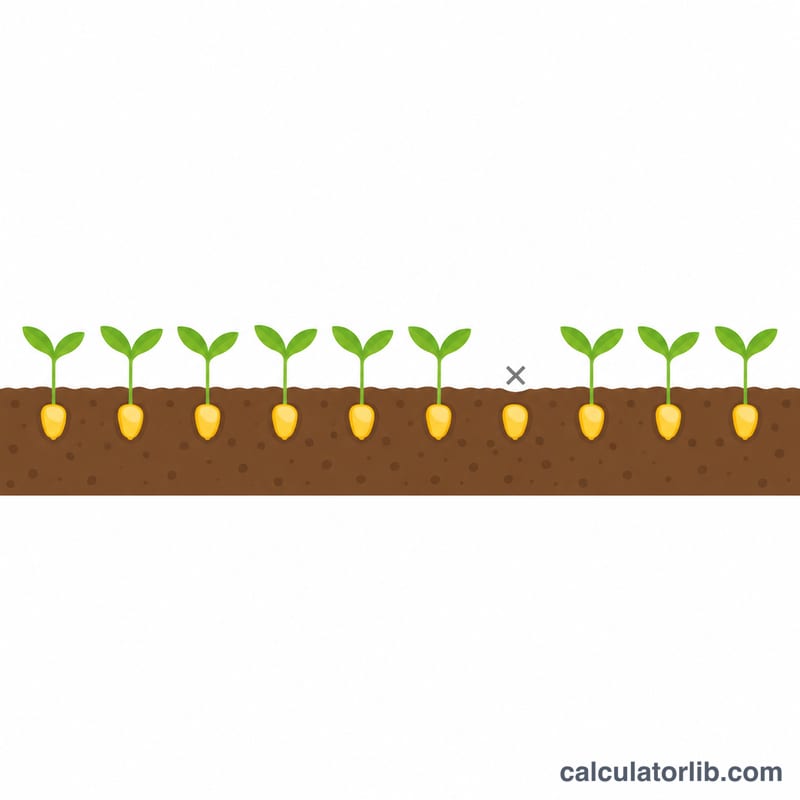
Yes. Skips and doubles reduce yield even when the average population is correct, so planter maintenance and speed matter.