What is the Days to Months Calculator?
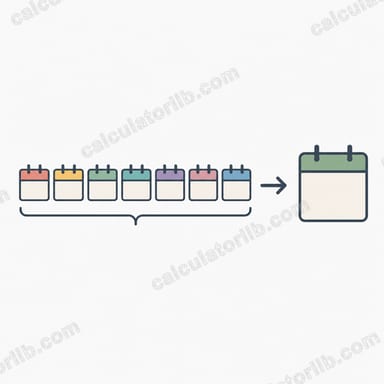
This tool converts a span of days into the equivalent number of months. Because months vary in length (28–31 days), it uses the average month length of 30.4375 days, derived from the average year of 365.25 days divided by 12. This gives a consistent, accurate conversion that accounts for leap years over the long run.
How to use it
Enter the number of days you want to convert and the calculator instantly returns the equivalent in months. It works for any value — whether you are estimating a project timeline, a billing period, a baby's age, or a loan term.
The formula explained
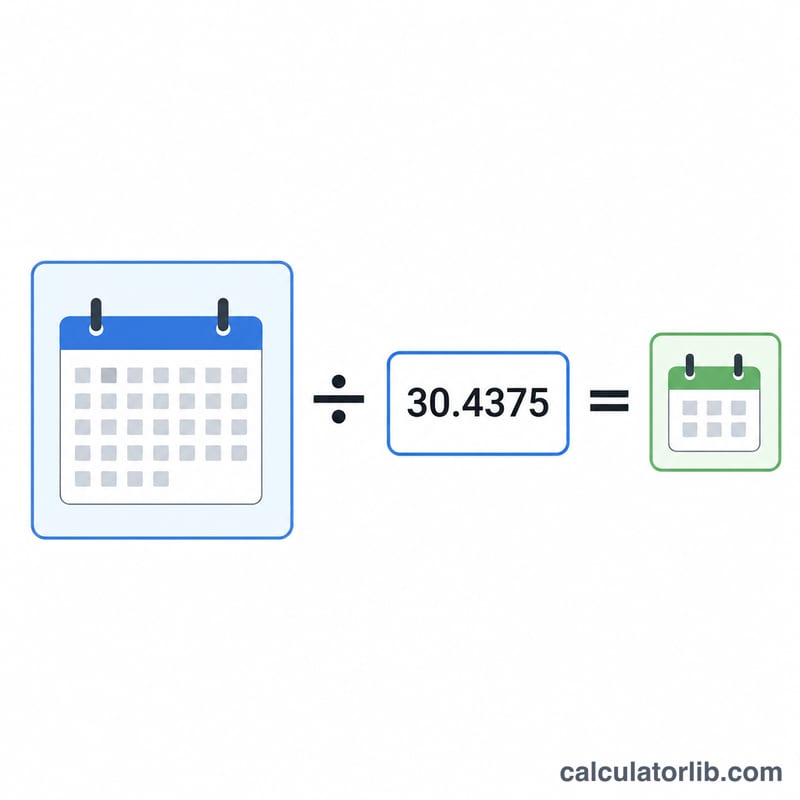
The conversion divides days by the average days per month:
$$\text{months} = \frac{\text{days}}{30.4375}$$
The figure 30.4375 comes from \(365.25 \div 12\). Using 365.25 (instead of 365) builds in the extra quarter-day per year that leap years correct, so conversions stay accurate across multi-year periods.
Worked example
Suppose you have 90 days. Divide by the average month length:
$$90 \div 30.4375 \approx 2.96 \text{ months}$$
So 90 days is just under 3 months — which matches intuition, since three average months total about 91.3 days.
Constants Used in This Conversion
This calculator divides your day count by a single constant, the average month length:
$$\text{Months} = \frac{\text{Days}}{30.4375}$$The 30.4375 figure comes from the Julian year (365.25 days) divided by 12. The table below lists that constant alongside the other day-length values you may meet when converting between days, months and years. These are astronomical and calendar definitions used internationally, not values specific to one country — but the 30/360 convention noted below is a financial market convention, not a calendar fact.
| Constant | Value (days) | Where it comes from | When it applies |
|---|---|---|---|
| Average month (Julian) | 30.4375 | 365.25 ÷ 12 | The default used by this calculator; the standard "average month" for general day-to-month estimates. |
| Average month (Gregorian) | 30.436875 | 365.2425 ÷ 12 | Slightly more accurate over centuries because the Gregorian calendar skips 3 leap days every 400 years; the difference from 30.4375 is under 0.001 day per month. |
| Common year | 365 | Calendar year without a leap day | Any year not divisible by 4 (and century years not divisible by 400, e.g. 1900, 2100). |
| Leap year | 366 | February gains a 29th day | Years divisible by 4, except century years unless divisible by 400 (2024 and 2000 are leap; 1900 is not). |
| February (common / leap) | 28 / 29 | Calendar month length | Exact calendar arithmetic; spans covering February make an average-based result read low relative to whole calendar months. |
| Short months | 30 | April, June, September, November | Exact calendar arithmetic and the classic "30 days hath September" rule. |
| Long months | 31 | Jan, Mar, May, Jul, Aug, Oct, Dec | Exact calendar arithmetic; seven of the twelve months are 31 days. |
| Quarter (3 average months) | ≈ 91.31 | 3 × 30.4375 = 91.3125 | Quarterly periods when only an approximate day count is needed; actual calendar quarters run 90–92 days. |
| Banking / 30-360 month | 30 | 30/360 day-count convention | Bond and some loan interest calculations, where every month is treated as 30 days and every year as 360 days. A financial convention only — never use it for calendar dates. |
| Week | 7 | Calendar definition | Useful cross-check: an average month is about 4.348 weeks (30.4375 ÷ 7). |
Worked check of the main constant: \(365.25 \div 12 = 30.4375\) days, so one common year of 365 days converts to \(365 \div 30.4375 = \) 11.99 months rather than exactly 12 — the missing quarter-day per year is why.
FAQ
Why use 30.4375 instead of 30? Using 30 ignores the fact that the year averages 365.25 days. 30.4375 spreads the year evenly across 12 months and stays accurate for long spans.
Can I convert months back to days? Yes — just multiply the months by 30.4375 to get the approximate number of days.
Is this exact for a specific calendar range? No. For exact calendar differences (e.g., a particular date to date), the actual month lengths matter. This calculator uses the average for a quick, reliable estimate.