What Is the Days Until June Calculator?
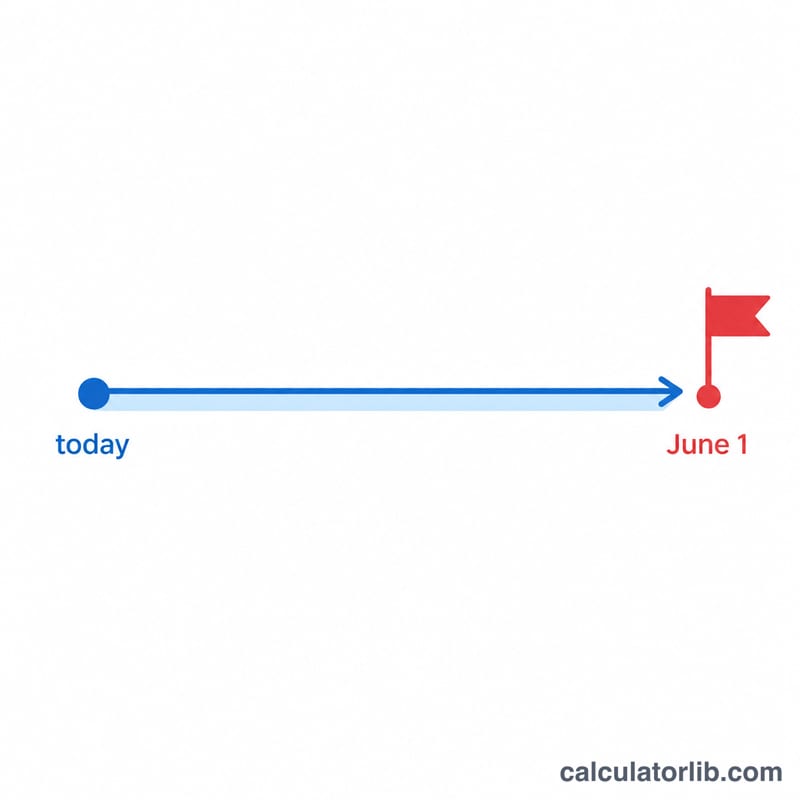
The Days Until June Calculator tells you exactly how many days remain until the next June 1. Whether you are counting down to the start of summer, a school year ending, a wedding, or a holiday at the start of June, this tool gives you a precise number instantly. Just pick a starting date and the calculator finds the very next June 1 and subtracts.
How to Use It
Choose the date you want to count from — usually today. The calculator then locates the next occurrence of June 1. If June 1 has not yet happened in the chosen year, it counts to that date; if June 1 has already passed (or is today), it counts to June 1 of the following year. The result is shown in days and also converted to weeks.
The Formula Explained
The calculation is a simple date difference: $$\text{days} = \text{next June 1} - \text{start date}$$ Internally, both dates are reduced to midnight so that partial days do not distort the count. The week figure is simply the day count divided by 7.
Worked Example
Suppose your start date is May 1, 2024. June 1, 2024 has not yet occurred, so it is the target. From May 1 to June 1 there are 31 days (May has 31 days). The calculator returns 31 days, or about 4.43 weeks.
$$31 \div 7 \approx 4.43 \text{ weeks}$$

How to Count the Days to June 1 by Hand
You can check the countdown without a calculator by adding up whole months. The method below uses the Gregorian calendar.
- Identify the next June 1. If your start date is before June 1 of the current year, the target is June 1 of that year. If it is after June 1, the target is June 1 of the following year.
- Count the remaining days in the start month. Subtract the start day from the month length, then add 1 to land on the 1st of the next month. For example, from March 15: \(31 - 15 + 1 = 17\) days to April 1.
- Add the full months in between. Use these lengths: Jan 31, Feb 28 (29 in a leap year), Mar 31, Apr 30, May 31. For a start in the second half of the year, you also need Jul 31, Aug 31, Sep 30, Oct 31, Nov 30 and Dec 31. Add each full month from the 1st of the month after your start up to May 31.
- Handle the year rollover and leap years. If the target is next year, include the rest of December and the months from January onward. Add one extra day if February 29 falls between your start date and June 1. A leap year is divisible by 4, except century years not divisible by 400 (2000 was a leap year; 1900 was not).
- Convert to weeks. Divide the total days by 7. The whole number is the weeks, and the remainder is the extra days.
Example 1: same year
From March 15, 2025 to June 1, 2025:
$$17 + 30 + 31 = 78\text{ days}$$
The terms are the days to April 1 (17), all of April (30) and all of May (31). Then \(78 \div 7 = 11.14\), which is 11 weeks and 1 day.
Example 2: year rollover
From November 20, 2025 to June 1, 2026 (2026 is not a leap year):
$$11 + 31 + 31 + 28 + 31 + 30 + 31 = 193\text{ days}$$
The terms are the days to December 1 (11), then December, January, February, March, April and May. Then \(193 \div 7 = 27.57\), which is 27 weeks and 4 days, since \(27 \times 7 = 189\).
Example 3: leap year
From February 10, 2024 to June 1, 2024: \(20 + 31 + 30 + 31 = 112\) days. Here the days to March 1 are \(29 - 10 + 1 = 20\), because February 2024 has 29 days.
FAQ
What if today is June 1? The countdown rolls over to June 1 of next year, returning roughly 365 (or 366) days.
Does it handle leap years? Yes. The date math accounts for February 29 automatically, so counts crossing a leap February are accurate.
Why count to June 1 specifically? June 1 is a common marker for the meteorological start of summer and the close of many school terms, making it a popular countdown target.