
What This Calculator Does
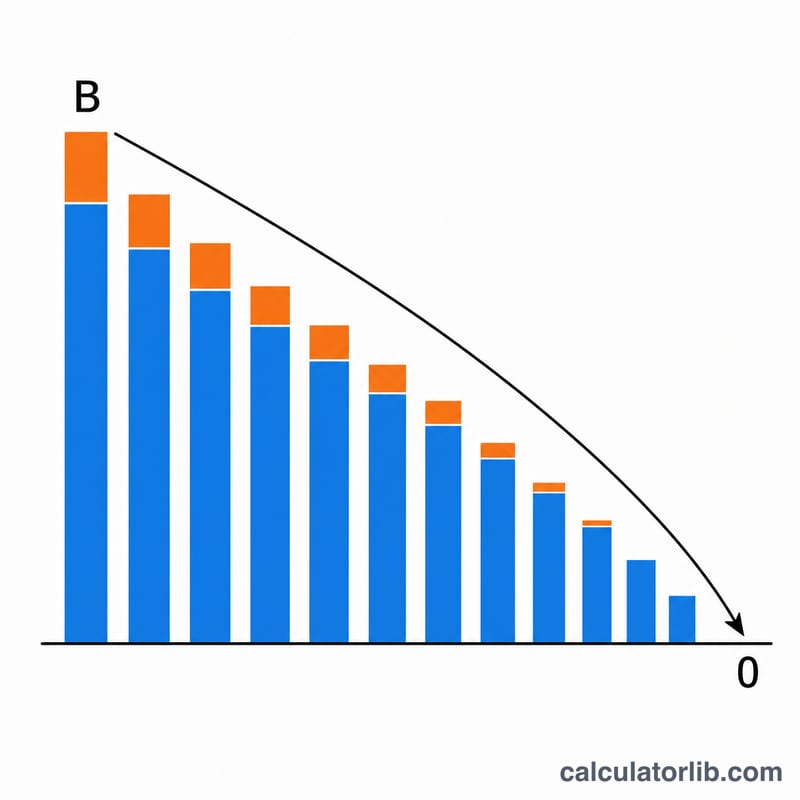
The Debt Payoff Calculator tells you how many months it will take to eliminate a debt — such as a credit card, personal loan, or line of credit — given a fixed monthly payment. It also reveals the total interest you'll pay along the way, which can be a powerful motivator to pay more each month.
How to Use It
Enter your current debt balance, the annual interest rate (APR) as a percentage, and the fixed amount you plan to pay every month. The calculator converts the APR to a monthly rate, then solves for the number of payments. If your monthly payment is smaller than the monthly interest charge, the debt can never be repaid and a warning is shown.
The Formula Explained
This tool uses the standard loan amortization equation. With balance B, monthly payment P, and monthly rate r (annual rate ÷ 12 ÷ 100):
$$n = \frac{-\ln\!\left(1 - \dfrac{B \cdot r}{P}\right)}{\ln(1 + r)}$$
Total interest is simply the sum of all payments minus the original balance: $$I = P \cdot n - B$$
Worked Example
Suppose you owe $5,000 at 18% APR and pay $200/month. The monthly rate is \(0.18 \div 12 = 0.015\). Then $$n = \frac{-\ln(1 - 5000 \cdot 0.015/200)}{\ln(1.015)} = \frac{-\ln(0.625)}{\ln(1.015)} \approx 31.57 \text{ months}.$$ Total paid \(\approx 200 \times 31.57 = \$6{,}313.60\), so total interest \(\approx \$1{,}313.60\).
FAQ
Why does a low payment never pay off the debt? If your payment is less than or equal to the monthly interest charge (balance × monthly rate), the balance grows faster than you pay it down.
Does this assume a fixed rate? Yes. It assumes a constant interest rate and a constant monthly payment. Variable-rate or promotional-rate debts may differ.
Are partial months counted? The result shows the exact (fractional) number of months. In practice the final payment is smaller, so round up for the number of actual payments.