What Is the Dividing Exponents Calculator?
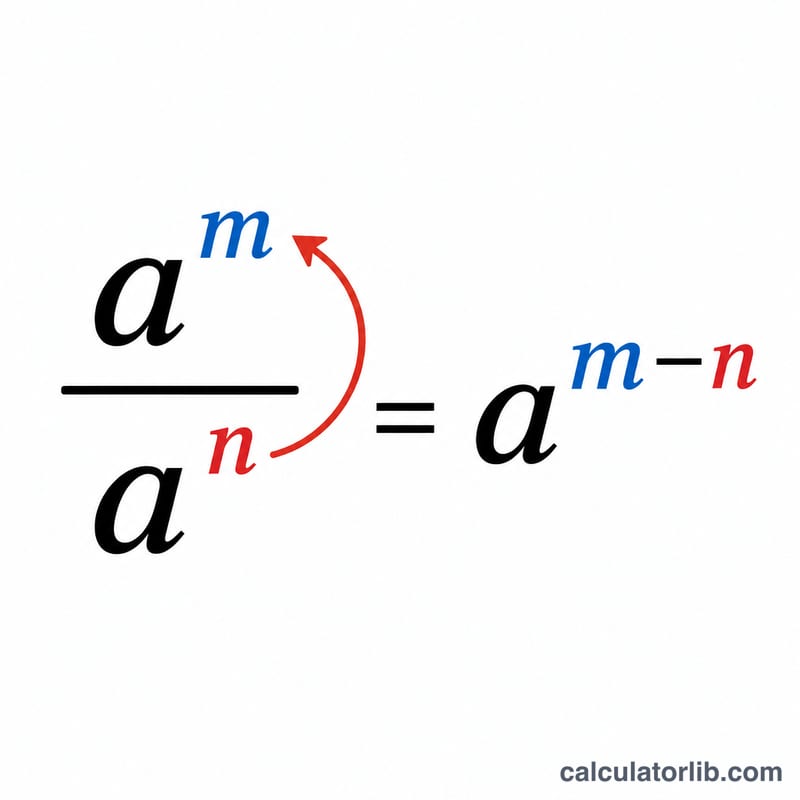
This calculator applies the quotient rule of exponents: when you divide two powers that share the same base, you subtract the exponents. In symbols, \(a^m \div a^n = a^{m-n}\). It returns both the simplified exponent (m − n) and the final numeric value, so you can check homework, simplify algebraic expressions, or work scientific-notation problems quickly.
How to Use It
Enter the common base a, the exponent of the numerator m, and the exponent of the denominator n. The tool subtracts n from m to get the simplified exponent, then raises the base to that power to give a decimal value. Exponents may be negative or fractional — for example a square-root cancellation produces a half-power.
The Formula Explained
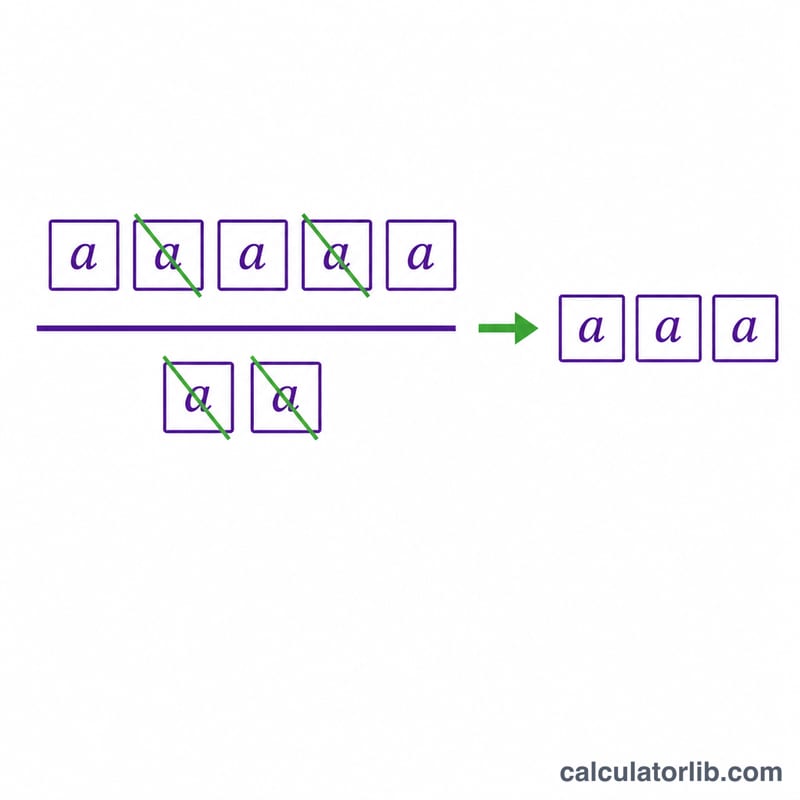
A power like \(a^m\) means a multiplied by itself m times. Dividing \(a^m\) by \(a^n\) cancels n of those factors from m of them, leaving m − n factors of a. That is why the exponents subtract rather than divide:
$$\frac{a^m}{a^n} = a^{\,m-n}$$
If m equals n the result is \(a^0 = 1\); if n is larger you get a negative exponent, which equals a fraction.
Worked Example
Simplify \(2^5 \div 2^2\). Keep the base 2 and subtract the exponents: \(5 - 2 = 3\). So the result is
$$2^3 = 8$$
The calculator shows a simplified exponent of 3 and a numeric value of 8.
More Worked Examples
Each example uses the quotient rule \(\frac{a^{m}}{a^{n}} = a^{m-n}\), which applies when both powers have the same nonzero base. The key step is always to subtract the exponents.
Example 1: Negative result exponent
- Expression: \(\frac{3^{2}}{3^{5}}\)
- Subtract the exponents: \(2 - 5 = -3\)
- Write the result: \(3^{2-5} = 3^{-3}\)
- Apply the negative exponent rule: \(3^{-3} = \frac{1}{3^{3}} = \frac{1}{27}\)
Check: \(\frac{9}{243} = \frac{1}{27}\). The two results match.
Example 2: Negative exponent in the denominator
- Expression: \(\frac{5^{4}}{5^{-2}}\)
- Subtract the exponents, remembering that subtracting a negative adds: \(4 - (-2) = 6\)
- Write the result: \(5^{4-(-2)} = 5^{6}\)
- Evaluate: \(5^{6} = 15625\)
Result: 15625
Example 3: Fractional exponents
- Expression: \(\frac{9^{3/2}}{9^{1/2}}\)
- Subtract the exponents: \(\frac{3}{2} - \frac{1}{2} = \frac{2}{2} = 1\)
- Write the result: \(9^{1} = 9\)
Check: \(9^{3/2} = 27\) and \(9^{1/2} = 3\), so \(27 \div 3 = 9\).
Example 4: Variable base
- Expression: \(\frac{x^{7}}{x^{3}}\)
- Subtract the exponents: \(7 - 3 = 4\)
- Result: \(x^{7-3} = x^{4}\), valid for any \(x \neq 0\).
Scenario Comparison: Different Exponent Cases
The sign of \(m-n\) determines what kind of answer you get: positive gives a larger power, zero gives 1, and negative gives a fraction (a reciprocal).
| Expression | m−n | Simplified form | Numeric value |
|---|---|---|---|
| \(2^{5} \div 2^{2}\) | 3 | \(2^{3}\) | 8 |
| \(4^{3} \div 4^{3}\) | 0 | \(4^{0}\) | 1 |
| \(2^{2} \div 2^{5}\) | -3 | \(2^{-3}\) | 0.125 |
| \(10^{3} \div 10^{-2}\) | 5 | \(10^{5}\) | 100000 |
| \(16^{1/2} \div 16^{1/4}\) | 1/4 | \(16^{1/4}\) | 2 |
Note that any nonzero base raised to the power 0 equals 1, which is why equal exponents always give 1 when divided.
FAQ
Do the bases have to match? Yes. The quotient rule only applies when both powers share the same base. Unlike bases must be evaluated separately.
What if m is smaller than n? You get a negative exponent, which represents a reciprocal — for instance \(a^{-2} = 1/a^2\). The calculator returns the equivalent decimal.
Can I use fractions or decimals? Yes, fractional and decimal exponents are supported, letting you handle roots and scientific notation as well as whole-number powers.