What this calculator does
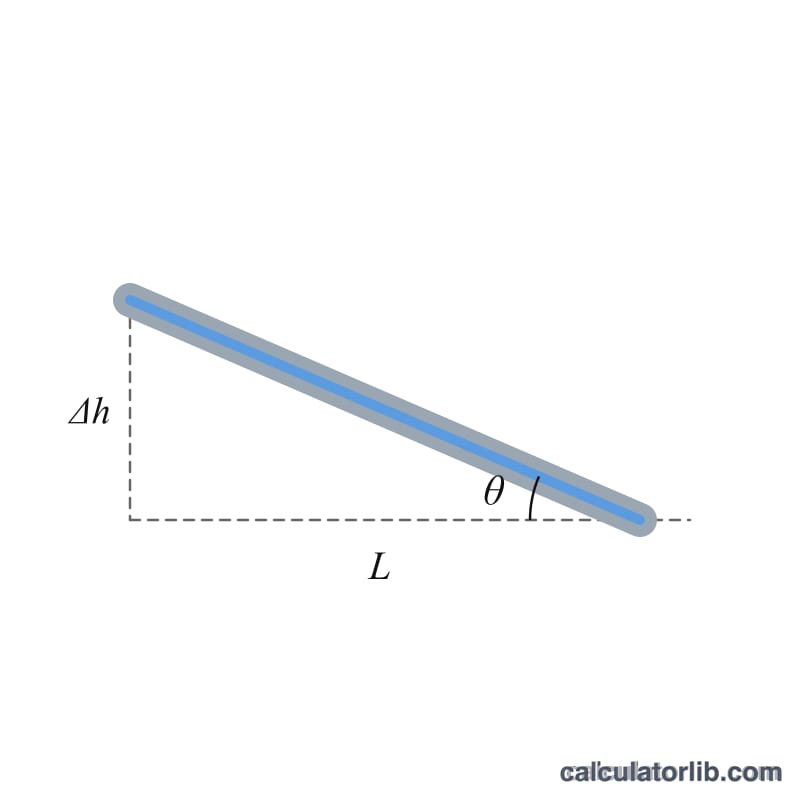
The Drainage Slope Calculator tells you how much a drainage pipe or channel must drop over a straight horizontal run so that water flows reliably by gravity. Too little slope lets solids settle and water pool; too much slope can let liquid outrun solids. Enter the run length and the desired grade, and the tool returns the vertical fall along with the equivalent slope ratio and angle.
The formula explained
The fall is simply the run multiplied by the slope expressed as a fraction:
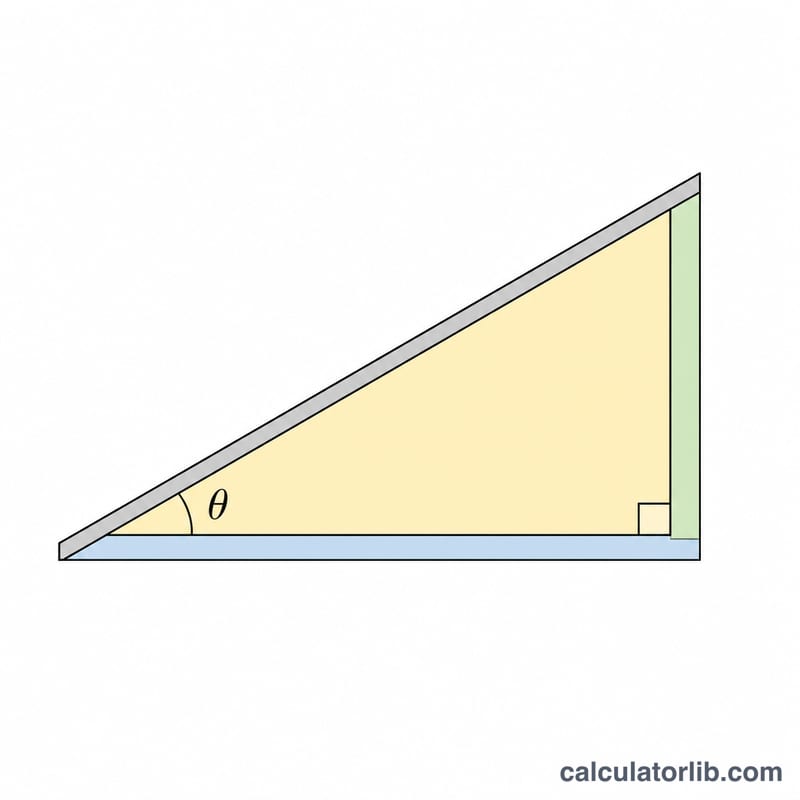
$$\text{Fall} = \text{Run} \times \frac{\text{Slope}}{100}$$Here \(\text{Run}\) = horizontal distance in feet, and \(\text{Slope}\) = grade in percent. The same grade can be written as a ratio \(1:n\) with \(n = \frac{100}{\text{Slope}}\), or as an angle \(\theta = \arctan\!\left(\frac{\text{Slope}}{100}\right)\) measured from horizontal.
How to use it
Type the horizontal run for your pipe or channel and the target slope percent. A common minimum for building drains is around 1% to 2%. The calculator instantly shows the total fall you must build in over that length, so you can set invert elevations at each end.
Worked example
Suppose a pipe has a run of 100 ft at a 2% grade. The fall is:
$$\text{Fall} = 100 \times \frac{2}{100} = 2\,\text{ft}$$That grade equals a ratio of \(1:\frac{100}{2} = 1:50\) and an angle of \(\arctan(0.02) \approx 1.146^{\circ}\).
Typical Drainage Slope Ranges by Pipe Size and Application
The table lists commonly cited minimum slopes. The plumbing figures come from the International Plumbing Code (IPC) and the Uniform Plumbing Code (UPC), which are used mainly in the United States. The other rows are general rules of thumb, not code values.
| Application | Minimum slope (approx.) | Ratio 1:n | Inches per foot |
|---|---|---|---|
| Plumbing drain, pipe 2½ in or smaller (IPC/UPC) | 2% (exactly 2.08%) | 1:48 | 1/4 in (0.25) |
| Plumbing drain, pipe 3–6 in (IPC/UPC) | 1% (exactly 1.04%) | 1:96 | 1/8 in (0.125) |
| Plumbing drain, pipe 8 in and larger (allowed in some codes) | 0.5% (exactly 0.52%) | 1:192 | 1/16 in (0.0625) |
| Outdoor storm or sewer drain pipe (common practice, 4 in and larger) | 1%–2% | 1:100 to 1:50 | about 1/8 to 1/4 in |
| Surface drain or French drain (common practice) | 1% or more | 1:100 or steeper | about 1/8 in or more |
| Patio or paved area grading (common practice) | 1%–2% | 1:100 to 1:50 | about 1/8 to 1/4 in |
| Soil next to a foundation (IRC, US: 6 in within the first 10 ft) | 5% | 1:20 | 0.6 in |
Caveat: Local code governs. Jurisdictions adopt different editions of the IPC or UPC and often amend them, and the allowed slope can depend on pipe use, cleanouts and flow velocity. Check with your local building authority or a licensed plumber or engineer before installing. This is general information, not professional advice.
Fall Over Different Run Lengths and Grades
Total fall is computed as:
$$\text{Fall} = \text{Run} \times \frac{ \text{Slope}}{100}$$
| Run | 1% grade | 2% grade | 4% grade |
|---|---|---|---|
| 10 ft | 0.1 ft (1.2 in) | 0.2 ft (2.4 in) | 0.4 ft (4.8 in) |
| 25 ft | 0.25 ft (3 in) | 0.5 ft (6 in) | 1 ft (12 in) |
| 50 ft | 0.5 ft (6 in) | 1 ft (12 in) | 2 ft (24 in) |
| 100 ft | 1 ft (12 in) | 2 ft (24 in) | 4 ft (48 in) |
Worked example: a 50 ft run at 2% gives \(50 \times \frac{2}{100} = 1\) ft of fall. A 25 ft run at 4% gives \(25 \times 0.04 = 1\) ft, and a 100 ft run at 1% gives \(100 \times 0.01 = 1\) ft. Steeper grades over shorter runs can produce the same total drop.
FAQ
What slope does a drain pipe need? Many plumbing codes call for about 1% (roughly 1/8 inch per foot) to 2% (1/4 inch per foot) for typical drains, but always follow your local code.
Can the slope be too steep? Yes. Excessive slope can cause water to drain faster than solids, leaving deposits behind, so a balanced grade is best.
Does this work in metric units? Yes. The fall comes out in whatever length unit you use for the run, since the slope is a unitless percent.