What Is Draw Length?
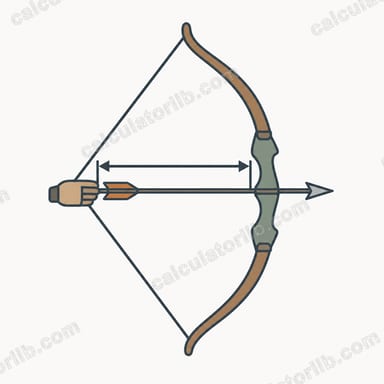
Draw length is the distance, in inches, that an archer pulls the bowstring back to a consistent anchor point at full draw. It is one of the most important measurements in archery because a bow that is set up for the wrong draw length will feel awkward, hurt accuracy, and can even be unsafe. This calculator uses the popular "wingspan" method to give you a quick, reliable starting estimate.

How to Use This Calculator
Stand with your back to a wall and stretch both arms out horizontally, forming a "T". Have a friend measure from the tip of one middle finger to the tip of the other — this is your arm span (wingspan). Enter that number in inches and the calculator divides it by 2.5 to estimate your draw length. The result is also shown in centimeters for convenience.

The Formula Explained
The standard rule of thumb is:
$$\text{Draw Length (inches)} = \frac{\text{Arm Span (inches)}}{2.5}$$
This works because, for most people, arm span is roughly equal to height, and draw length scales proportionally with arm reach. The factor of \(2.5\) reflects the typical geometry of an archer at full draw with a proper anchor point.
Worked Example
Suppose your arm span measures 70 inches. Dividing by 2.5 gives $$70 \div 2.5 = 28 \text{ inches}.$$ So your estimated draw length is 28 inches, or about 71.12 cm. You would then choose arrows and set up a bow around a 28-inch draw length.
Arm Span to Draw Length Chart
This chart applies the wingspan method: draw length (in) = arm span (in) ÷ 2.5, and the centimetre value is the inch value × 2.54. Measure your arm span fingertip to fingertip with your arms held straight out to the sides.
| Arm span (in) | Draw length (in) | Draw length (cm) |
|---|---|---|
| 60 | 24.0 | 61.0 |
| 62 | 24.8 | 63.0 |
| 64 | 25.6 | 65.0 |
| 66 | 26.4 | 67.1 |
| 68 | 27.2 | 69.1 |
| 70 | 28.0 | 71.1 |
| 72 | 28.8 | 73.2 |
| 74 | 29.6 | 75.2 |
| 76 | 30.4 | 77.2 |
| 78 | 31.2 | 79.2 |
| 80 | 32.0 | 81.3 |
Values are rounded to one decimal place for centimetres. For arm spans between rows, divide your measurement by 2.5 directly.
Interpreting Your Draw Length Result
Most adult archers land somewhere between roughly 24 and 32 inches of draw length. Shorter results are typical of smaller-framed adults and youths, while longer results are typical of taller archers with a long reach.
Worked example: an archer with a 71 inch arm span gets \(\frac{71}{2.5} = \) 28.4 inches.
How the number is used
- Bow setup: Compound bows are commonly adjusted in half-inch steps through cam settings and draw length modules, so a result like 28.4 would usually be rounded to 28.5 inches or the nearest available setting.
- Arrow length and spine: Draw length influences how long your arrows need to be, and arrow length together with point weight and draw weight affects the spine (stiffness) you need. Arrows that are too long or too short for your draw can fly poorly, so check manufacturer spine charts.
- Form and comfort: A draw length that is too long tends to cause overreaching and a collapsed posture, while one that is too short can cramp your form and reduce consistency.
Treat it as an estimate
The wingspan method is a quick starting point, not a precise fit. Results can differ from a fitting by a professional coach or pro shop by about an inch, depending on your anchor point, bow type, and shooting style. Use the number as a starting point, then confirm it with a qualified archery technician before buying or adjusting equipment.
FAQ
Is this measurement exact? No — it's an estimate. For a precise figure, draw a measuring arrow on a bow and have a coach check your anchor point. The wingspan method is excellent for first-time setups.
Why divide by 2.5 and not another number? 2.5 is the long-standing industry rule of thumb that matches typical full-draw archer geometry across a wide range of body sizes.
What if my arm span and height differ a lot? The wingspan method follows your reach, which usually predicts draw length better than height. If they differ greatly, treat the result as a starting point and fine-tune on a bow.